

Math practice for second graders covers eight core skills: skip counting, addition, subtraction, early multiplication, measurement, counting money, geometry, and word problems.
Second grade is the year students move from counting one at a time to working with numbers in groups, and from single-step problems to multi-step reasoning.
Addition and subtraction now involve regrouping (carrying and borrowing), multiplication is introduced through repeated addition and arrays, and word problems ask students to combine several skills in one question.
This guide breaks down each skill: what it covers at Grade 2 level, why it matters, a worked example, and where to find deeper practice on that specific area.
Why Math Practice for Second Graders Matters
Grade 2 is the year math shifts from concrete counting to number relationships. Children start regrouping (carrying and borrowing) in addition and subtraction, recognizing repeated groups as a step toward multiplication, and applying number sense to real situations like measuring objects or making change.
Skills also start to build on each other. Skip counting supports early multiplication. Addition and subtraction fluency supports word problems. Measurement and counting money apply number sense to the physical world.
A student who is strong in isolated calculation but weak in word problems, for example, often struggles to apply that calculation to real situations, which is why practice should touch all eight areas rather than just the ones that feel easiest.
Regular, short practice sessions (rather than occasional long ones) also help build automaticity, meaning a child can recall facts like 6 + 7 or 15 – 8 without stopping to count on fingers. Automaticity frees up mental space for the more complex reasoning that word problems and multi-step questions require.
Skip Counting
Skip counting means counting forward or backward by a number other than one, most commonly by 2s, 5s, and 10s in Grade 2, with some curricula introducing 3s as well.
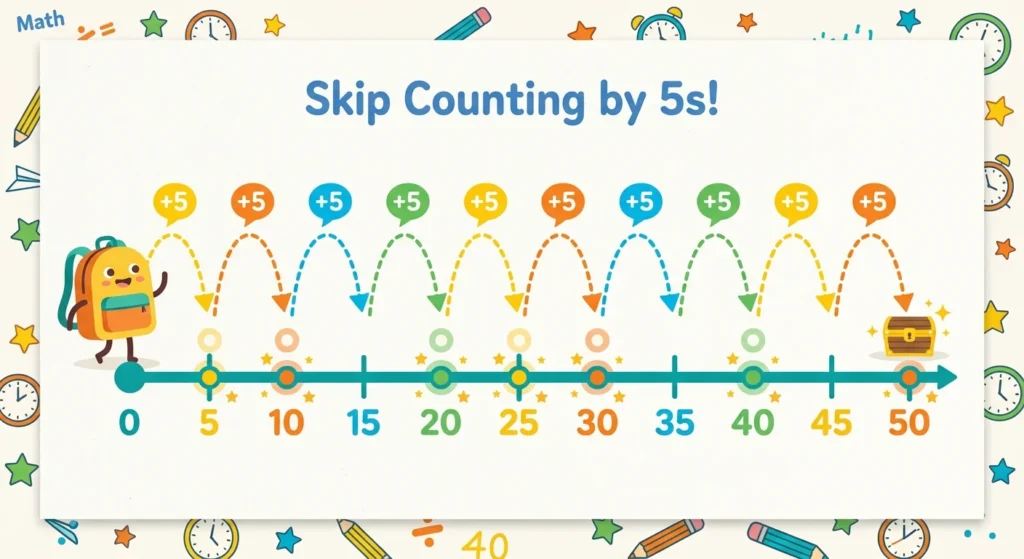
It builds the number pattern recognition that leads directly into multiplication and helps students count larger groups of objects quickly.
Worked example: Skip count by 5s from 0 to 50: 0, 5, 10, 15, 20, 25, 30, 35, 40, 45, 50. A student who has mastered this can count a jar of 50 pennies in groups of five far faster than counting one at a time.
Skip counting also supports telling time (counting by 5s around a clock face) and early multiplication (skip counting by 3 four times is the same as 3 × 4).
For a full breakdown of skip counting patterns, common activities, and practice problems at this grade level, see Gonit’s skip counting for Grade 2 guide.
Addition
Grade 2 addition typically covers two-digit and three-digit addition with regrouping, meaning a student carries a digit to the next place value when a column adds up to 10 or more.
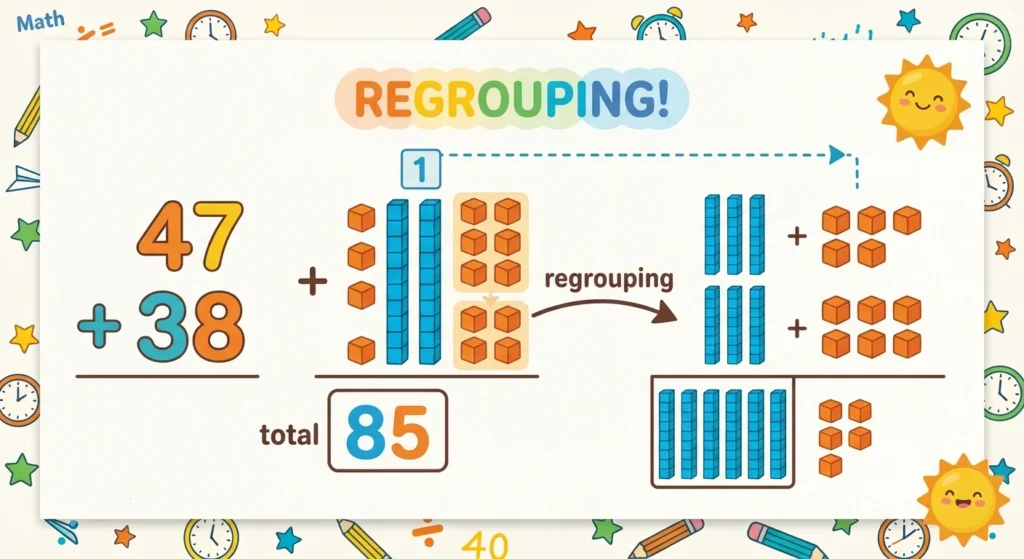
This is one of the biggest jumps from Grade 1, where addition rarely required regrouping.
Worked example: 47 + 38. Add the ones column: 7 + 8 = 15. Write down the 5, regroup (carry) the 1 ten. Add the tens column: 4 + 3 + 1 (regrouped) = 8. The answer is 85.
Regrouping is the concept most students need the most repeated practice with, since it requires holding two steps in mind at once.
For step-by-step regrouping practice and additional worked examples, see Gonit’s Grade 2 addition guide.
Subtraction
Subtraction in Grade 2 introduces borrowing (also called regrouping), the reverse of the carrying process used in addition.
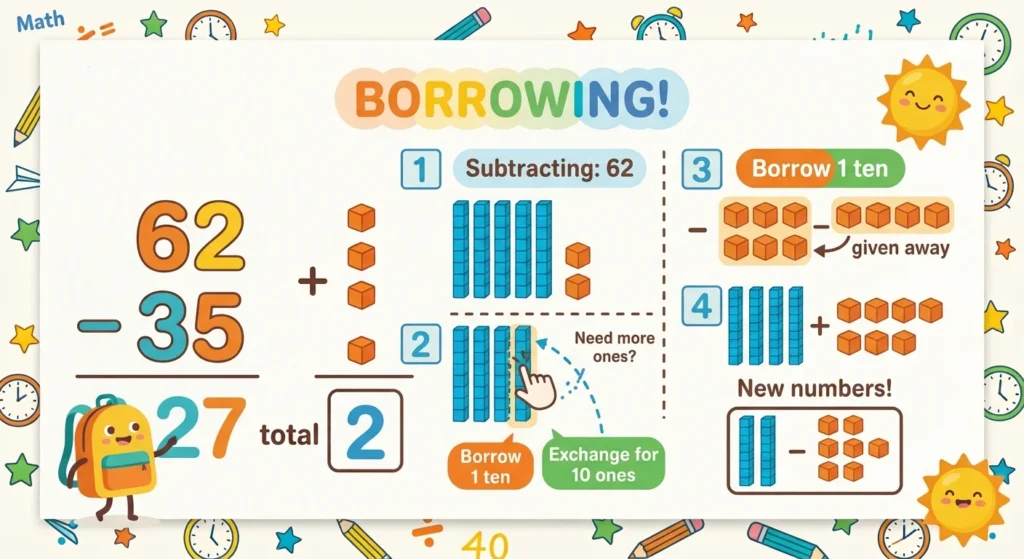
Students subtract two- and three-digit numbers and learn to borrow from the tens or hundreds place when the ones digit in the number being subtracted is larger than the ones digit in the starting number.
Worked example: 62 – 35. The ones column needs 2 – 5, which is not possible without borrowing. Borrow 1 ten from the 6, making it 5, and the ones digit becomes 12. Now 12 – 5 = 7. Subtract the tens: 5 – 3 = 2. The answer is 27.
Because borrowing is conceptually harder than carrying for most students, it benefits from more repetition and visual models (like base-ten blocks) before moving to pure numerals.
See Gonit’s Grade 2 subtraction guide for a full set of borrowing practice problems.
Multiplication (Early Concepts)
Grade 2 multiplication is introductory: students learn that multiplication is repeated addition and begin working with arrays (rows and columns of objects) to understand the concept, typically without memorizing full times tables yet.
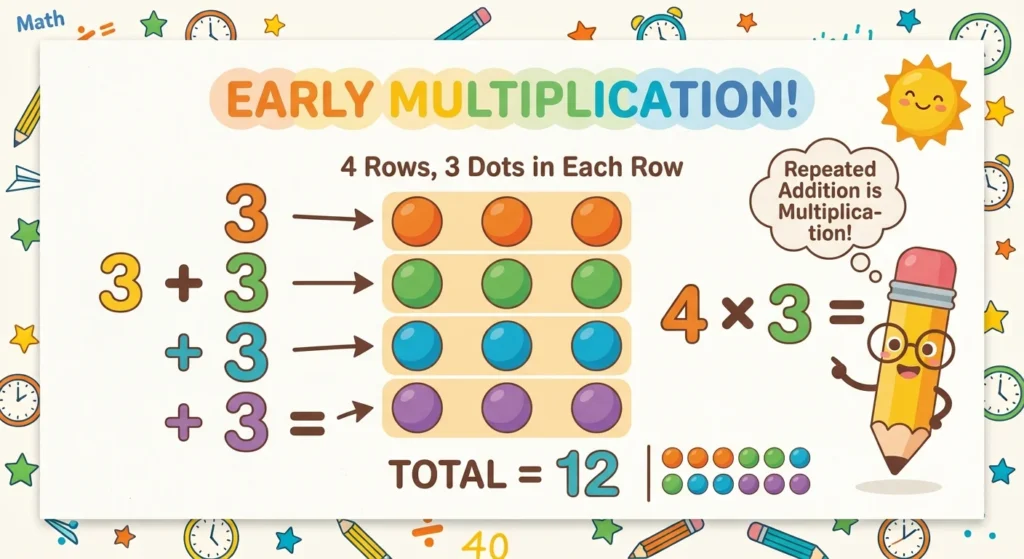
This groundwork makes formal multiplication fact memorization in Grade 3 much smoother.
Worked example: An array of 4 rows with 3 objects in each row shows 4 × 3, which is the same as 3 + 3 + 3 + 3 = 12.
Connecting multiplication to skip counting and arrays, rather than jumping straight to memorized facts, helps students understand what multiplication actually represents.
For age-appropriate introductory multiplication practice, see Gonit’s Grade 2 multiplication guide.
Measurement
Grade 2 measurement covers length, weight, and time. Students learn to measure length using standard units (centimeters and meters, with inches and feet also common depending on the curriculum), compare weights, and read clocks to the nearest five minutes.
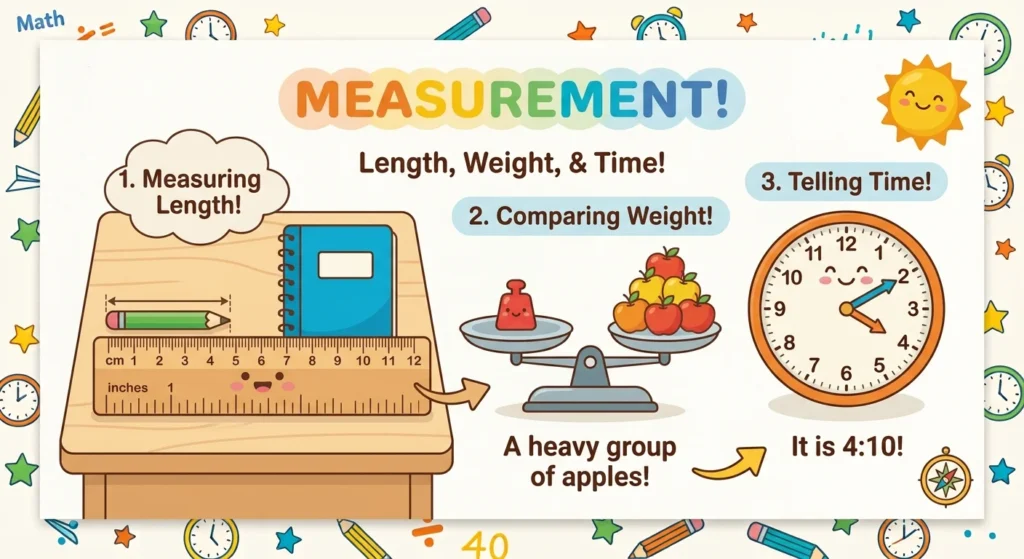
Worked example: A pencil measures 15 centimeters. A notebook measures 22 centimeters. The notebook is 7 centimeters longer than the pencil (22 – 15 = 7), which connects measurement directly back to subtraction practice.
Measurement is one of the more hands-on Grade 2 skills, since it benefits from using an actual ruler or clock rather than only working from a worksheet.
For structured measurement practice covering length, weight, and time together, see Gonit’s Grade 2 measurement guide.
Counting Money
Counting money in Grade 2 typically covers identifying coins and small bills, adding their values together, and making simple change.
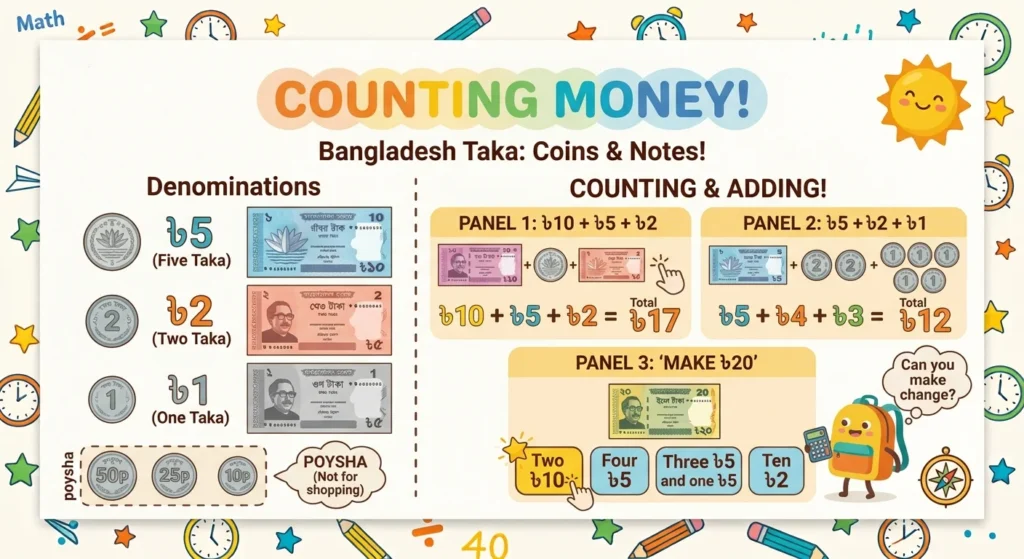
In Bangladesh, this usually means working with taka and paisa denominations, while curricula referencing US currency work with cents and dollars; either way, the underlying skill, combining values of different denominations, is the same.
Worked example: A student has one 10 taka note, one 5 taka coin, and two 2 taka coins. The total is 10 + 5 + 2 + 2 = 19 taka.
Counting money combines addition fluency with real-world application, which is part of why it is a strong bridge skill between pure calculation and word problems. See Gonit’s Grade 2 counting money guide for denomination-specific practice sets.
Geometry
Grade 2 geometry focuses on identifying and describing two-dimensional and three-dimensional shapes by their attributes, such as the number of sides, angles, and faces, rather than just recognizing shapes by name.
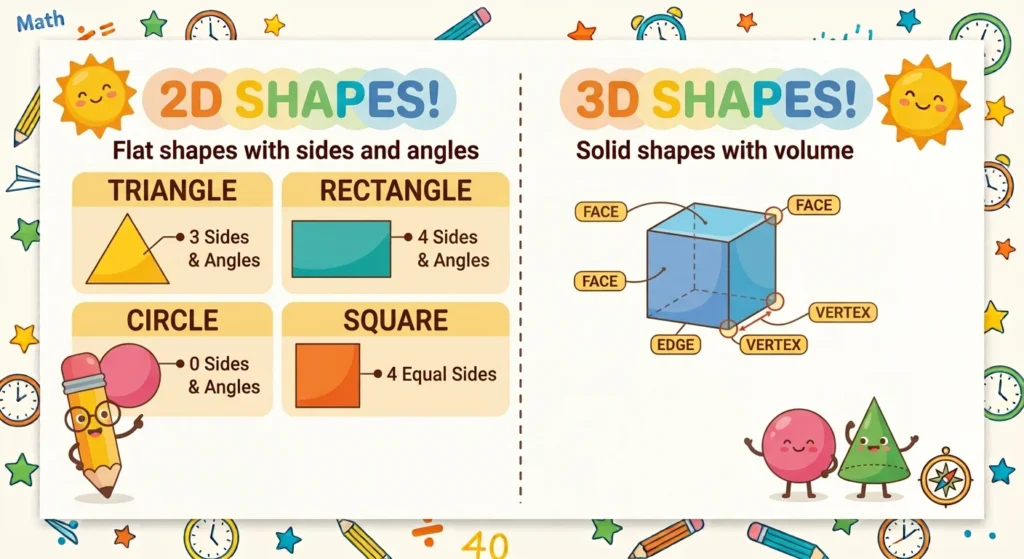
Students also begin partitioning shapes into equal parts, an early step toward fractions.
Worked example: A rectangle has 4 sides and 4 right angles, while a triangle has 3 sides and 3 angles. A cube (a 3D shape) has 6 faces, 12 edges, and 8 vertices.
Describing shapes by their properties, rather than only naming them, is what distinguishes Grade 2 geometry from earlier grades and sets up more formal geometric reasoning later.
For a full breakdown of 2D and 3D shape properties at this level, see Gonit’s Grade 2 geometry guide.
Word Problems
Word problems in Grade 2 require students to read a short scenario, identify which operation (or operations) it calls for, and solve it, often combining two of the skills above in a single question.
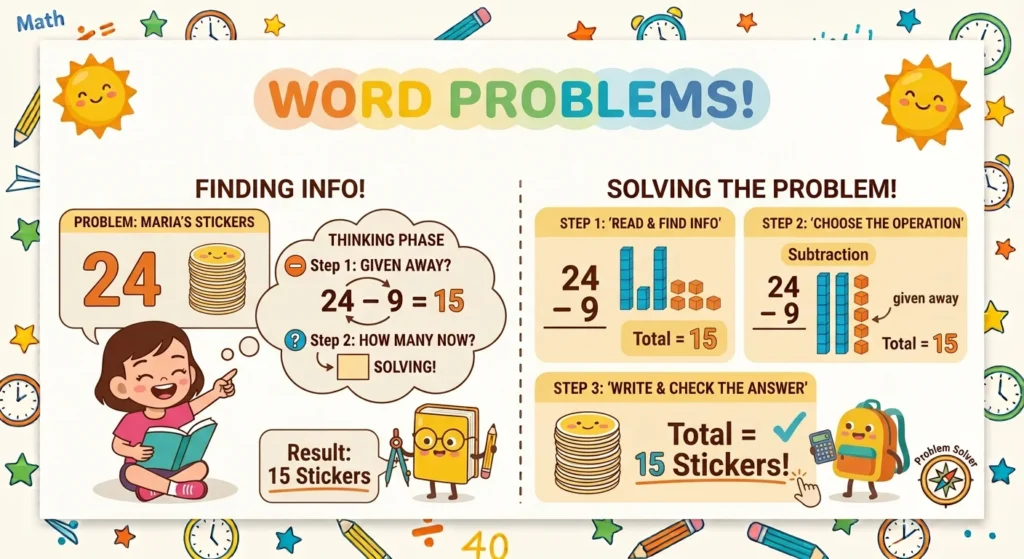
This is typically the most challenging of the eight areas because it requires reading comprehension alongside math skills.
Worked example: “Maria has 24 stickers. She gives 9 to her friend and then buys 15 more. How many stickers does Maria have now?”
This requires subtraction (24 – 9 = 15) followed by addition (15 + 15 = 30), so Maria has 30 stickers.
Word problems are where all the other skills come together, which is why they are often the best indicator of whether a student truly understands a concept versus having memorized a procedure.
For a structured set of Grade 2 word problems covering multiple operations, see Gonit’s Grade 2 word problems guide.
How to Build a Math Practice Routine for Second Graders
A short, consistent routine works better than infrequent long sessions for this age group. A few guidelines that hold up well for seven- and eight-year-olds:
Frequency and length. Fifteen to twenty minutes, four to five times a week, tends to work better than one long weekend session. Attention spans at this age are limited, and shorter sessions keep practice from becoming a source of frustration.
Mix skills rather than drilling one at a time. Spending a whole week only on addition, for example, means subtraction and money skills get rusty by the time they come up again. Rotating through two or three of the eight skills per session, with review built in, keeps everything fresh.
Use concrete tools before moving to pure numbers. Base-ten blocks for regrouping, real coins for counting money, and an actual ruler or clock for measurement all help make abstract concepts click before a student works purely on paper.
Track progress, not just completion. Noting which skills a student answers quickly and confidently versus which ones take longer or require more hints helps target the next session’s focus, rather than simply moving through worksheets in order.
Apps like Gonit are built around this kind of structured, mixed-skill practice, with progress tracked automatically across each of the eight Grade 2 areas covered above, which can make it easier to see where a student needs more repetition without having to track it manually.
Common Mistakes in Math Practice for Second Graders
Skipping the “why” behind regrouping. Students who memorize the steps of carrying or borrowing without understanding what a ten actually represents often make errors when numbers get slightly larger or when problems are presented differently.
Treating word problems as a separate subject. Because word problems combine reading and math, some students who are strong in calculation still struggle here. Practicing word problems alongside (not after) the operation they draw on helps students connect the two.
Over-relying on worksheets for measurement and money. These are the two most hands-on skills in the Grade 2 curriculum. Practicing exclusively on paper, without a ruler, clock, or real coins, tends to slow down mastery.
Rushing multiplication before repeated addition and arrays are solid. Grade 2 multiplication is meant to build conceptual understanding, not memorized facts. Pushing straight to times tables before a student understands what multiplication represents can create gaps that surface later.
Practicing only the student’s favorite skill. It is common for a student (or a parent) to gravitate toward the skill that feels easiest, whether that is addition or geometry, while avoiding the harder ones. A rotation that covers all eight areas prevents this imbalance.
What math skills should a second grader know?
By the end of Grade 2, students are typically expected to skip count by 2s, 5s, and 10s, add and subtract two- and three-digit numbers with regrouping, understand multiplication as repeated addition, measure length and read clocks to the nearest five minutes, count and combine coin or currency values, describe 2D and 3D shapes by their attributes, and solve one- and two-step word problems.
How much math practice does a second grader need per week?
Fifteen to twenty minutes, four to five days a week, is a reasonable target for most second graders. Consistency across the week matters more than the length of any single session.
Why is my child good at math facts but struggles with word problems?
Word problems require reading comprehension in addition to calculation. A student can have strong number fact recall and still struggle to identify which operation a scenario calls for, which is why word problems benefit from separate, targeted practice rather than being treated as an extension of computation practice.
Is Grade 2 multiplication the same as memorizing times tables?
No. Grade 2 multiplication typically focuses on understanding multiplication as repeated addition and working with arrays, not memorizing full times tables. Times table memorization usually becomes a bigger focus starting in Grade 3.
What is regrouping in Grade 2 math?
Regrouping (also called carrying in addition and borrowing in subtraction) is the process of exchanging ten units in one place value for one unit in the next place value over, or the reverse. It is the central new concept in Grade 2 addition and subtraction.
Can an app help with math practice for second graders?
An app can help by providing structured, mixed practice across multiple skills with built-in progress tracking, which can be harder to maintain consistently with worksheets alone. Gonit, for example, covers all eight Grade 2 skill areas above with problems designed for this grade level.
Make Preparing for Math Olympiad Simple!



Conclusion
Math practice for second graders builds the foundation for everything that follows: regrouping sets up multi-digit arithmetic, early multiplication leads into fact fluency, and word problems train reasoning that carries through every math topic after this one.
Covering all eight skills, rather than only the easy ones, is what makes that foundation solid.
A short, consistent routine mixing skills and using concrete tools like coins, rulers, and clocks tends to produce steadier progress than occasional long sessions on one topic.
Gonit is built for exactly this kind of structured, mixed practice, with problems for all eight Grade 2 skills and progress tracked automatically as a student works through them.

Mikha Piregu is a Content Writer with experience spanning educational content, including math and math olympiad topics, as well as advocacy writing, research-based articles, and SEO-driven web content. He creates high-quality blog content, web copy, and feature articles that support brand visibility, audience engagement, and long-term organic growth through data-informed storytelling. Skilled in WordPress, WooCommerce, and modern digital tools, Mikha adapts content across various platforms, including blogs, websites, campaigns, and advocacy initiatives, with clarity and purpose.

There are no comments posted here yet.
Sign in to leave a comment