


Prime and composite numbers are two distinct categories of positive integers greater than 1, classified by how many factors they have.
A prime number has exactly two factors, 1 and the number itself. A composite number has more than two factors. The number 1 sits outside both groups because it has only one factor. So 7 is prime because nothing divides it evenly except 1 and 7. And 12 is composite because 1, 2, 3, 4, 6, and 12 all divide it evenly.
- Start with factors, not lists
- What is a prime number?
- What is a composite number?
- Why 1 is neither prime nor composite
- Why 2 is the only even prime number
- Difference between prime and composite numbers
- The Sieve of Eratosthenes
- Prime numbers 1 to 100 chart
- Composite numbers list from 1 to 50
- How to find prime numbers: the divisibility method
- Worked examples: 37, 51, 97 and 121
- Prime factorisation: the next step
- Real life uses of prime numbers
- Common mistakes and how to fix them
- activities and games
- Tips for parents
- Tips for teachers
- Olympiad connections
- Practice questions with answers
- Conclusion
That is the whole classification. Everything else in this guide is about building the understanding underneath it, so your child is not memorising two lists but seeing why the lists look the way they do.
Start with factors, not lists
If your child is confused about prime and composite numbers, the problem is almost never the definitions. It is usually that the word “factor” has not settled yet.
A factor of a number is a whole number that divides it exactly, leaving no remainder.
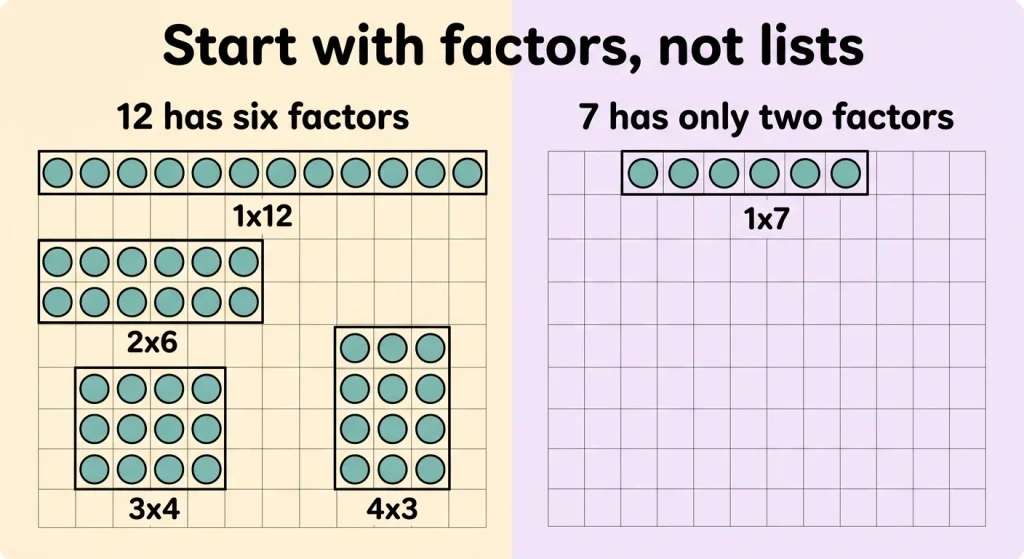
Take 12. Ask which whole numbers divide into 12 with nothing left over. 12 divided by 1 is 12. 12 divided by 2 is 6. 12 divided by 3 is 4. 12 divided by 4 is 3. 12 divided by 6 is 2. 12 divided by 12 is 1. But 12 divided by 5 leaves a remainder, so 5 is not a factor. The factors of 12 are 1, 2, 3, 4, 6 and 12. Six factors in all.
A useful way to show this physically is with counters, beans or buttons. Give your child 12 objects and ask them to arrange them into equal rows. They will find 1 row of 12, 2 rows of 6, 3 rows of 4, 4 rows of 3, 6 rows of 2 and 12 rows of 1. Every arrangement is a factor pair.
Now give them 7 objects and ask for the same thing. Only two arrangements work, 1 row of 7 and 7 rows of 1. Nothing else lays out neatly. That stubbornness is exactly what makes 7 prime, and children usually remember the feeling of the counters refusing to split long after they have forgotten a definition.
Two things worth clearing up while you are here. Factors divide into a number, so they are never bigger than the number. Multiples are what you get when you multiply the number, so they are never smaller. The factors of 6 are 1, 2, 3 and 6. The multiples of 6 are 6, 12, 18, 24 and so on. Mixing these two up is the single most common reason a child answers prime and composite questions wrongly. A child who is fluent with their multiplication tables will spot factors much faster, because every table fact is a factor pair in disguise.
What is a prime number?
A prime number is a whole number greater than 1 that has exactly two distinct factors, 1 and itself.
The first few prime numbers are 2, 3, 5, 7, 11, 13, 17, 19, 23 and 29.
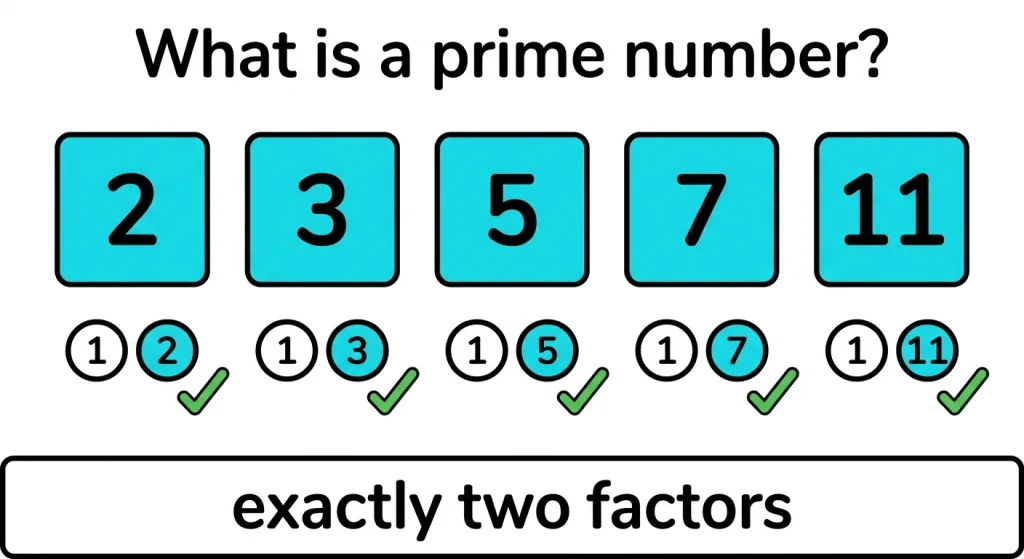
Check 13. Does 2 divide it? No. Does 3? No. 4, 5, 6? No. Nothing works until you reach 13 itself. So the complete factor list of 13 is 1 and 13, which is two factors, so 13 is prime.
Notice the word “exactly” in the definition. Not “at least two” and not “about two”. Exactly two. That one word is doing all the work, and it is what settles the status of 1 later on.
Some other things that are true of every prime number. The smallest prime is 2. Prime numbers have no factor pairs other than 1 times the number. Prime numbers cannot be made by multiplying two smaller whole numbers greater than 1. And there is no largest prime, which is a lovely fact to share with a curious child. The primes go on forever, and the Greek mathematician Euclid proved it more than two thousand years ago.
What is a composite number?
A composite number is a whole number greater than 1 that has more than two factors.
The first few composite numbers are 4, 6, 8, 9, 10, 12, 14, 15, 16 and 18.
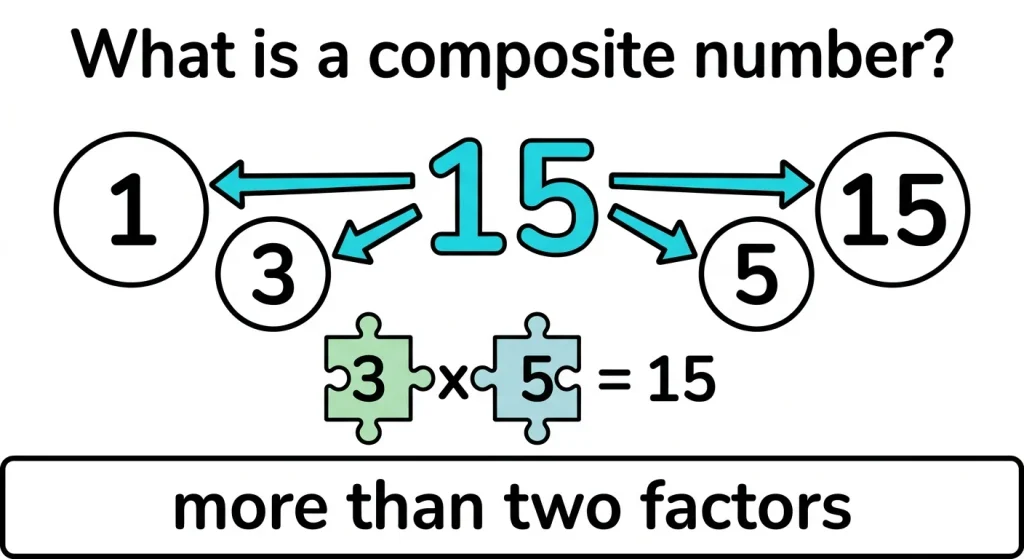
Take 15. Its factors are 1, 3, 5 and 15. That is four factors, which is more than two, so 15 is composite. The word composite means something put together, and that is literally what has happened here. 15 is 3 multiplied by 5. It was composed from smaller pieces.
Useful facts about composite numbers. The smallest composite number is 4. Every composite number can be written as a product of prime numbers. Composite numbers come in both odd and even varieties, so 9, 15, 21 and 25 are odd composites while 4, 6, 8 and 10 are even composites. And every whole number greater than 1 is either prime or composite, with no third option and no overlap.
Why 1 is neither prime nor composite
This is the question that sends most parents searching online, so let us settle it properly rather than just asserting it.
The number 1 has exactly one factor, which is 1 itself. Write out its factor list and you get a single entry.
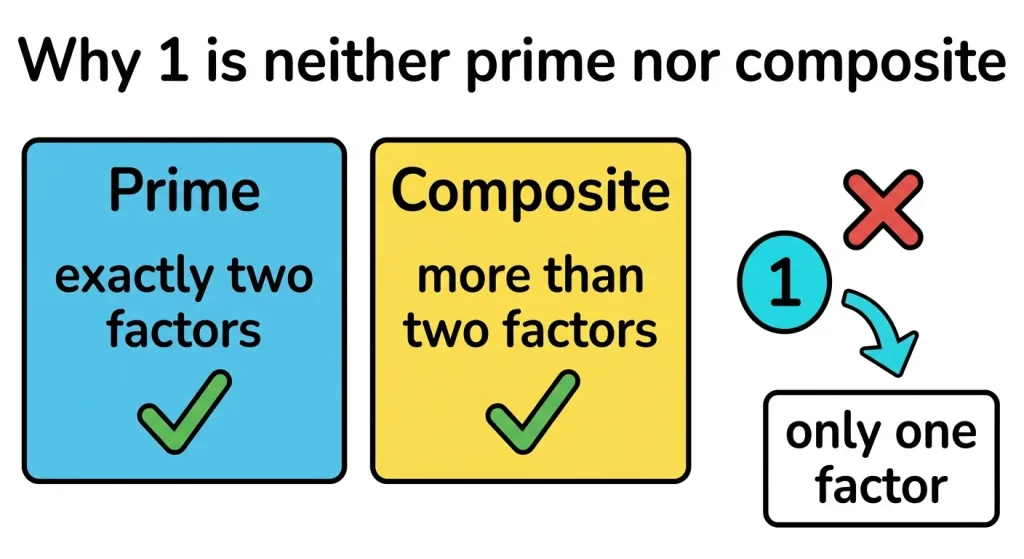
A prime number needs exactly two different factors. A composite number needs more than two. One factor fits neither condition, so 1 belongs to neither group.
Children often push back here. They say that 1 can only be divided by 1 and itself, so surely it is prime. The answer is that for the number 1, “1” and “itself” are the same number. You are not naming two factors, you are naming the same factor twice. The definition asks for two distinct factors, and 1 cannot supply them.
If your child is ready for a deeper reason, here it is. Mathematicians decided to classify 1 separately because of what happens to prime factorisation otherwise. Every composite number breaks into exactly one set of prime factors.
The number 12 is 2 times 2 times 3, and there is no other way to do it. But if 1 counted as prime, then 12 would also be 1 times 2 times 2 times 3, and 1 times 1 times 2 times 2 times 3, and so on forever. The uniqueness would collapse. Keeping 1 out of the prime club is what protects that uniqueness.
The same reasoning applies to 0, which is also neither prime nor composite. Every whole number divides into 0, so it has infinitely many factors rather than exactly two.
Why 2 is the only even prime number
Think about what “even” means. An even number is one that 2 divides exactly. So every even number automatically has 2 on its factor list.
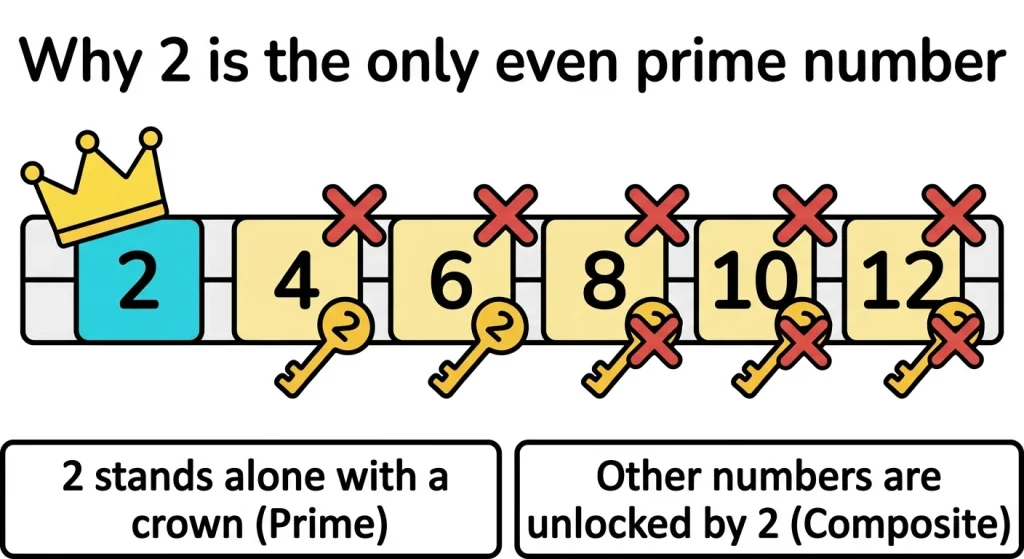
Now take any even number bigger than 2, say 18. Its factors must include 1, 2 and 18 at the very least. That is already three factors, which is more than two, so it cannot be prime. The same argument works for 4, 6, 8, 100, 2026 and every other even number you can name. Having 2 as a factor is fatal to primality unless the number is 2 itself.
And 2 is the exception precisely because for 2, the factor 2 and the number itself are the same thing. The factors of 2 are 1 and 2. Two factors, no more, so 2 is prime.
This gives you a clean statement to share: all even numbers greater than 2 are composite, and 2 is the only even prime number.
Watch out for the mirror image mistake. Children who learn that all primes except 2 are odd often flip it around and conclude that all odd numbers are prime. They are not. 9 is odd and composite, because 3 times 3 is 9. So are 15, 21, 25, 27, 33 and 35. Being odd gets a number past the first checkpoint, nothing more.
Difference between prime and composite numbers
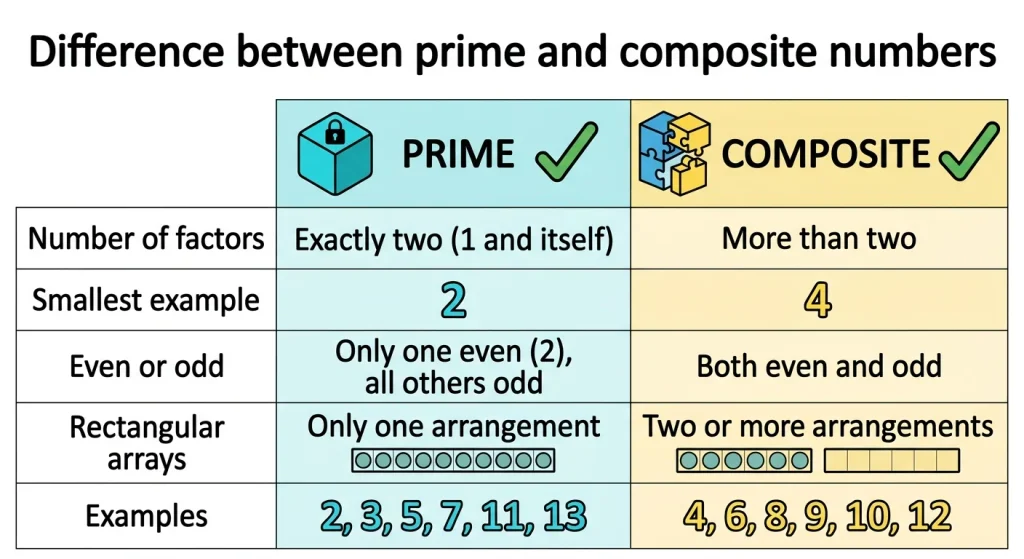
| Feature | Prime numbers | Composite numbers |
|---|---|---|
| Number of factors | Exactly two | More than two |
| Factors are | 1 and the number itself | 1, the number itself, and at least one other |
| Smallest example | 2 | 4 |
| Can be written as a product of two smaller whole numbers greater than 1 | No | Yes |
| Even or odd | Only one is even, which is 2 | Both even and odd exist |
| Examples | 2, 3, 5, 7, 11, 13, 17, 19 | 4, 6, 8, 9, 10, 12, 14, 15 |
| Role in factorisation | The building blocks | Built from prime building blocks |
| Rectangular arrangement test | Only one row arrangement works | Two or more arrangements work |
The number 1 appears in neither column, and 0 appears in neither column.
The Sieve of Eratosthenes
The Sieve of Eratosthenes is a method for finding all the prime numbers up to a chosen limit by crossing out the composites. It is named after a Greek mathematician who worked in Alexandria around 240 BC, and it is still the best classroom tool for this topic because the child discovers the primes instead of being handed them.
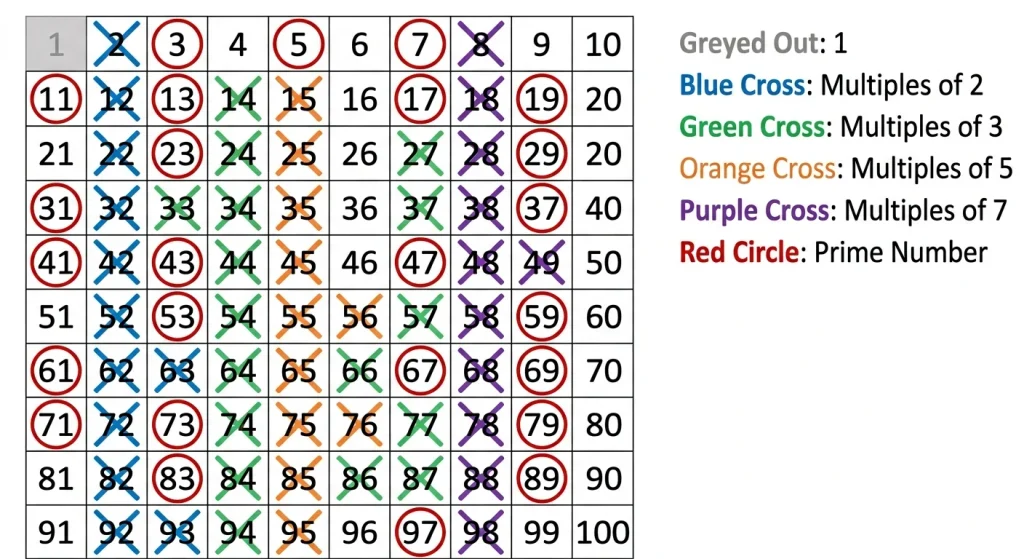
You need a grid of numbers from 1 to 100, ten rows of ten, and a pencil.
Step one. Cross out 1. It is neither prime nor composite, so it takes no further part.
Step two. Circle 2, then cross out every other multiple of 2. That means 4, 6, 8, 10 and so on, all the way to 100. You have just removed every even number except 2, which is half the grid gone in one pass.
Step three. Move to the next number that is still uncrossed, which is 3. Circle it, then cross out every multiple of 3 that remains. So 6 is already gone, 9 goes now, then 12 if it is still there, 15, 21, 27 and so on.
Step four. The next uncrossed number is 5. Circle it and cross out every remaining multiple of 5, which means 25, 35, 55, 65, 85 and 95, since the even multiples went in step two.
Step five. The next uncrossed number is 7. Circle it and cross out the remaining multiples of 7, which are 49, 77 and 91.
Step six. Stop. Every number still uncrossed is prime.
The stopping point surprises people, so it is worth explaining. You only need to sieve with primes up to the square root of your limit. The square root of 100 is 10, and the primes below 10 are 2, 3, 5 and 7. Any composite number under 100 must have a factor of 10 or less, because if both its factors were bigger than 10 their product would exceed 100. So after sieving with 2, 3, 5 and 7, every composite has already been caught.
When the grid is finished, 25 numbers remain circled. Those are the 25 prime numbers below 100. Children who build this grid themselves also notice the patterns in it, such as the fact that after 2 and 5, every prime ends in 1, 3, 7 or 9, and that primes thin out as the numbers get larger.
Prime numbers 1 to 100 chart
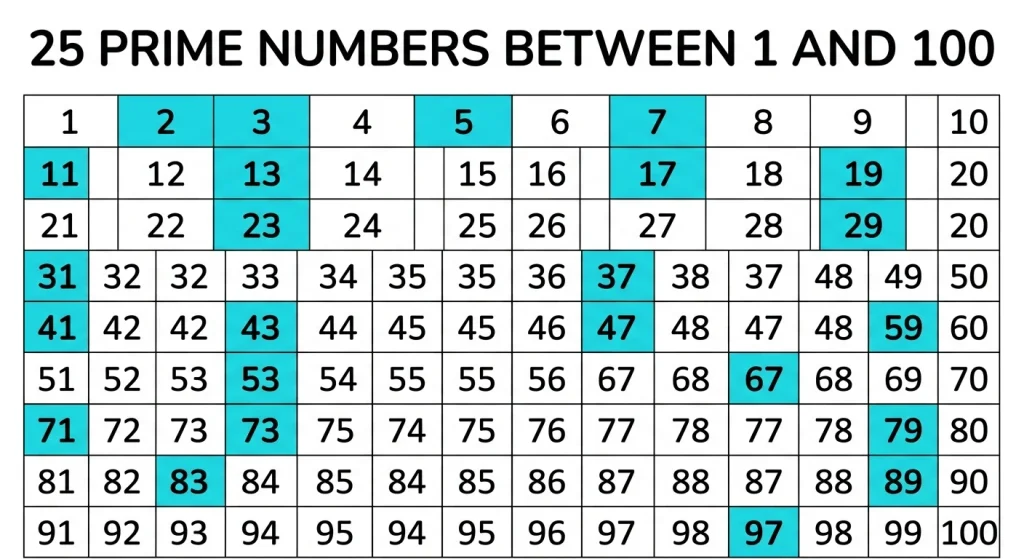
There are 25 prime numbers between 1 and 100.
| Range | Prime numbers | Count |
|---|---|---|
| 1 to 10 | 2, 3, 5, 7 | 4 |
| 11 to 20 | 11, 13, 17, 19 | 4 |
| 21 to 30 | 23, 29 | 2 |
| 31 to 40 | 31, 37 | 2 |
| 41 to 50 | 41, 43, 47 | 3 |
| 51 to 60 | 53, 59 | 2 |
| 61 to 70 | 61, 67 | 2 |
| 71 to 80 | 71, 73, 79 | 3 |
| 81 to 90 | 83, 89 | 2 |
| 91 to 100 | 97 | 1 |
The full list in one line: 2, 3, 5, 7, 11, 13, 17, 19, 23, 29, 31, 37, 41, 43, 47, 53, 59, 61, 67, 71, 73, 79, 83, 89, 97.
Look at the right hand column and you can see the primes thinning out. There are four in the first ten numbers and only one in the nineties. They never stop completely, but they do spread further apart.
Composite numbers list from 1 to 50
There are 34 composite numbers between 1 and 50.
| Range | Composite numbers |
|---|---|
| 1 to 10 | 4, 6, 8, 9, 10 |
| 11 to 20 | 12, 14, 15, 16, 18, 20 |
| 21 to 30 | 21, 22, 24, 25, 26, 27, 28, 30 |
| 31 to 40 | 32, 33, 34, 35, 36, 38, 39, 40 |
| 41 to 50 | 42, 44, 45, 46, 48, 49, 50 |
Of these, the odd composites are 9, 15, 21, 25, 27, 33, 35, 39, 45 and 49. Those ten numbers are worth pointing out specifically, because they are the ones children most often mislabel as prime.
How to find prime numbers: the divisibility method
The sieve is perfect for finding all the primes in a range. But when someone hands you a single number and asks whether it is prime, you need a test. Here is a method your child can apply to any number up to about 400.
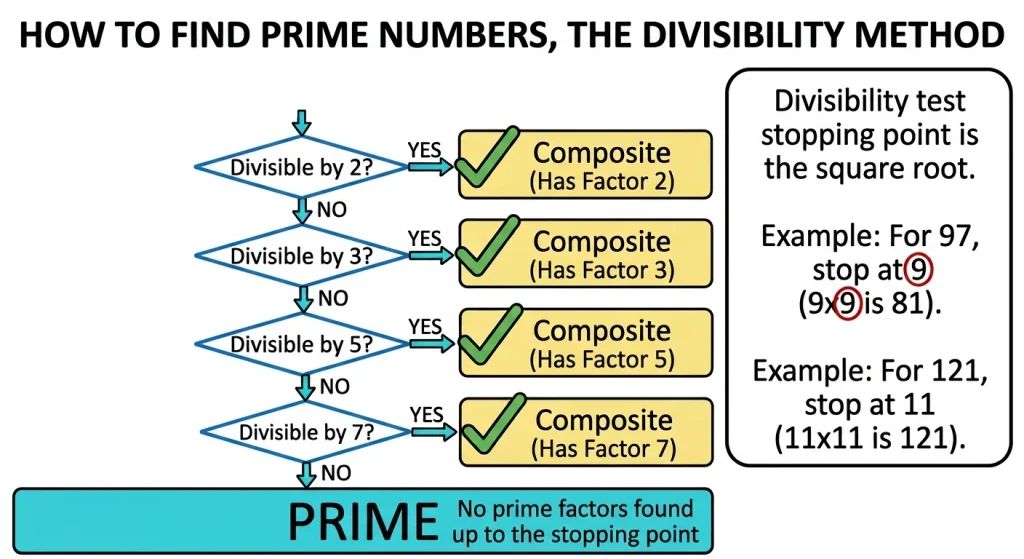
Step 1. Handle the easy cases. If the number is 1, it is neither prime nor composite. If it is 2 or 3, it is prime. Done.
Step 2. Find your stopping point. Ask which numbers multiplied by themselves get close to your number without going over. If your number is 97, note that 9 times 9 is 81 and 10 times 10 is 100, so you only need to test divisors up to 9. You never need to test beyond the square root, because factors come in pairs and one member of every pair is always at or below the square root.
Step 3. Test divisibility by 2. If the last digit is 0, 2, 4, 6 or 8, the number is divisible by 2 and therefore composite, unless the number is 2 itself.
Step 4. Test divisibility by 3. Add up the digits. If that total is divisible by 3, so is the original number, which makes it composite.
Step 5. Test divisibility by 5. If the last digit is 0 or 5, it is divisible by 5 and composite, unless the number is 5 itself.
Step 6. Test divisibility by 7, then 11, then 13, and so on. Keep going through the primes until you pass your stopping point from step 2. For these you usually just divide and check for a remainder, so comfort with long division makes this step quick.
Step 7. Decide. If no prime up to the stopping point divides your number, the number is prime. If any of them does, it is composite.
Notice that you only ever test prime divisors. There is no point testing 4 after you have tested 2, because anything divisible by 4 is already divisible by 2. That alone cuts the work roughly in half.
Worked examples: 37, 51, 97 and 121
Is 37 prime or composite?
Stopping point first. 6 times 6 is 36 and 7 times 7 is 49, so test divisors up to 6, which means the primes 2, 3 and 5. The last digit is 7, so 2 does not divide it. The digits add to 3 plus 7 equals 10, and 10 is not divisible by 3. The last digit is not 0 or 5, so 5 does not divide it. Nothing works. 37 is prime.
Is 51 prime or composite?
Stopping point. 7 times 7 is 49, so test up to 7. The last digit is 1, so not divisible by 2. Digits add to 5 plus 1 equals 6, and 6 is divisible by 3, so 51 is divisible by 3. In fact 51 is 3 times 17. 51 is composite. This one catches a lot of children, because 51 looks prime at a glance.
Is 97 prime or composite?
Stopping point. 9 times 9 is 81 and 10 times 10 is 100, so test up to 9, which means the primes 2, 3, 5 and 7. Last digit 7, so not divisible by 2. Digits add to 16, which is not divisible by 3. Last digit is not 0 or 5. And 97 divided by 7 is 13 with a remainder of 6. Nothing divides it. 97 is prime. It is also the largest prime below 100.
Is 121 prime or composite?
Stopping point. 11 times 11 is exactly 121, so test the primes up to 11, which are 2, 3, 5, 7 and 11. Last digit 1, so 2 fails. Digits add to 4, so 3 fails. Last digit is not 0 or 5. 121 divided by 7 is 17 with a remainder of 2. But 121 divided by 11 is exactly 11. 121 is composite, and it is 11 times 11. This example teaches an important lesson. You cannot stop early. If your child had quit after testing 7, they would have called 121 prime.
Prime factorisation: the next step
Once prime and composite numbers are solid, prime factorisation follows naturally. Prime factorisation means writing a composite number as a product of prime numbers only.
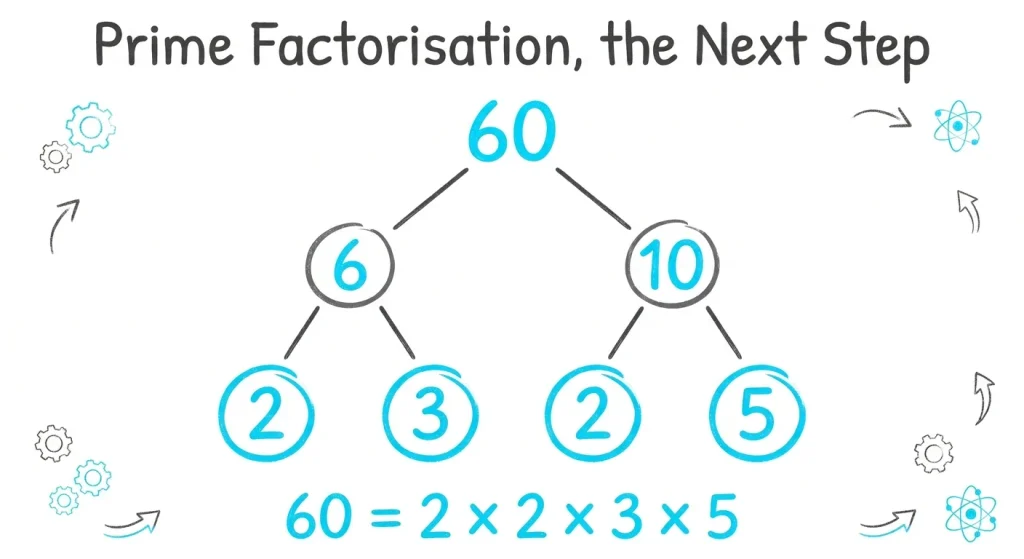
Take 60. Split it into any two factors, say 6 times 10. Neither is prime, so split again. 6 becomes 2 times 3, and 10 becomes 2 times 5. Now every piece is prime, so you stop. 60 equals 2 times 2 times 3 times 5.
Try starting differently, with 60 as 4 times 15. Then 4 becomes 2 times 2 and 15 becomes 3 times 5. You land on exactly the same set, 2 times 2 times 3 times 5.
That is not a coincidence. Every composite number has one and only one prime factorisation, a result important enough to have a grand name, the Fundamental Theorem of Arithmetic.
This is the atoms idea made concrete.
Composite numbers are molecules, primes are the atoms, and the factor tree is how you take the molecule apart. HCF, LCM, equivalent fractions and finding square roots all run on this machinery, which is why time spent on prime and composite numbers in Class 5 and Class 6 pays off repeatedly.
The same thinking reappears years later in factorisation in maths in Class 8, where expressions rather than numbers get broken into factors.
Real life uses of prime numbers
Children ask what primes are actually for, and the honest answer is impressive.
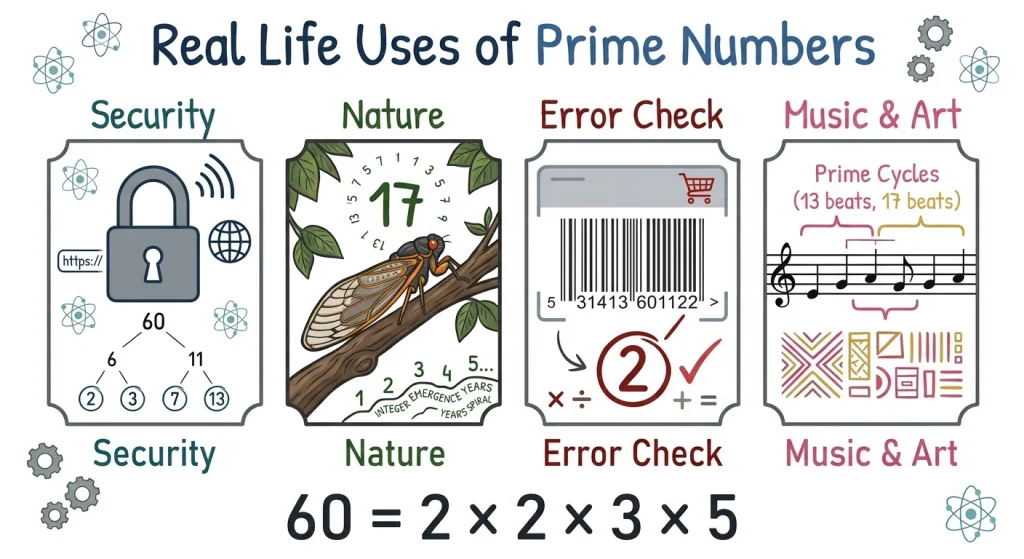
Digital security. When you pay a bill online or open a banking app, your data is scrambled using very large prime numbers. The method works because multiplying two huge primes together is easy, while taking the product apart to recover the original primes is practically impossible even for powerful computers. The whole security of online payments rests on that imbalance.
Patterns in nature. Some cicada species in North America emerge from underground only every 13 or 17 years, both primes. Biologists think the prime cycle makes it harder for predators with shorter breeding cycles to synchronise with them.
Error checking. Barcodes, ISBN numbers on books and many bank account formats use prime related arithmetic in their check digits, so a mistyped digit gets caught immediately.
Music and design. Composers and designers sometimes use prime length cycles when they want patterns that take a long time to repeat, since prime cycles only line up after a long interval.
Common mistakes and how to fix them
Thinking 1 is prime. The fix is to count factors out loud every time. The number 1 has one factor. Prime means exactly two. One is not two.
Thinking all odd numbers are prime. The fix is a counterexample the child finds themselves. Ask for the factors of 9. They will say 1, 3 and 9. Three factors, so composite, and it is odd.
Thinking all even numbers are composite. Almost right, but 2 is the exception. Have the child list the factors of 2 and see that there are only two.
Confusing factors with multiples. Factors fit inside, multiples stretch outwards. Write both lists for 6 side by side and point at the difference.
Stopping the divisibility test too early. The 121 example above is the cure. Always work out the stopping point before testing.
Forgetting that 1 and the number itself are factors. Some children say the factors of 7 are none, because they skip the obvious ones. Insist that every factor list starts with 1 and ends with the number.
Treating primes as a list to memorise. A child who has memorised the primes to 100 but cannot test 143 has learnt nothing transferable. For the record, 143 is 11 times 13.
8 activities and games
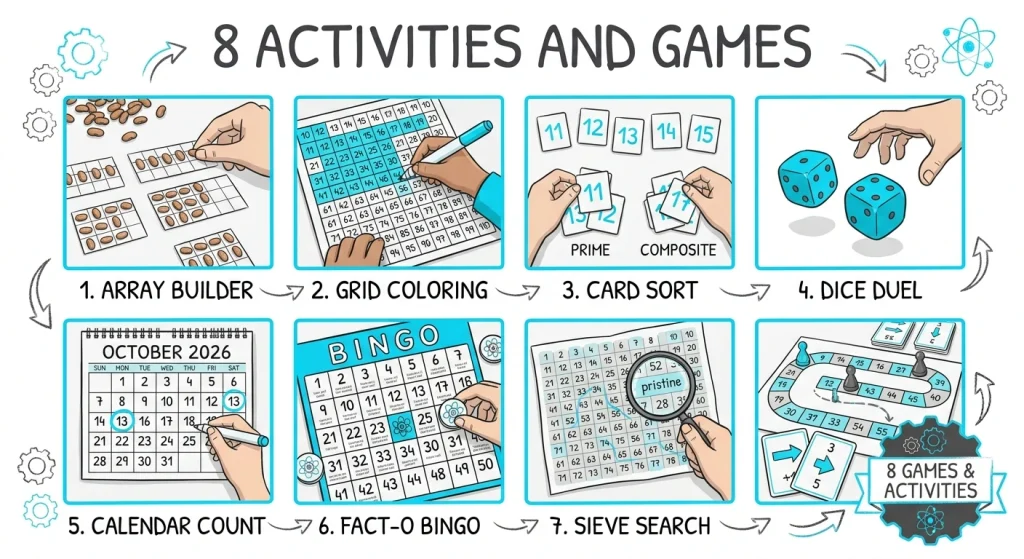
1. Counter arrays. Give your child a handful of beans, buttons or coins. Call out a number and ask them to make every possible rectangle with that many objects. One rectangle means prime, more than one means composite.
2. Build the sieve. Draw a 1 to 100 grid on paper and work through the Sieve of Eratosthenes with coloured pencils, a different colour for each step. The finished grid makes a good wall chart.
3. Prime or composite snap. Write numbers 2 to 50 on paper slips. Turn them over one at a time and race to call out prime or composite. The caller must name a factor to win the point.
4. Factor hunt around the house. Count things you can see, chairs, steps, roti on the plate, pages in a chapter. Ask whether each count is prime or composite and why.
5. The 100 square walk. Call out multiples of 2, then 3, then 5, and have your child step forward only on numbers that survive. The last ones standing are prime.
6. Factor tree race. Give two children the same composite number, such as 72, and let them build factor trees starting from different splits. They will be delighted when both trees end with the same primes.
7. Dice product sort. Roll two dice and multiply. Sort the product into a prime pile or a composite pile. Children quickly notice that almost everything lands in the composite pile, which is a real insight about how rare primes are.
8. Calendar primes. Each morning, ask whether the date is prime or composite. It takes ten seconds and by the end of a month the testing method has become automatic.
None of these needs anything you do not already have at home or in a classroom, and they double as critical thinking practice because every answer has to come with a reason.
Tips for parents
Let your child do the counting. The temptation is to say “no, 51 is divisible by 3”, but the learning happens when they add the digits themselves and spot it.
Ask for the reason, not the label. “Composite” earns half a mark. “Composite, because 3 and 17 both divide it” is understanding.
Normalise slow checking. A child who carefully tests 2, 3, 5 and 7 is doing it right, even if it looks laborious. Speed comes later, and chasing it early produces guessing.
Use the atoms picture often. Mention that 24 is made of 2, 2, 2 and 3 the way water is made of hydrogen and oxygen. The metaphor sticks.
Do not rush into prime factorisation, HCF and LCM. If the definitions are shaky, those topics turn into procedures the child follows without understanding.
Keep sessions short. Ten focused minutes with counters beats an hour of worksheets.
Tips for teachers
Teach factors thoroughly before you name primes at all. A class that cannot list the factors of 18 confidently will not classify numbers reliably.
Use the sieve as a discovery activity rather than a demonstration. Let students cross out and notice. The thinning of the primes and the ending digits pattern are observations they can make themselves.
Introduce the special case of 1 early rather than hoping nobody asks. The uniqueness of prime factorisation argument works well with Class 6 and Class 7.
Plant the 121 trap deliberately. A number that looks prime until you reach 11 teaches the square root rule better than any explanation.
Sort rather than circle. Give students mixed number cards and physical sorting into two piles, with a third pile for 1. Sorting demands a decision and a reason for every card.
Connect to NCERT framing. In the NCERT sequence, factors and multiples arrive in Class 5, prime and composite numbers along with prime factorisation and divisibility tests sit in Class 6 under Playing with Numbers, and Class 7 applies all of it to HCF, LCM and fractions. Telling students where this is heading helps them see why it matters.
Address vocabulary explicitly. Factor, multiple, divisor, product and remainder all look similar to a ten year old. Keep a word wall.
Olympiad connections
Prime and composite numbers are not just a syllabus topic. They are the entry point to number theory, which is one of the richest areas in Olympiad mathematics. Competitions such as SOF IMO, Math Kangaroo and later the IOQM lean on them constantly.
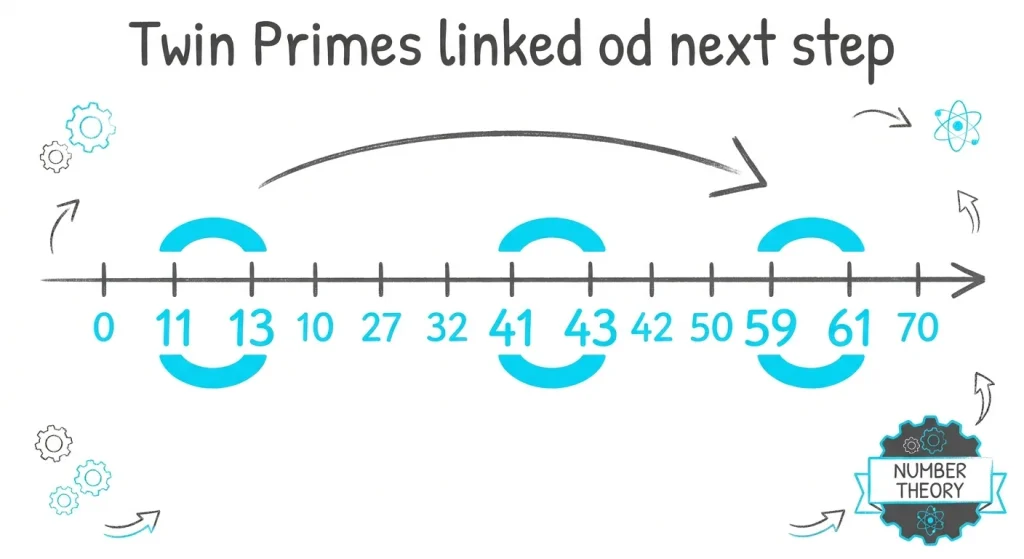
Typical Olympiad style questions that grow from this foundation include finding how many factors a number has without listing them, which uses the exponents in its prime factorisation. A number like 36, which is 2 squared times 3 squared, has (2 plus 1) times (2 plus 1) equals 9 factors. Count them and you will find exactly nine.
Other classics include twin primes, which are prime pairs two apart such as 11 and 13 or 41 and 43. Goldbach style questions ask students to write an even number as the sum of two primes, so 24 becomes 11 plus 13. Questions about the smallest number with exactly 12 factors test the same machinery in reverse. And problems asking why a given expression can never be prime usually turn on spotting a hidden common factor.
None of these need advanced tools. They need a student who genuinely understands what a prime is and is comfortable taking numbers apart. If your child enjoys this kind of thinking, a set of math olympiad questions is a natural next stop, and it helps to have a method for how to solve math olympiad problems before diving in.
Practice questions with answers
Level 1, identification
- Is 29 prime or composite?
- Is 45 prime or composite?
- Which is the only even prime number?
- Is 1 prime, composite or neither?
- List all prime numbers between 20 and 40.
Level 2, applying the method
- Is 91 prime or composite? Show your working.
- Write the prime factorisation of 84.
- How many composite numbers are there between 1 and 20?
- Which numbers between 30 and 40 are prime?
- Is 143 prime or composite?
Level 3, reasoning
- The sum of two prime numbers is 24. Give two different pairs.
- A number has exactly three factors. What can you say about it?
- Why can no prime number greater than 5 end in the digit 5?
- Find the smallest number that has exactly six factors.
- Two primes differ by 2 and both lie between 50 and 75. Find them.
Answers
- Prime. Only 1 and 29 divide it.
- Composite. Factors are 1, 3, 5, 9, 15 and 45.
- Neither, because it has only one factor.
- 23, 29, 31 and 37.
- Composite. Test up to 9 since 9 times 9 is 81 and 10 times 10 is 100. Not divisible by 2, 3 or 5, but 91 divided by 7 is exactly 13. So 91 is 7 times 13.
- 84 equals 2 times 2 times 3 times 7.
- Eleven. They are 4, 6, 8, 9, 10, 12, 14, 15, 16, 18 and 20.
- 31 and 37.
- Composite. It is 11 times 13.
- 5 plus 19, and 7 plus 17. Also 11 plus 13.
- It must be the square of a prime, such as 4, 9, 25 or 49. Its factors are 1, the prime and the square.
- Any number ending in 5 is divisible by 5, so it has at least three factors.
- 12, whose factors are 1, 2, 3, 4, 6 and 12.
- 59 and 61, or 71 and 73.
Make Preparing for Math Olympiad Simple!


What are prime and composite numbers?
A prime number is a whole number greater than 1 with exactly two factors, 1 and itself, such as 2, 3, 5 and 7. A composite number is a whole number greater than 1 with more than two factors, such as 4, 6, 8 and 9. Every whole number above 1 is one or the other.
What is the difference between prime and composite numbers?
The difference is the factor count. Prime numbers have exactly two factors while composite numbers have more than two. A prime cannot be split into smaller whole number factors, while a composite can always be written as a product of primes.
Is 1 a prime number?
No. The number 1 has only one factor, itself, and a prime needs exactly two different factors. It is not composite either, so 1 is classified as neither.
Is 2 a prime number?
Yes. The factors of 2 are 1 and 2, exactly two of them. It is also the only even prime, because every other even number has 2 as an extra factor.
How many prime numbers are there between 1 and 100?
There are 25. They are 2, 3, 5, 7, 11, 13, 17, 19, 23, 29, 31, 37, 41, 43, 47, 53, 59, 61, 67, 71, 73, 79, 83, 89 and 97.
What is the smallest composite number?
4 Its factors are 1, 2 and 4, which is three factors.
Is 0 prime or composite?
Neither. Every whole number divides 0, so it does not have exactly two factors, and the definitions only apply to whole numbers greater than 1.
Are all odd numbers prime?
No. 9, 15, 21, 25 and 27 are all odd and composite. Being odd only means 2 is not a factor, which is one test out of several.
What is the largest prime number?
There is no largest one. Euclid proved more than two thousand years ago that the primes never run out, though the largest one anyone has actually written down keeps growing as computers get faster.
When do students learn prime and composite numbers?
In the NCERT sequence, factors and multiples appear in Class 5, prime and composite numbers with divisibility rules and prime factorisation come in Class 6, and Class 7 builds on them for HCF, LCM and work with fractions.
Can a prime number be negative?
No. Prime and composite classification applies only to whole numbers greater than 1.
What are co-prime numbers?
Two numbers are co-prime when their only common factor is 1. They do not have to be prime themselves. For example 8 and 9 are co-prime, since the factors of 8 are 1, 2, 4 and 8 while the factors of 9 are 1, 3 and 9, and the only one they share is 1.
Conclusion
Prime and composite numbers come down to one question: how many factors does this number have? Exactly two makes it prime. More than two makes it composite. The number 1, with only one factor, is neither.
Everything else follows from that. Why 2 is the only even prime, why 9 and 15 fool so many children, why you can stop testing at the square root.
Keep the atoms picture in play: primes are the building blocks, composites are what gets built, and every composite breaks apart in exactly one way. That idea carries straight into prime factorisation, HCF and LCM.

Mikha Piregu is a Content Writer with experience spanning educational content, including math and math olympiad topics, as well as advocacy writing, research-based articles, and SEO-driven web content. He creates high-quality blog content, web copy, and feature articles that support brand visibility, audience engagement, and long-term organic growth through data-informed storytelling. Skilled in WordPress, WooCommerce, and modern digital tools, Mikha adapts content across various platforms, including blogs, websites, campaigns, and advocacy initiatives, with clarity and purpose.

There are no comments posted here yet.
Sign in to leave a comment