


Equivalent fractions are different fractions that have distinct numerators and denominators but represent the same value or proportion of a whole.
- What Are Equivalent Fractions?
- Seeing Equivalent Fractions: Visual Models
- Equivalent Fractions on a Number Line
- Why Multiplying or Dividing Both Parts Keeps the Value the Same
- How to Find Equivalent Fractions
- How to Check Whether Two Fractions Are Equivalent
- What Are Equivalent Fractions for 1/2?
- Equivalent Fractions for Other Common Fractions
- Equivalent Fractions Chart
- How to Find the Simplest Form of a Fraction Using HCF
- How Equivalence Helps You Compare, Add and Subtract Fractions
- Equivalent Fractions in Real Life
- Common Mistakes Students Make and How to Correct Them
- What CBSE and NCERT Expect in Class 3, 4 and 5
- Hands-On Activities and Games for Equivalent Fractions
- Tips for Parents Teaching Equivalent Fractions at Home
- Tips for Teachers Delivering Equivalent Fraction Lessons
- Equivalent Fractions in Olympiad Style Problems
- Practice Questions With Answers
- Final Thoughts,
That is the idea behind equivalent fractions. They are not a trick or a rule to memorise. They come from one fact about the world: the same amount can be cut into a different number of pieces without the amount changing.
This guide covers what that means, two methods for finding equivalents, three ways to check your answer, full lists for the fractions children meet most, and practice you can use tonight.
What Are Equivalent Fractions?
Equivalent fractions are two or more fractions that have different numerators and denominators but represent the same value.
For example, 1/2, 2/4, 3/6, 4/8 and 50/100 are all equivalent, because each describes half of a whole.
Cut a roti into 2 equal pieces and take 1: you have 1/2. Cut the same roti into 4 equal pieces and take 2: you have 2/4. The pieces are smaller and there are more of them, but the food on your plate is identical.
Say it this way at home: equivalent fractions change how the whole is cut, not how much you have.
Why two different-looking fractions can be equal
A fraction is an instruction in two parts. The denominator tells you how many equal pieces the whole was divided into. The numerator tells you how many you take. If those two words are still new, go over what the numerator and denominator of a fraction mean before starting on equivalence.
Double the number of pieces and each piece becomes half as big, so you need twice as many to keep the same amount. Double the bottom, double the top. The two changes cancel out and the value stays put.
That is why 1/2 and 2/4 are equal, and why the list never ends. Cut the roti into 6 pieces and take 3, or 100 and take 50. Every fraction has infinitely many equivalent fractions, which is the useful part: you can always reshape a fraction into whatever form a problem needs.
Seeing Equivalent Fractions: Visual Models
Children need to see equivalence before they calculate it. Teaching the procedure first produces a child who can generate answers but cannot tell whether they make sense. The same visual reasoning that helps with shapes and patterns does the work here.
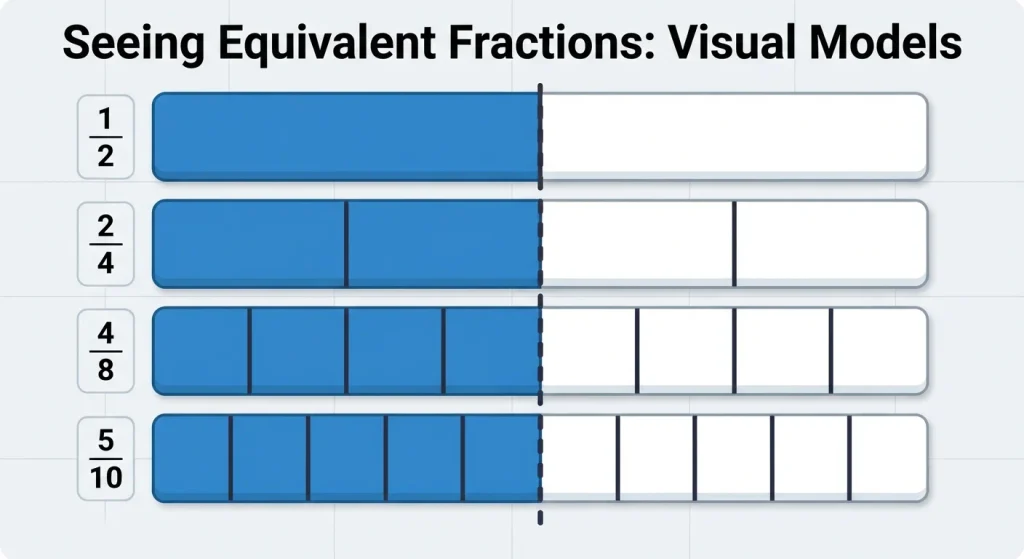
Fraction bars
Draw two identical rectangles, one above the other, exactly the same length. This matters: if the wholes differ, the comparison means nothing.
Divide the top into 2 equal parts and shade 1. Divide the bottom into 4 and shade 2. Have your child put a finger at the edge of each shaded region. The fingers line up, so 1/2 = 2/4.
Add a third bar in eighths with 4 shaded and a fourth in tenths with 5 shaded. The shading edge stays in the same vertical line all the way down. Children often notice this before you say it, and that noticing is the lesson.
Pie and circle models
Circles work well for halves, quarters and eighths, because those cuts are easy to draw accurately. One circle cut into 2 with 1 shaded covers the same area as an identical circle cut into 6 with 3 shaded, so 1/2 = 3/6.
Avoid circles for thirds, fifths and sevenths. Freehand cuts are rarely equal, and a child who sees unequal slices learns the wrong thing. Use bars instead.
Area models
Grids handle larger denominators best. Draw a 4 by 4 grid, giving 16 squares, and shade 8. Draw a bold line down the middle and your child can see that 8/16 covers exactly one of the two halves.
Grids also make the multiplying rule visible. Take a rectangle in 3 columns with 1 shaded, which is 1/3. Draw 2 horizontal lines across it. There are now 9 boxes with 3 shaded, so 1/3 = 3/9. Nothing was added. The same region was cut into more pieces.
Equivalent Fractions on a Number Line
The number line connects fractions to everything else in mathematics, and it is the model most parents skip. If placing numbers on a line is still shaky, work through how to draw a number line and explaining number positions on a number line first.
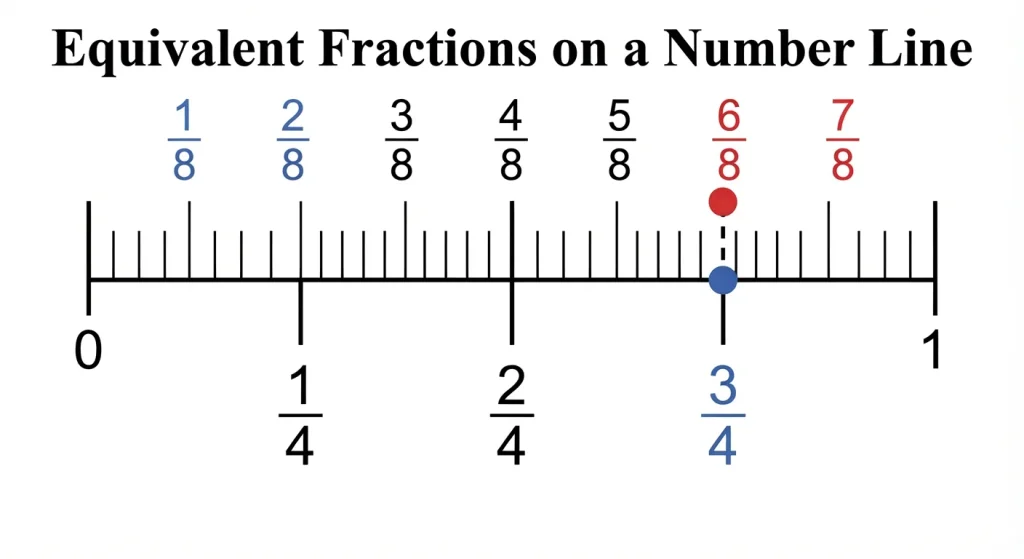
Worked example: showing that 3/4 = 6/8.
- Draw a line, mark 0 at one end and 1 at the other, and make it 8 cm long so it divides neatly.
- Below the line, tick every 2 cm. That gives 4 equal gaps, so the ticks are 1/4, 2/4 and 3/4. Dot the third tick, at 6 cm.
- Above the line, tick every 1 cm. That gives 8 equal gaps, so the ticks are eighths. Count six and dot 6/8, also at 6 cm.
- Both dots sit at the same place. A point on the number line has one position only, so 3/4 and 6/8 are the same number.
This is the strongest argument for a child who still suspects the two fractions are secretly different. They share an address.
Why Multiplying or Dividing Both Parts Keeps the Value the Same
Any number divided by itself equals 1, so 2/2 = 1, 3/3 = 1 and 5/5 = 1. Multiplying by 1 changes nothing.
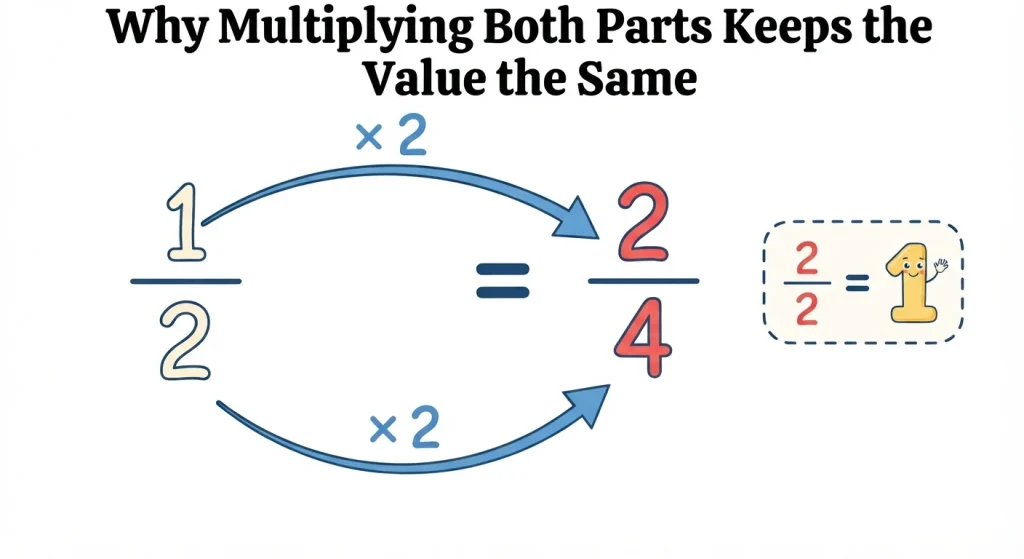
So when you multiply 1/2 by 2/2, you are multiplying by 1:
1/2 × 2/2 = 2/4
The value cannot have changed. You only renamed it. This is also why adding fails. Adding 2 to both parts of 1/2 gives 3/4, which is not the original multiplied by anything. It is a different number.
Say it out loud with your child: we multiply by a disguised 1, we never add.
How to Find Equivalent Fractions
To find an equivalent fraction, multiply or divide both the numerator and the denominator by the same non-zero number. Multiplying gives larger numbers. Dividing gives smaller ones, which is simplifying.
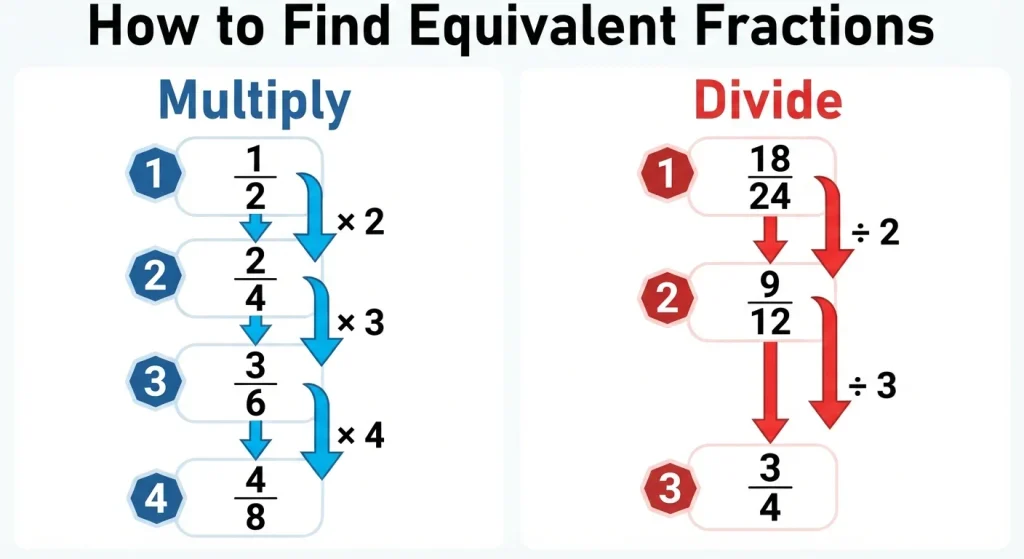
Method 1: Finding equivalent fractions using multiplication
Steps
- Choose any whole number greater than 1. Quick recall of the multiplication tables makes this step instant.
- Multiply the numerator by that number.
- Multiply the denominator by the same number.
- Write the new fraction. It is equivalent to the original.
- Repeat with a different multiplier for more equivalents.
Example 1: three fractions equivalent to 1/2.
- × 2: (1 × 2) / (2 × 2) = 2/4
- × 3: (1 × 3) / (2 × 3) = 3/6
- × 4: (1 × 4) / (2 × 4) = 4/8
So 1/2 = 2/4 = 3/6 = 4/8.
Example 2: the equivalent of 2/5 with denominator 20.
Since 5 × 4 = 20, the multiplier is 4. Then 2 × 4 = 8, so 2/5 = 8/20.
Example 3: the equivalent of 3/4 with numerator 9.
Since 3 × 3 = 9, the multiplier is 3. Then 4 × 3 = 12, so 3/4 = 9/12.
Whatever you do to one number, you do to the other. Nothing else.
Method 2: Finding equivalent fractions using division
Division works only when the numerator and denominator share a common factor, a number that divides both exactly. Comfort with long division and with factors makes those factors easier to spot.
Steps
- Find a number that divides both the numerator and the denominator exactly.
- Divide the numerator by it.
- Divide the denominator by the same number.
- Write the new fraction.
- Repeat until no common factor above 1 remains. The fraction is then in its simplest form.
Example 1: simplify 8/12. Both divide by 4, so (8 ÷ 4) / (12 ÷ 4) = 2/3. Since 2 and 3 share no factor but 1, that is the simplest form.
Example 2: simplify 18/24 in stages. Divide both by 2 to get 9/12, then by 3 to get 3/4. Two small steps are fine and often easier than spotting the largest factor at once.
Example 3: simplify 50/100. Both divide by 50, giving 1/2. Worth doing, because children meet 50/100 constantly in marks and percentages.
How to Check Whether Two Fractions Are Equivalent
Generating equivalents is one skill. Checking a pair someone hands you is another, and it appears in school tests and Olympiad papers alike.
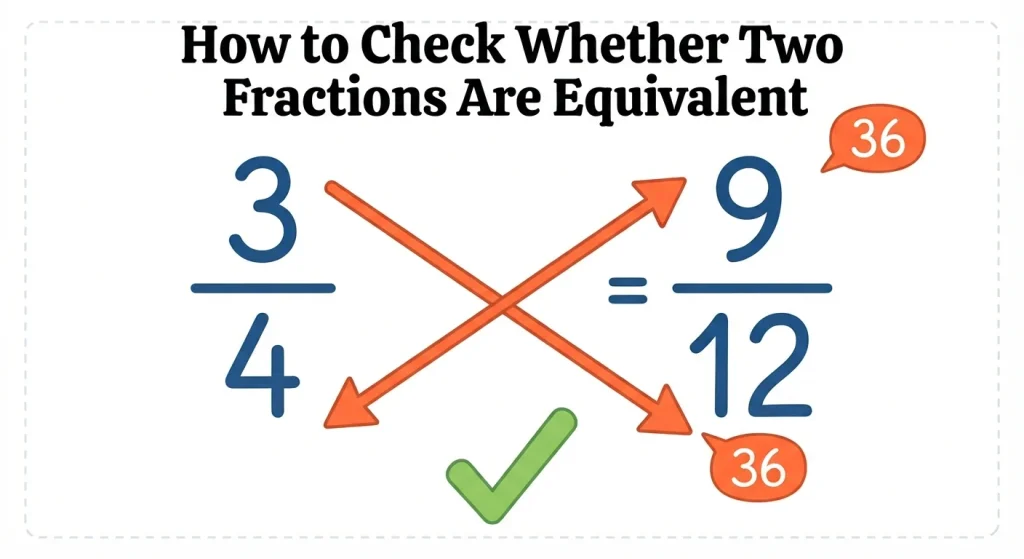
Cross multiplication
For a/b and c/d, multiply across the diagonals. If a × d equals b × c, the fractions are equivalent.
Example 1: 3/4 and 9/12. 3 × 12 = 36 and 4 × 9 = 36. They match, so the fractions are equivalent.
Example 2: 2/3 and 5/7. 2 × 7 = 14 and 3 × 5 = 15. Not equal, so these are not equivalent.
Example 3: 6/9 and 10/15. 6 × 15 = 90 and 9 × 10 = 90. Equivalent, and both simplify to 2/3 as a second opinion.
Simplify both and compare
Reduce each to simplest form. For 12/16 and 15/20: 12/16 divides by 4 to give 3/4, and 15/20 divides by 5 to give 3/4. Same simplest form, so they are equivalent.
Convert both to decimals
Divide numerator by denominator in each. Here 1/4 = 0.25 and 3/12 = 0.25, so they are equivalent. This suits older children and bridges to Class 5 decimal work, where converting a decimal to a fraction is the return journey.
What Are Equivalent Fractions for 1/2?
The equivalent fractions for 1/2 are 2/4, 3/6, 4/8, 5/10, 6/12, 7/14, 8/16, 9/18, 10/20 and so on without end. Every one has a denominator exactly double its numerator, and every one means half of a whole.
The full list to twenty halves
1/2 = 2/4 = 3/6 = 4/8 = 5/10 = 6/12 = 7/14 = 8/16 = 9/18 = 10/20 = 11/22 = 12/24 = 13/26 = 14/28 = 15/30 = 16/32 = 17/34 = 18/36 = 19/38 = 20/40
Further along the same line: 25/50, 30/60, 40/80, 50/100.
How they are generated
- × 2: (1 × 2) / (2 × 2) = 2/4
- × 3: (1 × 3) / (2 × 3) = 3/6
- × 5: (1 × 5) / (2 × 5) = 5/10
- × 25: (1 × 25) / (2 × 25) = 25/50
- × 50: (1 × 50) / (2 × 50) = 50/100
The rule for spotting a half instantly
If the denominator is twice the numerator, the fraction equals 1/2. So 7/14, 11/22 and 24/48 are all halves. Teach your child to glance at the bottom number and ask whether it is double the top. This single habit speeds up comparing and simplifying.
Seeing it
Shade half a square. Draw one line down the middle of the shaded part and the same line through the unshaded part: four quarters with two shaded, which is 2/4. More lines give 3/6, 4/8, 5/10. The shaded area never changes.
Why 1/2 matters more than the rest
Half is the benchmark children use to judge every other fraction. A child who recognises a half in any disguise can sort fractions into more than half and less than half at a glance, which settles a comparison like 5/9 against 4/11 with no calculation. It also carries the percentage link, since 50/100 is a half and 50 per cent is the same thing.
Quick answers
Is 3/6 equal to 1/2? Yes, 6 is double 3. Is 5/9 equal to 1/2? No, 9 is not double 5, and 5/9 is slightly more than a half. Is 50/100 equal to 1/2? Yes, and this is the version children meet in marks and discounts.
Equivalent Fractions for Other Common Fractions
With 1/2 above, these four cover most of what children meet in Class 3 to Class 5.
Equivalent fractions for 1/3
1/3 = 2/6 = 3/9 = 4/12 = 5/15 = 6/18 = 7/21 = 8/24 = 9/27 = 10/30 = 11/33 = 12/36
The denominator is always three times the numerator.
Equivalent fractions for 1/4
1/4 = 2/8 = 3/12 = 4/16 = 5/20 = 6/24 = 7/28 = 8/32 = 9/36 = 10/40 = 11/44 = 12/48 = 25/100
The denominator is always four times the numerator. The last one, 25/100, is why a quarter is 25 per cent.
Equivalent fractions for 2/3
2/3 = 4/6 = 6/9 = 8/12 = 10/15 = 12/18 = 14/21 = 16/24 = 18/27 = 20/30 = 22/33 = 24/36
Numerators rise in twos while denominators rise in threes, in step.
Equivalent fractions for 3/4
3/4 = 6/8 = 9/12 = 12/16 = 15/20 = 18/24 = 21/28 = 24/32 = 27/36 = 30/40 = 33/44 = 36/48 = 75/100
Numerators climb in threes, denominators in fours. And 75/100 explains why three quarters is 75 per cent.
Equivalent Fractions Chart
Keep this where your child studies. A reference table removes the need to recalculate the same facts every evening.
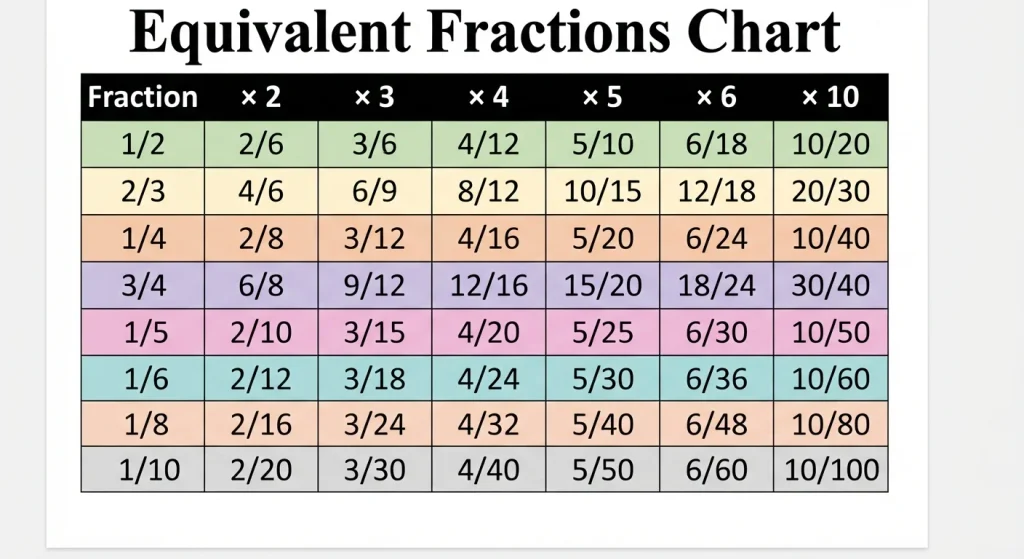
| Fraction | × 2 | × 3 | × 4 | × 5 | × 6 | × 10 |
|---|---|---|---|---|---|---|
| 1/2 | 2/4 | 3/6 | 4/8 | 5/10 | 6/12 | 10/20 |
| 1/3 | 2/6 | 3/9 | 4/12 | 5/15 | 6/18 | 10/30 |
| 2/3 | 4/6 | 6/9 | 8/12 | 10/15 | 12/18 | 20/30 |
| 1/4 | 2/8 | 3/12 | 4/16 | 5/20 | 6/24 | 10/40 |
| 3/4 | 6/8 | 9/12 | 12/16 | 15/20 | 18/24 | 30/40 |
| 1/5 | 2/10 | 3/15 | 4/20 | 5/25 | 6/30 | 10/50 |
| 2/5 | 4/10 | 6/15 | 8/20 | 10/25 | 12/30 | 20/50 |
| 1/6 | 2/12 | 3/18 | 4/24 | 5/30 | 6/36 | 10/60 |
| 1/8 | 2/16 | 3/24 | 4/32 | 5/40 | 6/48 | 10/80 |
| 1/10 | 2/20 | 3/30 | 4/40 | 5/50 | 6/60 | 10/100 |
Every fraction in a row equals every other fraction in that row.
How to Find the Simplest Form of a Fraction Using HCF
A fraction is in its simplest form when the numerator and denominator share no common factor other than 1. The quickest route uses the HCF, the highest common factor.
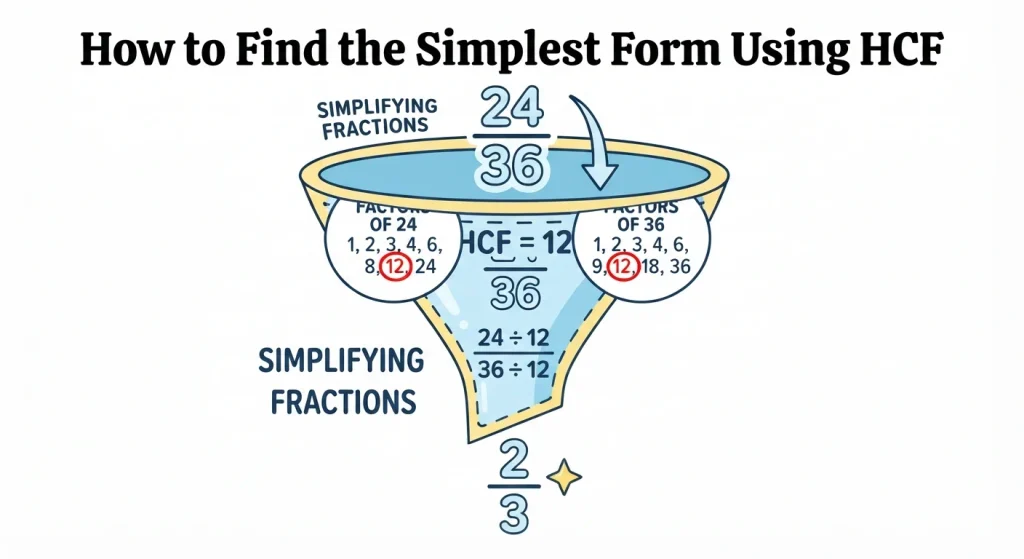
Steps
- List the factors of the numerator.
- List the factors of the denominator.
- The largest number in both lists is the HCF.
- Divide the numerator and the denominator by it.
- The result is the simplest form, equivalent to the original.
Example: simplify 24/36.
- Factors of 24: 1, 2, 3, 4, 6, 8, 12, 24
- Factors of 36: 1, 2, 3, 4, 6, 9, 12, 18, 36
- The HCF is 12, and 24 ÷ 12 = 2 with 36 ÷ 12 = 3, so 24/36 = 2/3.
Example: simplify 45/60. The HCF is 15, so 45/60 = 3/4.
If the HCF is hard to spot, divide repeatedly by small numbers. For 24/36: halve to 12/18, halve to 6/9, divide by 3 to get 2/3. Same destination, more steps, no harm done.
Simplifying is equivalence running backwards. Every time your child simplifies, they are finding an equivalent fraction with smaller numbers.
How Equivalence Helps You Compare, Add and Subtract Fractions
Comparing. Which is bigger, 2/3 or 3/5? Rewrite both with denominator 15: 2/3 = 10/15 and 3/5 = 9/15. Same-sized pieces, so counting settles it. 2/3 is bigger.
Adding. For 1/4 + 1/8, you cannot add quarters to eighths directly, in the same way you cannot add 3 apples to 2 oranges and call it 5 apples. Replace 1/4 with 2/8, then 2/8 + 1/8 = 3/8.
Subtracting. For 3/4 minus 1/6, rewrite both in twelfths: 9/12 minus 2/12 = 7/12.
In each case the real work is finding equivalent fractions. The arithmetic at the end is the easy part, which is why a child who is fluent here finds Class 5 fraction work almost routine.
Equivalent Fractions in Real Life
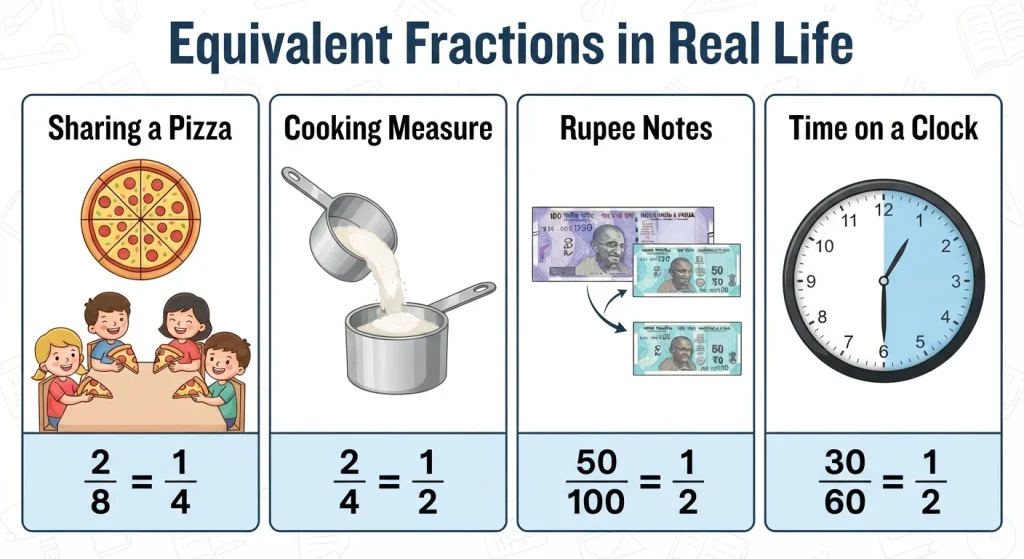
Sharing food. A pizza cut into 8 slices shared by 4 people gives each person 2/8, which is 1/4. Cut into 12, each gets 3/12, still 1/4. The cut changes, the share does not.
Measuring ingredients. A recipe needs 1/2 cup of sugar and the only measure is a 1/4 cup. Two scoops give 2/4, which is 1/2.
Money in rupees. Half of 100 rupees is 50 rupees, so 50/100 of the money is 1/2 of it. A quarter of 200 rupees is also 50 rupees, so 50/200 is 1/4. Money word problems for Class 3 give more practice of this kind.
Time. Thirty minutes out of 60 is 30/60, which simplifies to 1/2, so we call it half an hour. Fifteen minutes is 15/60, a quarter of an hour. If reading a clock face is still shaky, start with how to tell time on a clock.
Marks. Scoring 18 out of 24 is 18/24, which simplifies to 3/4, or 75 per cent. Scoring 15 out of 20 is 15/20, also 3/4. Two different tests, the same performance.
Common Mistakes Students Make and How to Correct Them
Mistake 1: adding the same number to both parts. A child turns 1/2 into 3/4 by adding 2 to each and believes they are equivalent. This is the most common error in the topic.
The fix. Draw 1/2 and 3/4 shaded on identical bars. The shading differs, so the fractions cannot be equal. Then give the reason: multiplying both parts by the same number is multiplying by 1, which changes nothing, while adding is a different operation with a different result.
Mistake 2: thinking a bigger denominator means a bigger fraction. Whole number instinct says 1/8 beats 1/4 because 8 beats 4.
The fix. Share a chocolate bar among 4 people, then among 8. More people, smaller share.
Mistake 3: multiplying only one part. Turning 2/3 into 2/6 by doubling only the bottom.
The fix. Say the operation aloud while writing it: “times 2 on top, times 2 on the bottom.” The error usually disappears once the words accompany the writing.
Mistake 4: dividing when there is no common factor. Trying to reduce 5/7 to 1/1.
The fix. Check that the same number divides both. Here 5 divides 5 but not 7, so 5/7 is already in simplest form, and that is a complete answer.
Mistake 5: comparing fractions of different wholes. Half a small roti treated as equal to half a large one.
The fix. Draw the wholes the same size every time. The statement 1/2 = 2/4 assumes one whole, and that assumption deserves to be spoken.
Mistake 6: believing simplest form is the only correct answer. A child writes 2/4 and panics because the key says 1/2.
The fix. Both are correct and name the same number. Simplest form is a presentation convention, not a truth about the value.
What CBSE and NCERT Expect in Class 3, 4 and 5
Class 3. Halves, quarters and thirds through shapes and sharing, building on the work in fractions for Class 1 and teaching fractions to Grade 2 students. Equivalence appears informally, often as two quarters making one half. Our guide to fractions for Class 3 covers this stage in full. The expectation is recognition, not calculation.
Class 4. Equivalent fractions arrive formally. Children generate equivalents by multiplying, identify equivalent pairs from a set, and begin simplifying small fractions. NCERT leans heavily on fraction bars and number lines here.
Class 5. The work turns procedural and connected: simplest form using HCF, comparing and ordering by common denominator, adding and subtracting unlike fractions, and the link to decimals and percentages. Equivalence is assumed knowledge, which is why a Class 4 gap becomes painful in Class 5.
8 Hands-On Activities and Games for Equivalent Fractions
All of these use what is already in the house. For more of the same style, see our fun math activities and math games collections.
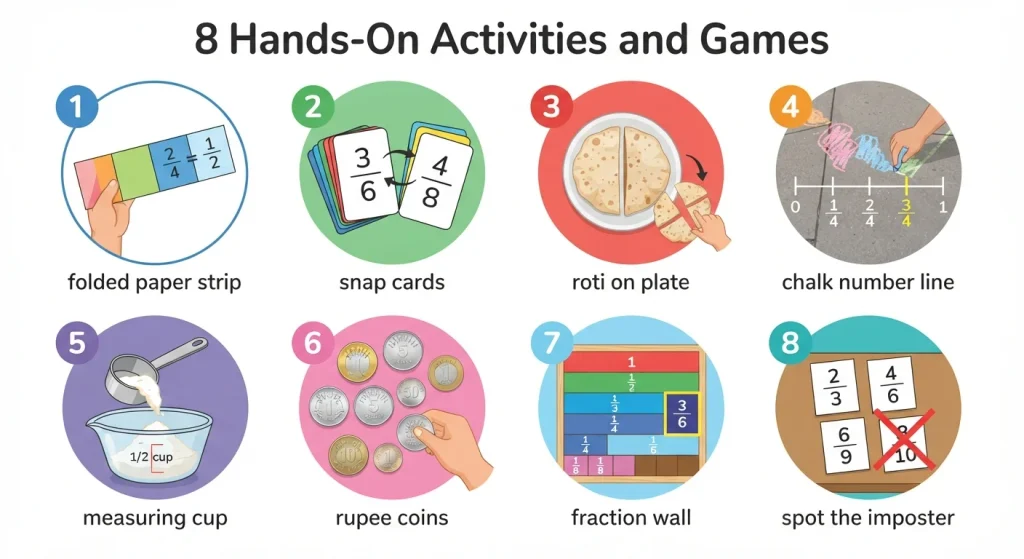
1. The paper folding test. Take two identical paper strips. Fold one in half and colour one part. Fold the other into eighths and colour four. Lay them side by side: the coloured lengths match, so 1/2 = 4/8. Repeat with thirds and sixths.
2. Equivalent fraction snap. Write fractions on small cards, including sets such as 1/2, 2/4, 3/6, 5/10. Play snap where a match is any two equivalent fractions. The player must say why they match to keep the pair.
3. Roti sharing at dinner. Cut one roti in half and another into quarters. Ask how many quarter pieces equal one half piece, then how many eighths. Food makes the abstraction disappear.
4. Number line hopscotch. Chalk a line from 0 to 1 with eight equal gaps. Call out 3/4 and have your child jump to the spot, then name the eighths equivalent, 6/8. Movement helps the position stick.
5. The measuring cup challenge. Give your child a 1/4 cup and ask for 1/2 cup, 3/4 cup and one full cup of rice. They discover 2/4, 3/4 and 4/4 by doing.
6. Rupee equivalence. Put out 100 rupees in coins. Ask for half, then ask what fraction that is. Write 50/100 and simplify to 1/2 together. Repeat with quarters and 25/100.
7. Fraction wall building. On one sheet, draw rows of equal length divided into 1, 2, 3, 4, 6, 8, 10 and 12 parts. Colour one row and find every other row where the colouring lines up exactly. Your child trusts a chart they built themselves.
8. Spot the odd one out. Write four fractions where three are equivalent and one is not, such as 2/3, 4/6, 6/9 and 8/10. Your child finds the imposter and proves it by cross multiplication. The format is the same as odd one out puzzles, and a near miss trains careful checking rather than guessing.
Tips for Parents Teaching Equivalent Fractions at Home
Start with objects and pictures and stay there longer than feels necessary. The rule takes five minutes to teach and a term to understand, and the understanding is what earns marks later.
Keep the wholes the same size in every drawing. Most confusion in this topic traces back to comparing shares of different wholes.
Ask your child to explain back. An explanation in their own words is far better evidence of understanding than a correct answer.
Use everyday moments rather than extra worksheets. Cutting fruit, splitting a bill, reading a recipe and checking the clock all carry the idea.
When a mistake appears, ask them to draw it rather than correcting it. Self-caught errors do not come back.
Praise the reasoning, not the speed.
Tips for Teachers Delivering Equivalent Fraction Lessons
Open with a contradiction, not a definition. Write 1/2 = 4/8 on the board and ask whether it can possibly be true.
Use three models in sequence and name them: fraction bars, then area grids, then the number line. The number line matters most, because it carries into decimals, percentages and the number system as a whole.
Make the multiplying by 1 argument explicit, even in Class 4. Children can hold the idea that 2/2 equals 1, and it converts a rule into a reason.
Teach against the adding error before a student offers it. Present 1/2 and 3/4 as a worked counterexample.
Mix generation and verification tasks. Deciding whether a given pair is equivalent uses different thinking from producing equivalents, and assessments use both.
Keep a fraction wall on display all term and refer to it when teaching comparing, adding and simplifying, so students see one continuous idea instead of four chapters.
Equivalent Fractions in Olympiad Style Problems
Olympiad questions rarely ask for a definition. They assume equivalence and test whether a student can use it flexibly under pressure. Fractions sit in the arithmetic section of the SOF IMO syllabus, and the general approach is covered in how to solve Math Olympiad problems.
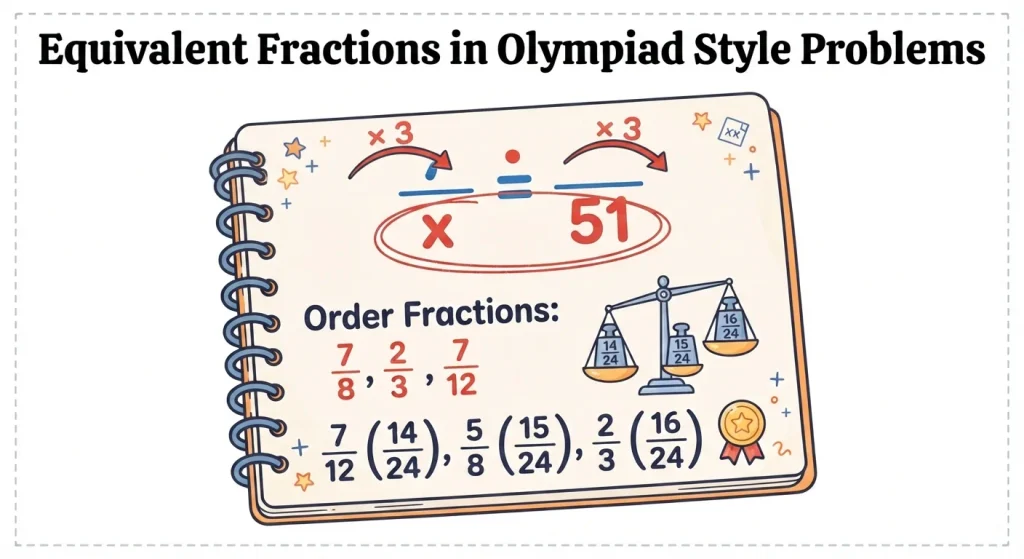
Five shapes recur:
Finding a missing number. If 7/x = 21/51, the numerator was multiplied by 3, so x = 51 ÷ 3 = 17.
Ordering several fractions. Arrange 5/8, 2/3 and 7/12. In twenty fourths these are 15/24, 16/24 and 14/24, so the order is 7/12, 5/8, 2/3. The whole problem is equivalence work.
Hidden patterns. Which fraction follows 2/6, 3/9, 4/12? Each equals 1/3, with numerators rising by 1 and denominators by 3, so the next is 5/15.
Word problems with different wholes. One student solves 3/4 of 40 questions, another 7/10 of 50. That is 30 against 35, so the second did more. The trap is comparing 3/4 with 7/10 and forgetting the wholes differ, a habit covered in how to solve math word problems.
Simplification under time pressure. Reduce 144/180. The HCF is 36, giving 4/5. Speed comes from recognising factors, which is part of getting full marks in a maths olympiad.
Students who only memorised the multiply rule stall on these. Students who understand that a fraction can be renamed at will, in either direction, find a way through. A set of Math Olympiad questions is the fastest way to build that flexibility.
Practice Questions With Answers
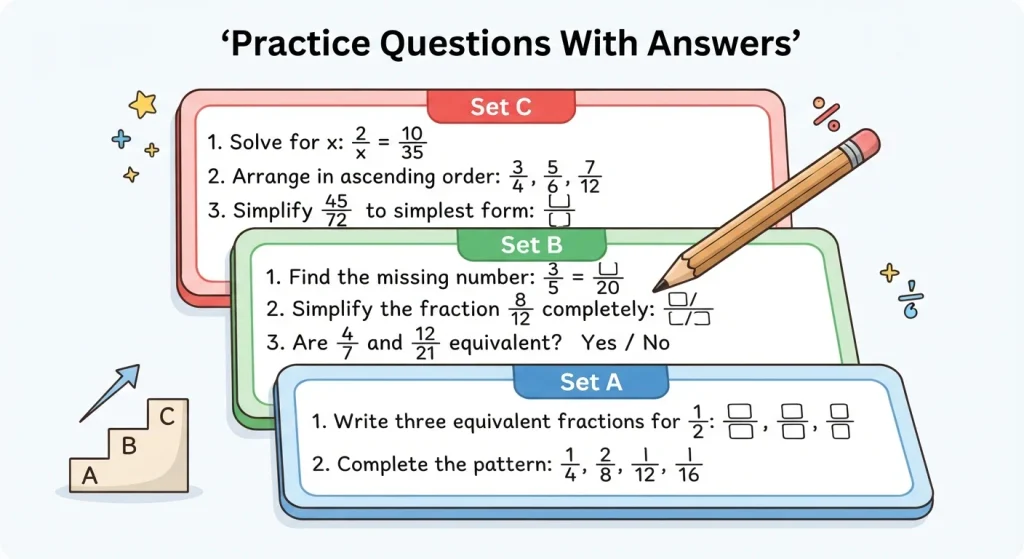
Set A: Starting out
- Write three fractions equivalent to 1/5.
- Fill in the blank: 3/4 = ?/8
- Is 2/4 equivalent to 1/2?
- Fill in the blank: 1/3 = 5/?
- Write 6/8 in its simplest form.
Set B: Building up
- Find the equivalent of 4/7 with denominator 35.
- Use cross multiplication to check whether 5/6 and 20/24 are equivalent.
- Simplify 36/48 using the HCF.
- Which is larger, 3/5 or 5/8?
- Fill in the blank: 9/? = 3/4
Set C: Challenge
- Find the missing number: 8/x = 24/45
- Arrange from smallest to largest: 3/4, 5/6, 7/12
- Simplify 126/198 completely.
- A jug holds 3/4 litre. How many 1/8 litre glasses can be filled from it?
- Two fractions are equivalent. One is 7/9 and the other has denominator 72. What is its numerator?
Answers
- 2/10, 3/15, 4/20, three of infinitely many.
- 6/8, since 4 × 2 = 8 so 3 × 2 = 6.
- Yes. Dividing both parts of 2/4 by 2 gives 1/2.
- 15, since 1 × 5 = 5 so 3 × 5 = 15.
- 3/4, dividing both parts by 2.
- 20/35, since 7 × 5 = 35 so 4 × 5 = 20.
- Yes. 5 × 24 = 120 and 6 × 20 = 120.
- 3/4. The HCF of 36 and 48 is 12.
- 5/8. In fortieths they are 24/40 and 25/40.
- 12, since 3 × 3 = 9 so 4 × 3 = 12.
- Since 8 × 3 = 24, x = 45 ÷ 3 = 15.
- 7/12, 3/4, 5/6. In twelfths: 7/12, 9/12, 10/12.
- 7/11. The HCF of 126 and 198 is 18.
- 6 glasses, since 3/4 = 6/8 and each glass takes 1/8.
- Since 9 × 8 = 72, the numerator is 7 × 8 = 56.
Make Preparing for Math Olympiad Simple!


What are equivalent fractions?
Equivalent fractions are two or more fractions that look different but represent the same value. For example, 1/2, 2/4 and 4/8 are equivalent because each describes half of a whole. They have different numerators and denominators but mark the same point on a number line.
How do you find equivalent fractions?
Multiply or divide both the numerator and the denominator by the same non-zero number. Multiplying 2/5 by 3 top and bottom gives 6/15. Dividing both parts of 8/12 by 4 gives 2/3. The top and the bottom must always receive the same treatment.
Can you add the same number to the numerator and denominator?
No. Adding 2 to both parts of 1/2 gives 3/4, which is larger, not equal. Equivalence comes from multiplying or dividing, because multiplying both parts by the same number is the same as multiplying the fraction by 1.
How many equivalent fractions does a fraction have?
Infinitely many. You can keep multiplying both parts by larger numbers forever, and every result is equivalent.
What is the easiest way to check whether two fractions are equivalent?
Cross multiplication. Multiply the numerator of the first by the denominator of the second, then the denominator of the first by the numerator of the second. Equal products mean equivalent fractions. For 3/4 and 9/12, both products are 36.
What are the equivalent fractions of 1/2?
2/4, 3/6, 4/8, 5/10, 6/12, 7/14, 8/16, 9/18, 10/20, 25/50 and 50/100, among infinitely many. In every one, the denominator is exactly double the numerator.
What is the difference between equivalent fractions and simplifying fractions?
Two directions of the same idea. Simplifying finds an equivalent fraction with smaller numbers by dividing both parts by a common factor. The simplest form is the equivalent that cannot be reduced further.
What is the simplest form of a fraction?
A fraction is in simplest form when the numerator and denominator share no common factor other than 1. Divide both by their HCF to get there. Dividing 24/36 by 12 gives 2/3.
At what Class are equivalent fractions taught?
Informally in Class 3 through sharing and shapes, formally in Class 4, and applied in Class 5 for simplifying, comparing, adding and subtracting.
Why are equivalent fractions important?
Almost every later fraction skill depends on them: comparing, adding and subtracting unlike fractions, simplifying answers, converting to decimals and percentages, and solving Olympiad problems all need a fraction rewritten in a more convenient but equal form.
Can a whole number be written as a fraction with equivalents?
Yes. The number 1 can be written as 2/2, 3/3 or 4/4, and 2 can be written as 4/2, 6/3 or 8/4. This is why multiplying a fraction by 2/2 does not change its value.
Does 0 work as a multiplier?
No. Multiplying both parts by 0 gives 0/0, which is not a valid fraction, since a denominator can never be 0. Always use a whole number greater than
Final Thoughts,
Equivalent fractions are less a rule than a habit of mind: the same quantity can wear many names, and choosing the right name makes a problem easy.
A child who sees that 1/2, 4/8 and 50/100 are one number in three costumes will compare, simplify, add and subtract fractions with far less effort than one who only remembers to multiply top and bottom.
So keep the order right. Pictures first, then the number line, then the methods, then practice. Draw the bars when a mistake appears, say the operation out loud while writing it, and use the kitchen and the clock as often as the notebook. The fluency builds quietly, and by Class 5 it is simply there.

Mikha Piregu is a Content Writer with experience spanning educational content, including math and math olympiad topics, as well as advocacy writing, research-based articles, and SEO-driven web content. He creates high-quality blog content, web copy, and feature articles that support brand visibility, audience engagement, and long-term organic growth through data-informed storytelling. Skilled in WordPress, WooCommerce, and modern digital tools, Mikha adapts content across various platforms, including blogs, websites, campaigns, and advocacy initiatives, with clarity and purpose.

There are no comments posted here yet.
Sign in to leave a comment