


A coordinate plane (or Cartesian grid) is a two-dimensional map formed by two intersecting, perpendicular number lines. It acts as a GPS for flat surfaces, allowing you to plot locations, graph data, and track equations.
- What is a coordinate plane?
- The parts of a coordinate plane
- Ordered pairs: why (3, 5) and (5, 3) are different points
- How to plot points on a coordinate plane, step by step
- How to read the coordinates of a point
- Points that sit on the axes
- Drawing shapes on the coordinate plane
- Finding side lengths from coordinates
- Where the coordinate plane shows up in real life
- Going further: the four quadrants (Class 6 and beyond)
- Common mistakes and how to fix them
- Eight activities and games to try
- Tips for parents
- Tips for teachers
- The coordinate plane in Olympiad problems
- Practice questions with answers
Navigating the grid relies on four foundational landmarks:
- X-axis & Y-axis: The perpendicular cross-sections. X runs horizontally (left/right); Y runs vertically (up/down).
- Origin: The central starting point
(0, 0)where both axes meet. - Quadrants: Four counter-clockwise regions that group points by their signs:
- Quadrant I
(+, +)– Top right - Quadrant II
(-, +)– Top left - Quadrant III
(-, -)– Bottom left - Quadrant IV
(+, -)– Bottom right
- Quadrant I
This guide covers what the coordinate plane is, what its parts are called, how to plot a point and how to read one, how to draw shapes on it, the one mistake almost every child makes, eight activities you can set up with chalk, and practice questions with answers.
What is a coordinate plane?
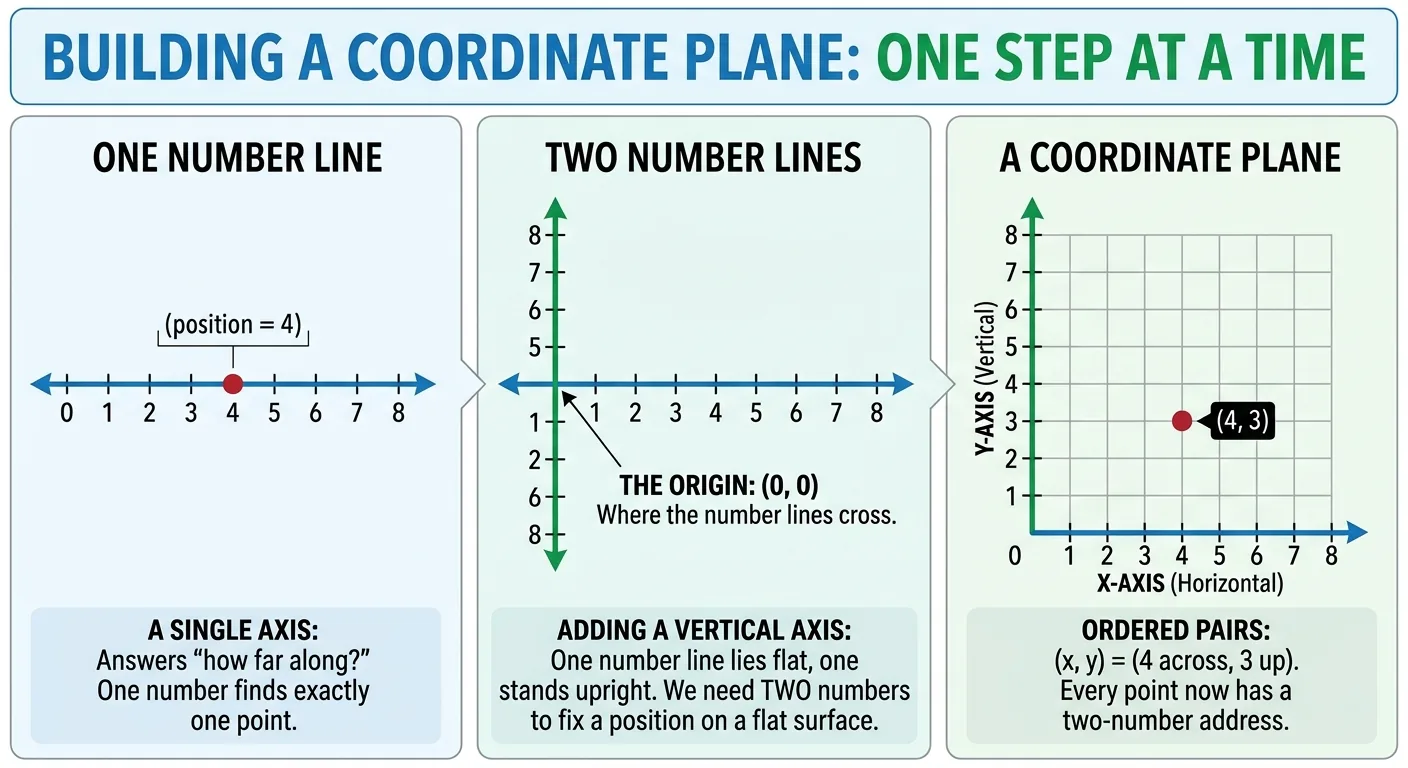
A coordinate plane is a flat grid made by two number lines that cross each other at right angles at zero. One lies flat, left to right. The other stands upright. Together they give every point on the grid an address made of two numbers.
Build it up the way your child’s brain will. A number line answers one question: how far along? Say “stand at 4” and there is exactly one place to stand.
Now think about a classroom floor. Tell a child to walk 4 steps from the corner and it depends four steps towards the window is not four steps towards the door. One number cannot fix a position on a flat surface. You need two.
So lay down a second number line, standing upright, crossing the first at zero. Now “4 across and 3 up” means one place and one place only. That is the whole invention, and it is where a child’s spatial understanding starts turning into something they can write down.
A plane in maths means a flat surface with length and width but no thickness a tabletop, a sheet of chart paper. That is why we call it two-dimensional. You will also hear coordinate grid, used when the gridlines are drawn in, and Cartesian plane, named after René Descartes, who came up with the idea in the 1600s. All three mean the same picture.
The parts of a coordinate plane
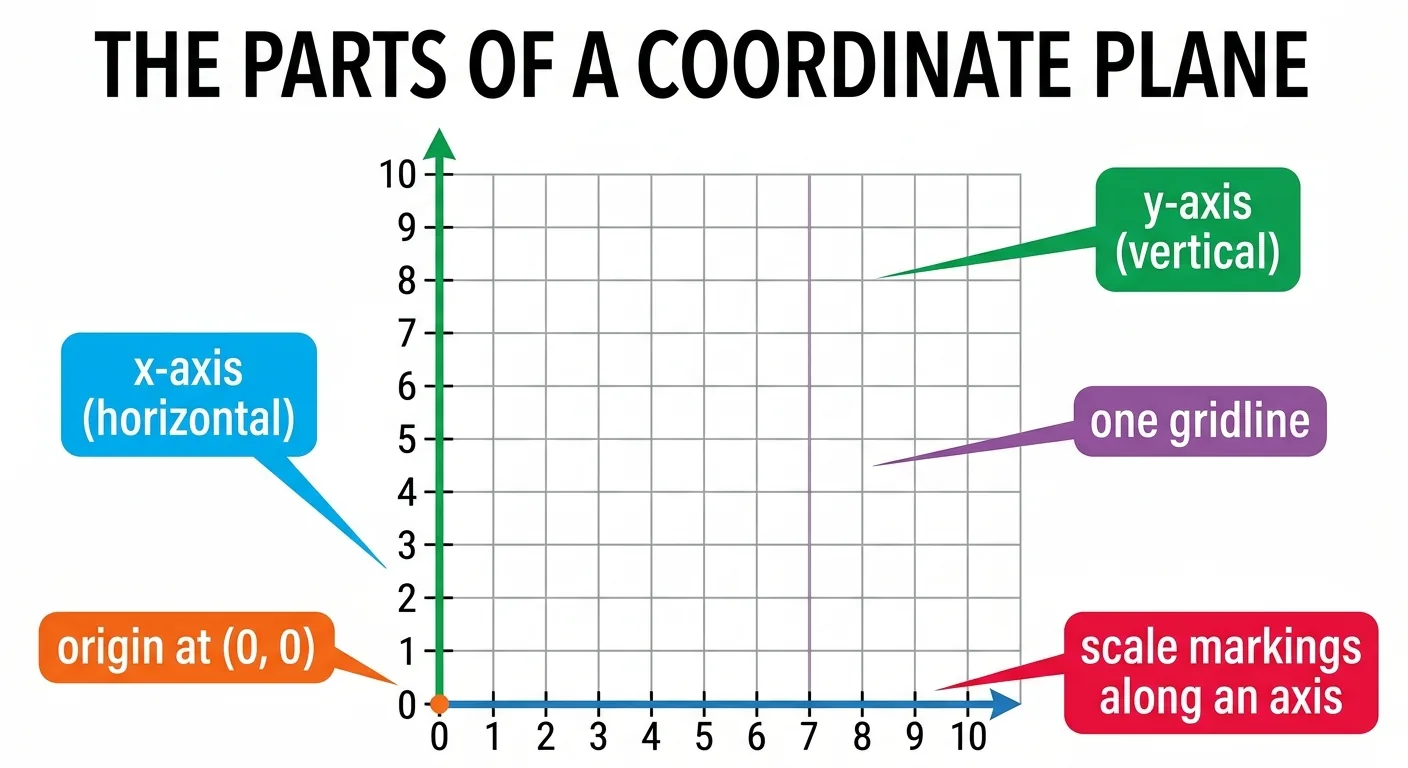
Four words, taught while pointing at a real drawn grid. Words learned while pointing stick far better than words learned from a list.
The x-axis is the horizontal number line, lying flat, running left to right. It measures how far across a point sits. A way to remember it: x is a cross, and you go a-cross the x-axis.
The y-axis is the vertical number line, standing upright, running bottom to top. It measures how far up a point sits. Remember it as the one that goes to the sky.
The origin is where the two axes cross. Its address is (0, 0): zero steps across, zero steps up.
This is worth labouring: every point your child ever plots starts at the origin. Not at the corner of the page, not at the last point they marked. At (0, 0), every time.
Gridlines and scale. The thin lines running across and up are gridlines, there so your child can count steps without a ruler. The scale is what each step is worth. Most Class 5 grids use a scale of 1, but a grid can count in 2s, 5s or 10s, and the printed numbers tell you which. Build one habit: before the pencil moves, ask what is one square worth here? That single question prevents a large share of all coordinate errors.
The steps must also be equal all the way along an axis, a line that goes 0, 1, 2, 5, 10 is a list, not a number line.
Ordered pairs: why (3, 5) and (5, 3) are different points
An ordered pair is the address of a point, written as two numbers inside brackets with a comma between them: (x, y). The word ordered is doing real work there.
The first number is the x-coordinate: how far to go across. The second number is the y-coordinate: how far to go up. So (3, 5) means start at the origin, go 3 across, then 5 up.
Why (3, 5) and (5, 3) are different points
Look at what happens when the same two numbers swap places.
| (3, 5) | (5, 3) | |
|---|---|---|
| Go across | 3 steps | 5 steps |
| Then go up | 5 steps | 3 steps |
| Where you land | Higher up, closer to the y-axis | Further right, closer to the x-axis |
| Same point? | No, two different places on the grid |
Plot both with your child. Seeing the dots land in visibly different places does more than any explaining. Then ask: is there a pair where swapping makes no difference? Yes, pairs where both numbers are the same, like (4, 4).
The memory aid that explains itself
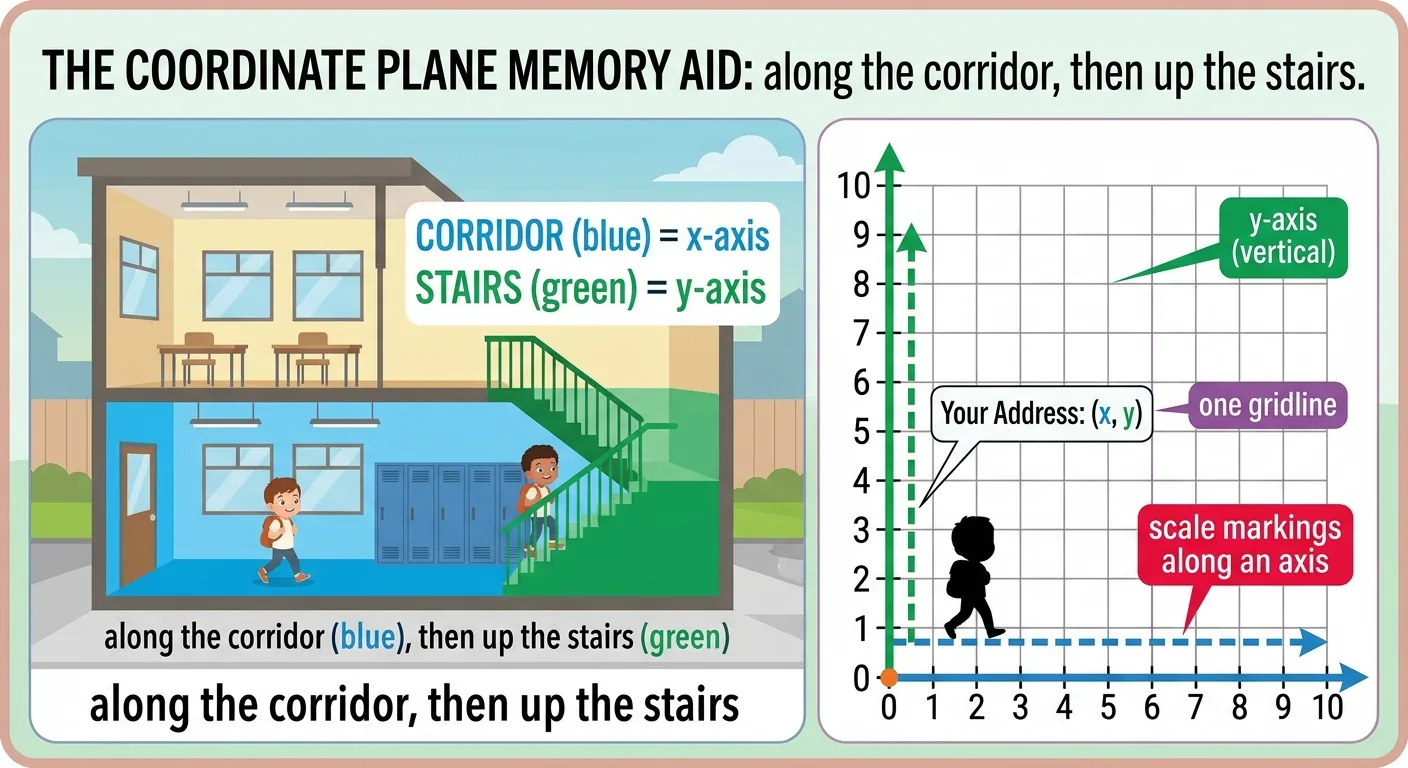
Most children are handed a rule: x first, then y. Rules with no reason behind them are the first thing to fall out of a child’s head under pressure. Give them a reason instead.
Reason one: the corridor and the stairs. To reach a classroom you walk along the corridor first, then climb the stairs. You cannot climb to the first floor while standing outside the gate. Along, then up, exactly what (x, y) tells you to do.
Reason two: the alphabet. x comes before y, and the pair keeps them in that order. A child who can say the alphabet can work out which number comes first. Use both: one is a picture, one is a fact, and different children hold on to different things.
How to plot points on a coordinate plane, step by step
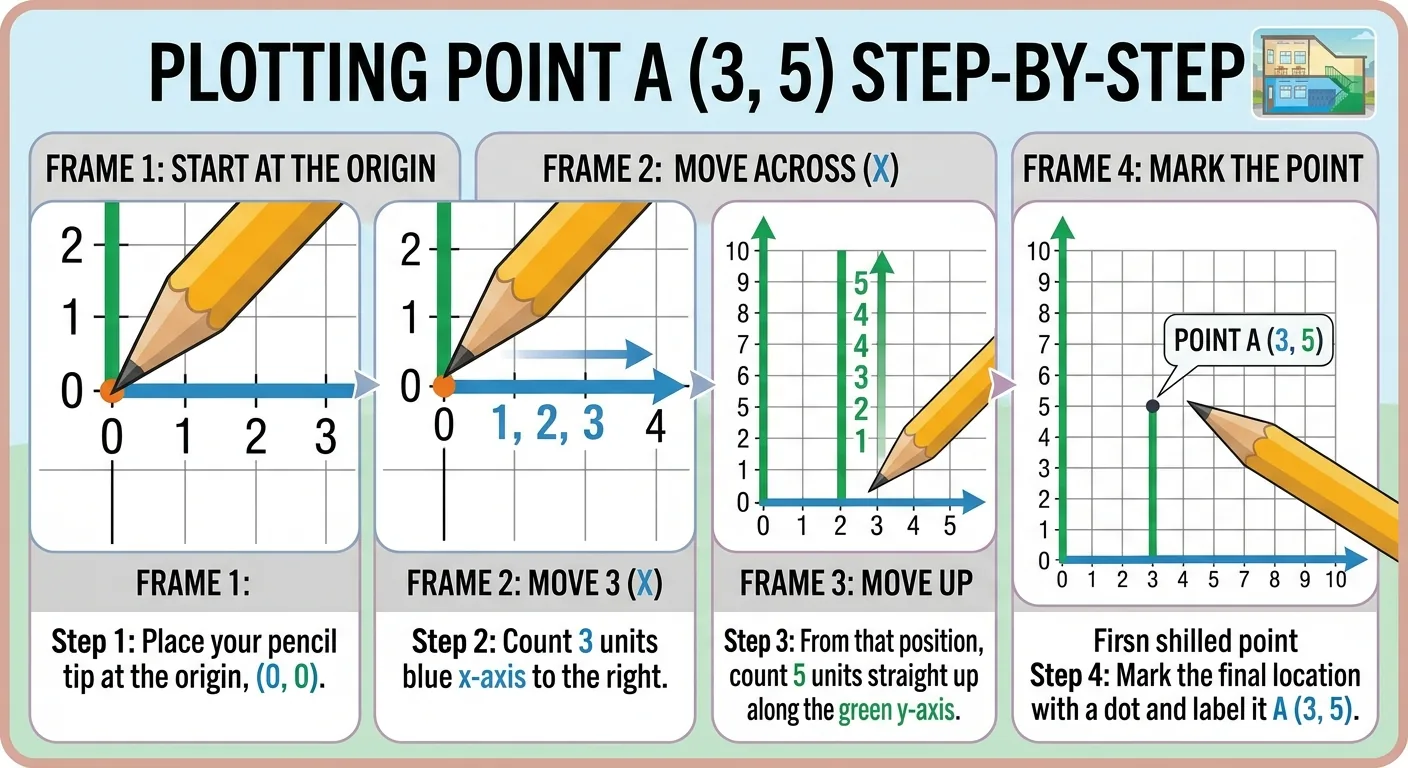
Three fixed steps, every time, even when the answer looks obvious.
- Start at the origin, (0, 0). Put your pencil tip there before anything else.
- Move across by the first number, counting along the x-axis. Check what one square is worth before you count.
- Move up by the second number, counting along the y-axis from where you stopped. Mark the point with a small dot and label it with a capital letter.
Example 1, plot A (3, 5). Start at the origin. Count 3 squares across to the right. Then count 5 squares straight up. Mark the dot and label it A. Say it aloud while you do it: “three across, five up.” Narrating is what builds the habit.
Example 2, plot B (5, 3). Start at the origin again, not from where A is. Count 5 across, then 3 up. Mark B. Leave A and B on the same grid: same two digits, clearly different places.
Example 3, plot C (7, 2). Count 7 across, then 2 up. Notice C sits low and far to the right. A large first number with a small second one always means that. Encourage your child to predict roughly where a point will land before counting, that habit catches mistakes.
Example 4, plot D (2, 7). Count 2 across, then 7 up. D sits high and close to the y-axis, the mirror of C. Point at C and D together and ask which numbers were swapped. That is the swapped-coordinate error, met on purpose in a safe place, before it turns up in a test.
How to read the coordinates of a point
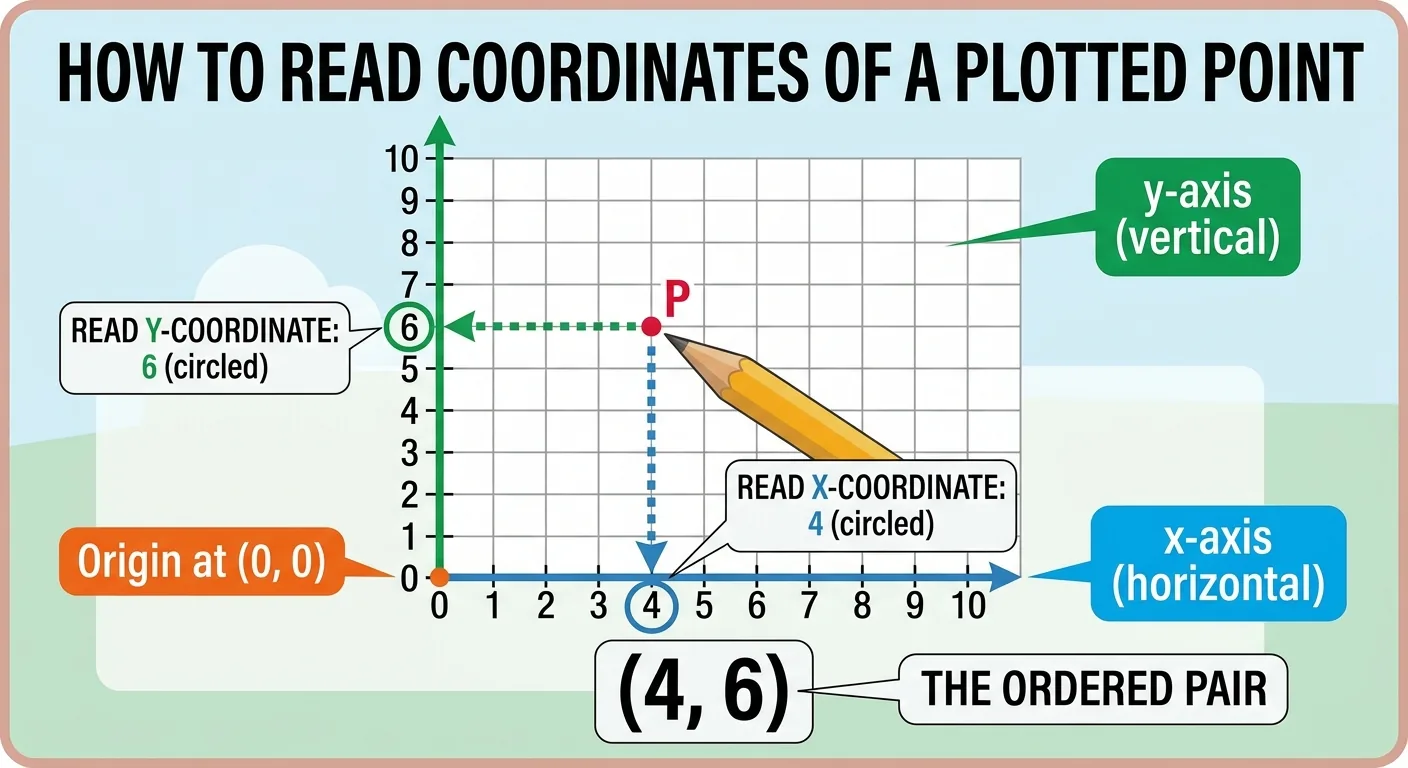
Reading is plotting run backwards. Same three steps, same order.
- Find the point and put your finger on it.
- Slide straight down to the x-axis and read the number. That is the x-coordinate.
- Go back to the point and slide straight across to the y-axis. Read the number. That is the y-coordinate. Write the pair as (x, y).
Example 5. A point sits 4 across and 6 up. Slide down: 4. Slide across: 6. The coordinates are (4, 6).
Example 6. Slide down: 6. Slide across: 1. The coordinates are (6, 1). A small y-coordinate always means a point low down.
Example 7. Slide down: 1. Slide across: 6. The coordinates are (1, 6), same digits as Example 6, different point.
A check your child can do alone: read the coordinates off a plotted point, cover the point, plot it fresh from the pair they wrote, and see whether the new dot lands in the same place. Finding their own mistake is worth ten corrections from you.
Points that sit on the axes
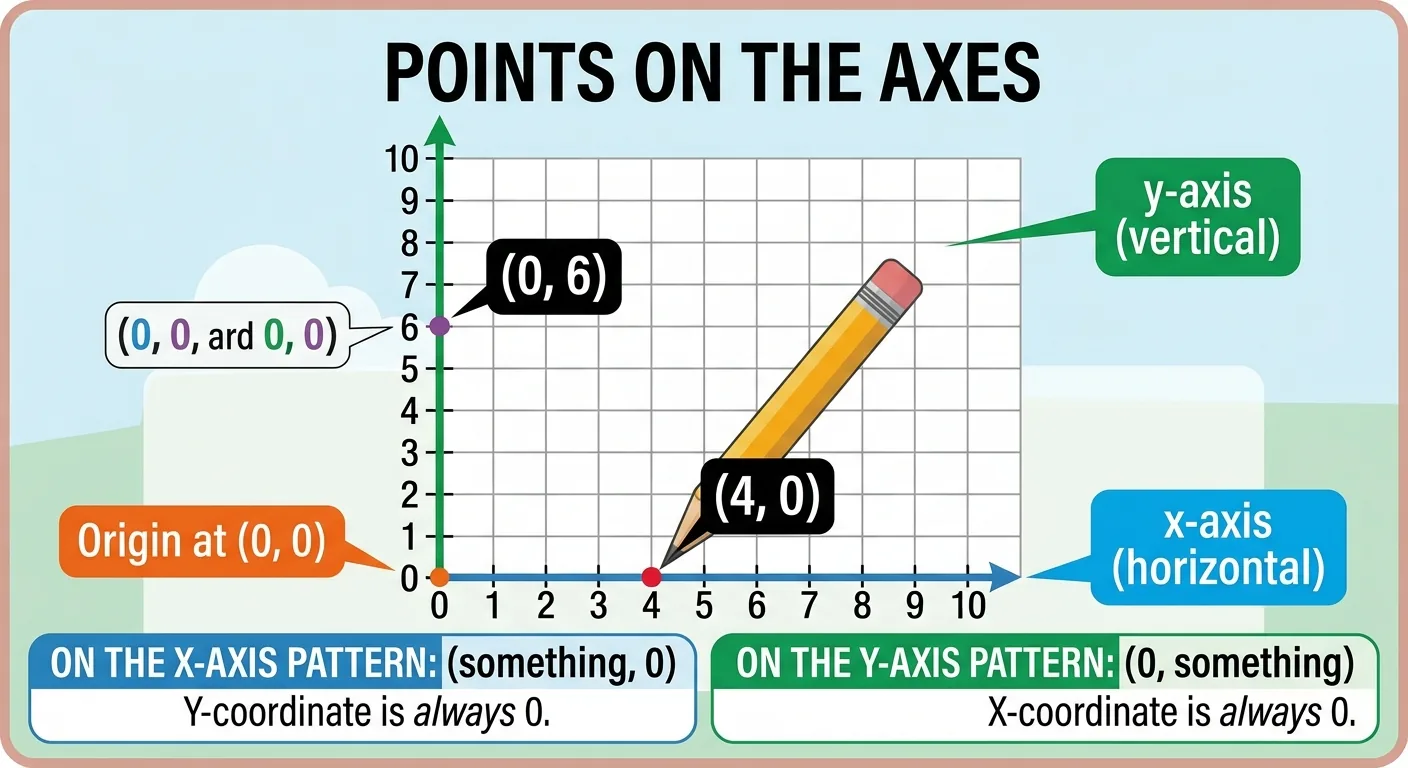
These get skipped, and then they cause trouble in Class 6. They take five minutes.
Take (4, 0). Go 4 across, then 0 up, which means don’t go up at all. The point sits on the x-axis. Any point whose y-coordinate is 0 sits on the x-axis: the pattern is (something, 0).
Take (0, 6). Go 0 across, stay where you are, then 6 up. The point sits on the y-axis. Any point whose x-coordinate is 0 sits on the y-axis: the pattern is (0, something).
(0, 0) is the origin itself, the one point sitting on both axes at once.
A useful question to ask: how is (4, 0) different from (0, 4)? One sits on the x-axis, four steps to the right. The other sits on the y-axis, four steps up. Children who can answer that one confidently have genuinely understood ordered pairs.
Drawing shapes on the coordinate plane
Once single points are easy, shapes are the natural next step and far more satisfying. Plot each vertex, then join them in order with a ruler.
A rectangle. Plot A (2, 1), B (7, 1), C (7, 5), D (2, 5) and join A–B–C–D–A. Before naming the shape, ask what your child notices about the numbers:
- A and B both have a y-coordinate of 1, so they sit at the same height. The line between them is horizontal.
- C and D both have a y-coordinate of 5, same height again, so that side is horizontal too.
- A and D share an x-coordinate of 2, so they sit directly above each other. That side is vertical.
- B and C share an x-coordinate of 7, so that side is vertical too.
That is the real lesson. Points sharing a y-coordinate lie on a horizontal line; points sharing an x-coordinate lie on a vertical line. A child who sees this can predict the shape before drawing it, useful groundwork for quadrilaterals later.
A triangle. Plot P (1, 1), Q (6, 1), R (3, 5) and join them. You get a flat base (P and Q share the y-coordinate 1) with a peak at R. Keep P and Q fixed and move R to (3, 8), then (1, 5), and watch the type of triangle change while the base stays put.
Finding side lengths from coordinates
For sides running straight across or straight up, your child needs no ruler and no formula. They need to subtract.
Horizontal sides. Side AB runs from A (2, 1) to B (7, 1). Same height, so subtract the x-coordinates: 7 − 2 = 5 units. Check it by counting squares along the line segment. Counting and subtracting agreeing is what convinces a child the subtraction is not a trick.
Vertical sides. Side AD runs from A (2, 1) to D (2, 5). Same vertical line, so subtract the y-coordinates: 5 − 1 = 4 units.
So the rectangle is 5 units wide and 4 tall, and your child can go straight on to area and perimeter using work they already know. This is where the coordinate plane stops being a separate topic and starts being a tool. One honest limit: subtraction works only for exactly horizontal or vertical sides. Slanted ones need the distance formula, which comes years later.
Where the coordinate plane shows up in real life
Children work harder at a topic they believe is real.
Maps and city grids. The numbered cross roads and sectors of a planned Indian city work exactly this way, finding “4th Cross, 2nd Main” is reading coordinates. A paper atlas does the same with grid squares labelled A1, B3, C7.
Seating plans. Cinema tickets, train reservations, exam halls. Row and seat are an ordered pair, and the order matters there too: row 12 seat 3 is not row 3 seat 12.
Cricket field positions. A fielding chart is a flat picture of the ground with players marked on it. Drawing the field on graph paper and giving each fielder coordinates is twenty highly effective minutes for a cricket-following child.
Games and screens. Chess names each square with a letter and a number. Battleship is pure coordinate plotting. Every image on a phone is a grid of pixels, each located by a pair of numbers, the grid your child is learning today is why their game knows where they tapped. And a simple table of days against glasses of water becomes a graph the moment each row is treated as an ordered pair, which is the bridge from this topic to data handling.
Going further: the four quadrants (Class 6 and beyond)
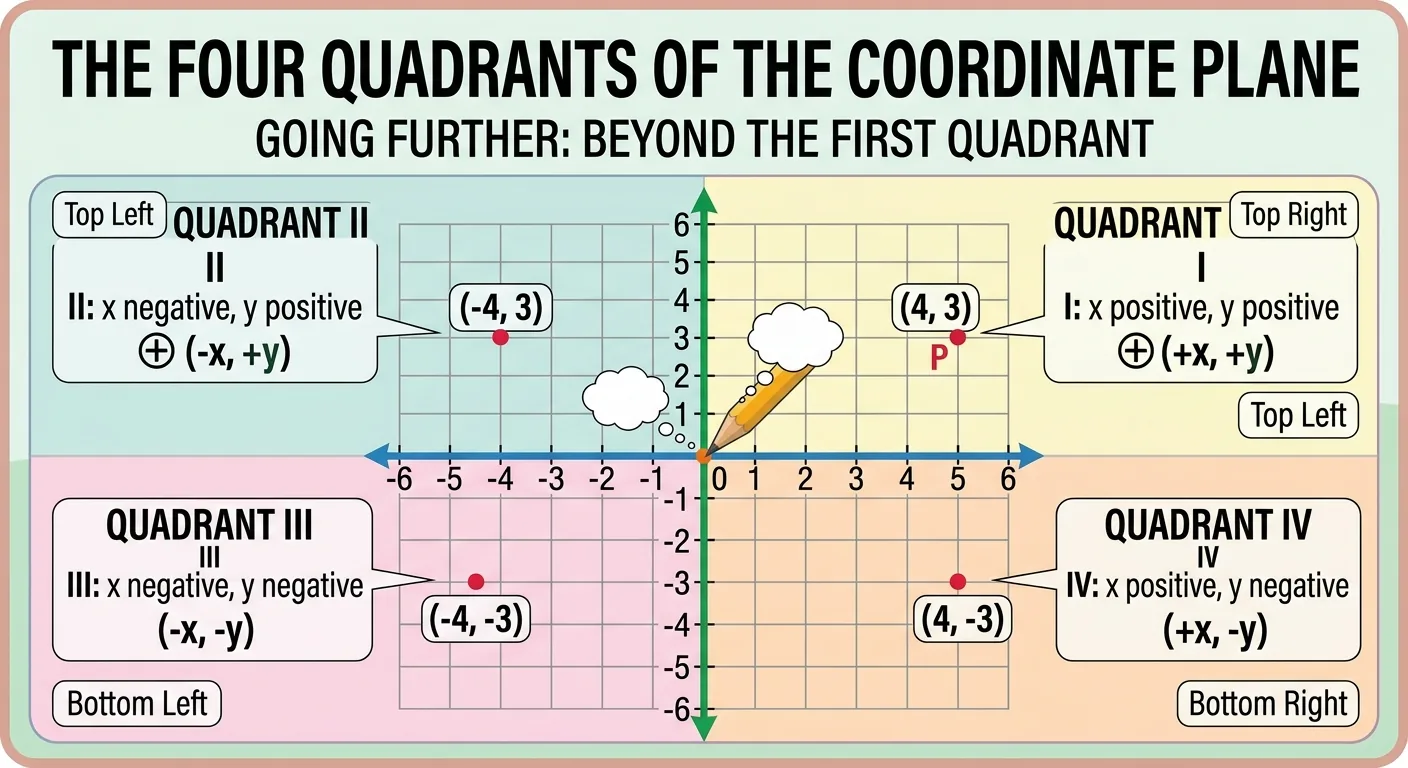
Everything so far has lived in the first quadrant. That is the Class 5 syllabus, and if your child is still counting carefully there is no hurry to go past it. Come back here in Class 6, or whenever your child asks what happens on the other side of zero.
The two axes cut the plane into four quadrants, numbered from the top right and going anticlockwise: I top right, II top left, III bottom left, IV bottom right. The axes themselves belong to no quadrant, so a point like (4, 0) sits on a boundary rather than inside a region.
The sign table
| Quadrant | Position | x-coordinate | y-coordinate | Example |
|---|---|---|---|---|
| I | Top right | Positive | Positive | (3, 4) |
| II | Top left | Negative | Positive | (−3, 4) |
| III | Bottom left | Negative | Negative | (−3, −4) |
| IV | Bottom right | Positive | Negative | (3, −4) |
Point out the pattern rather than drilling the table. The x-coordinate says left or right of the y-axis; the y-coordinate says above or below the x-axis. Work out those two and the quadrant follows automatically.
Plotting with negatives changes nothing in the method, a negative number just means move the other way. Plot E (−4, 3): 4 steps left, then 3 up, landing in Quadrant II. Plot F (−2, −5): 2 left, then 5 down, Quadrant III. Plot G (6, −1): 6 right, then 1 down, Quadrant IV.
A lift with basement levels introduces this well: floor 3 is three up, floor −2 is two below, the ground floor is 0. Reflecting a shape across an axis also connects neatly to lines of symmetry. NCERT takes coordinate geometry up formally in the later classes, with distance between points and eventually the equations of lines, none of it needed now. What your child builds here is exactly the foundation those chapters assume.
Common mistakes and how to fix them
These five account for nearly every lost mark at this level. Each one has a specific fix.
1. Swapping x and y. The child plots (3, 5) where (5, 3) belongs. Fix: return to the corridor-and-stairs picture, make them say “across first, then up” aloud while the pencil moves, and have them plot a deliberately swapped pair like (2, 6) and (6, 2) so the error happens in slow motion.
2. Not starting at the origin. They count from the page corner, or from the last point plotted. Fix: a physical rule, pencil tip touches (0, 0) before every single point, no exceptions. Fussy for a week, then automatic.
3. Counting the origin as 1. Every coordinate ends up one too far along. Fix: count the jumps between lines, not the lines. Have them tap the squares as they move. The origin is where you stand before you start, not your first step.
4. Misreading the scale. The grid counts in 2s or 5s and the child counts each square as 1. Fix: the one-question habit, what is one square worth?, before the pencil moves, then show (4, 6) plotted correctly and incorrectly on a grid counting in 2s, side by side.
5. Writing coordinates carelessly. Writing 3,5 with no brackets, or 3.5. Fix: explain what the notation is for. (3, 5) is a single address for one point; without the brackets it is two loose numbers, and a decimal point in place of the comma is something else entirely.
One broader note. When a point lands wrong, resist pointing at the right answer. Ask instead: “show me where you started, and what you did first.” Most children catch their own error within ten seconds, and a mistake caught that way is rarely repeated.
Eight activities and games to try
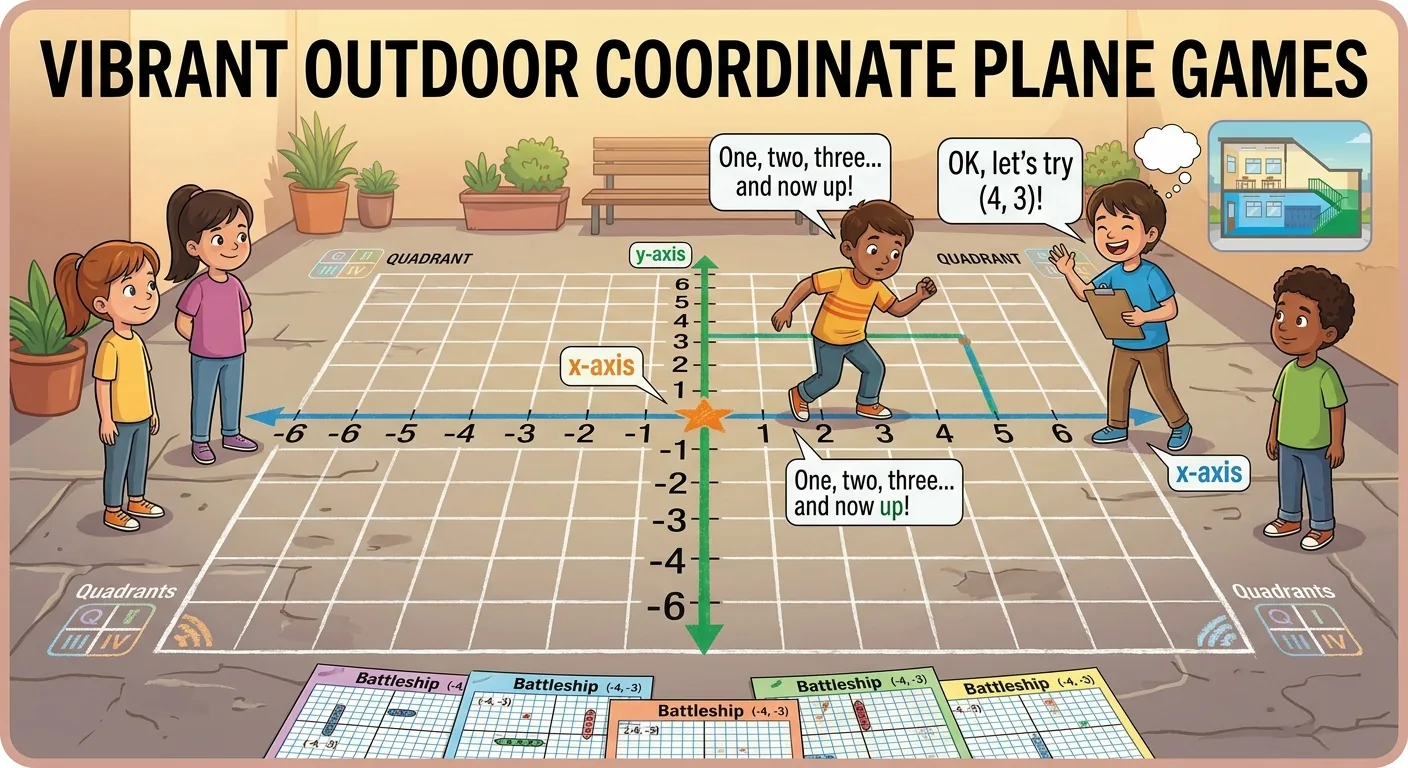
All eight need chalk, graph paper, or things already lying around the house.
1. The chalk grid on the floor. Draw an eight-by-eight grid outside, number both axes, and call out coordinates for your child to walk to. Then swap roles, and get one wrong on purpose so they have to catch you. Walking the coordinates puts “along, then up” into their body, which is why this is the most useful activity here.
2. Graph-paper battleship. Each player hides four ships on a grid and takes turns calling coordinates. Children will do a hundred coordinates in half an hour without once calling it practice.
3. Secret picture plotting. You write a list of pairs, your child plots and joins them in order to reveal a house or a rocket. Then they make one for you, writing the list is harder than following it, and that is where the learning is.
4. The human coordinate grid. Arrange chairs in rows and columns, call a pair, and whoever stands at (3, 2) sits down. Last one standing wins.
5. Coordinate treasure hunt. Draw a rough grid map of your home. Hide something small, write its location as an ordered pair, and put the next clue at the first location. Three or four hops is enough.
6. Cricket field chart. Draw the ground on graph paper with the pitch at the centre, place nine fielders, write each one’s coordinates, then rearrange the field for a different bowler.
7. Coordinate snap. Two sets of cards, one with ordered pairs, one with small grids showing a plotted point. Match pair to picture. Making the cards is itself twenty useful minutes.
8. Guess my point. You pick a point secretly; your child narrows it down with yes-or-no questions. This builds visual reasoning as much as plotting, and it scales up as they get sharper.
Tips for parents
Draw the grid together, at least once. Drawing the axes, numbering them and marking the origin teaches what each part is for. Do it properly once before switching to printed sheets.
Make them say it out loud. Children who narrate their own steps make far fewer order errors than children who work silently.
Don’t rush to the four quadrants. A child fluent in the first quadrant picks up the other three in an afternoon. A child who is shaky in the first will be lost in all four.
Ask the diagnostic question. “Where did you start, and what did you do first?” tells you whether the problem is the order, the origin or the scale, and those need different fixes.
Keep sessions short. Fifteen focused minutes with a game beats an hour of worksheets. If your child enjoys this, maths enrichment activities are a natural next step.
Tips for teachers
Start on the floor, not the board. One lesson walking a chalk grid saves three lessons of correcting swapped coordinates.
Teach reading and plotting as one skill. Students plot a point, then hand the grid to a neighbour to read the coordinates back. When the two disagree, they work out between them who erred and why.
Put the swapped pair on the board deliberately. Plot (2, 7) and (7, 2) together in the first lesson. Meeting the error as a demonstration takes the sting out of it.
Vary the scale early. Students who only ever see a scale of 1 assume it is always 1, and that assumption is expensive later.
Assess with a shape. “Plot these six points and name the shape” tells you more than twelve isolated plotting questions, and it takes less marking, useful groundwork for geometry generally.
The coordinate plane in Olympiad problems
Olympiad questions rarely ask a child to plot a point. They ask them to use the grid, which is why the fluency above matters beyond school marks.
Hidden vertices. Three corners of a rectangle are (1, 2), (6, 2) and (6, 5). Where is the fourth? A child who knows that points sharing an x-coordinate sit above each other reasons it out: the fourth shares the x of (1, 2) and the y of (6, 5), so it is (1, 5).
Paths on a grid. How many shortest routes run from (0, 0) to (3, 2) moving only right or up? This family of questions appears constantly, and it is only approachable for a child who can picture the grid confidently.
Patterns and symmetry. Plot (1, 2), (2, 4), (3, 6), (4, 8): the dots fall in a straight line, and spotting that is the first step towards everything graphing later becomes. Counting whole-number points inside a rectangle, or reflecting a shape across an axis, rewards the same picture-in-the-head.
That is the common thread: these problems reward children who can see the grid, which is built by plotting, walking and playing rather than by working faster. More on the approach in our guide to solving Olympiad problems.
Practice questions with answers
Work these on squared paper. The last two are the Class 6 extension.
- A point sits 5 across and 2 up from the origin. Write its coordinates.
- A point sits 0 across and 7 up. Write its coordinates and name the axis it sits on.
- Plot and label A (1, 4), B (4, 1), C (6, 6), D (0, 3), E (5, 0).
- Which two points in question 3 use the same digits in a different order? Which sits on the y-axis, and which on the x-axis?
- Plot P (2, 2), Q (8, 2), R (8, 6), S (2, 6), join them in order and name the shape.
- How long are PQ and QR? What is the perimeter and area of PQRS?
- Three corners of a rectangle are (1, 1), (5, 1) and (5, 4). Where is the fourth?
- Extension: in which quadrant does each point lie: (−2, 5), (3, −7), (−4, −1), (6, 2)?
- Extension: plot M (−3, 4) and N (4, −3). Are they the same point? Explain.
Answers
- (5, 2)
- (0, 7), on the y-axis, because the x-coordinate is 0.
- A is 1 across and 4 up; B is 4 across and 1 up; C is 6 across and 6 up; D sits on the y-axis, 3 up; E sits on the x-axis, 5 across.
- A (1, 4) and B (4, 1). D is on the y-axis; E is on the x-axis.
- A rectangle.
- PQ = 8 − 2 = 6 units; QR = 6 − 2 = 4 units. Perimeter = 20 units; area = 24 square units.
- (1, 4), it shares the x-coordinate of (1, 1) and the y-coordinate of (5, 4).
- Quadrant II, Quadrant IV, Quadrant III, Quadrant I.
- Different points. M is 3 left and 4 up, in Quadrant II; N is 4 right and 3 down, in Quadrant IV.
Frequently asked questions
What is a coordinate plane?
A coordinate plane is a flat grid made by two number lines crossing at right angles at zero. The horizontal line is the x-axis, the vertical line is the y-axis, and the point where they meet is the origin, (0, 0). Every point has an address written as an ordered pair, (x, y), where the first number tells you how far across and the second how far up.
How do you plot points on a coordinate plane?
Start at the origin, (0, 0). Move across by the first number along the x-axis, then up by the second number along the y-axis. Mark the spot and label it. Along first, then up.
Why does the order of the numbers matter?
Because (3, 5) and (5, 3) are different places on the grid. The first number is always the across measurement and the second the up measurement. The only pairs where swapping makes no difference are ones where both numbers are the same, like (4, 4).
What is the origin?
The origin is the point where the two axes cross, written (0, 0). It is the starting point for plotting every point on the plane, zero steps across and zero steps up.
Is a coordinate grid the same as a coordinate plane?
Yes, for practical purposes. People say coordinate grid when the gridlines are drawn in, and coordinate plane when speaking more generally. The Cartesian plane is the same thing again.
Do Class 5 students need all four quadrants?
Usually not. Class 5 work is in the first quadrant, where both coordinates are positive. The four quadrants and negative coordinates come in Class 6, and NCERT introduces the full Cartesian plane formally in the later classes.
How do I stop my child from swapping x and y?
Give them a reason rather than a rule. Along the corridor before you climb the stairs, and x comes before y in the alphabet. Then have them say “across, then up” out loud while plotting, and ask them to plot a deliberately swapped pair like (2, 6) and (6, 2) so they see the difference for themselves.
How do you find the length of a side from coordinates?
If the side is horizontal, subtract the smaller x-coordinate from the larger one; if vertical, subtract the y-coordinates. From (2, 1) to (7, 1) the length is 7 − 2 = 5 units. This works for horizontal and vertical sides only slanted ones need methods taught in later classes.
Final thoughts
The coordinate plane looks like new territory, but your child has been finding seats and houses by two numbers for years.
Keep Class 5 in the first quadrant, start every point at the origin, and let them say “across, then up” out loud until it stops needing saying. Fifteen minutes of chalk-grid walking or graph-paper battleship each week will do more than a stack of worksheets and when the four quadrants arrive in Class 6, they will already be easy.

Mikha Piregu is a Content Writer with experience spanning educational content, including math and math olympiad topics, as well as advocacy writing, research-based articles, and SEO-driven web content. He creates high-quality blog content, web copy, and feature articles that support brand visibility, audience engagement, and long-term organic growth through data-informed storytelling. Skilled in WordPress, WooCommerce, and modern digital tools, Mikha adapts content across various platforms, including blogs, websites, campaigns, and advocacy initiatives, with clarity and purpose.

There are no comments posted here yet.
Sign in to leave a comment