


A Math Olympiad is a competitive mathematical examination designed for pre-university and school students to test and build advanced problem-solving, logical reasoning, and critical thinking skills.
- What is the Math Olympiad?
- How Does the Math Olympiad Work?
- Math Olympiad Levels by Grade and Class
- Math Olympiad vs IMO vs SOF IMO: What IMO Actually Means
- What Kind of Questions Appear in a Math Olympiad?
- What is the Purpose of the Math Olympiad?
- How to Apply for a Math Olympiad
- Is the Math Olympiad Worth It for My Child?
- How to Get Started with Math Olympiad Preparation
- Frequently Asked Questions
- Key Takeaways
Top scorers advance through school, regional, national and international rounds. Olympiad maths is open to students from Grade 1 to Grade 12, called Class 1 to Class 12 in India, and the purpose of the Math Olympiad is to find and develop mathematical talent that a normal school exam cannot measure.
The names change by country. In India the ladder runs through SOF IMO at school level and IOQM at national level. In the United States it runs through the AMC series.
The structure underneath is the same everywhere, and this guide covers both routes side by side: What is Math Olympiad, what the word “Olympiad” actually refers to, how the rounds work in India and the USA, the levels available at each age, and whether it is worth your child’s time.
What is the Math Olympiad?
A Math Olympiad is a competitive examination in mathematics where students solve problems that require creative reasoning rather than routine calculation. Unlike a school test, which checks whether you have learned the syllabus, an Olympiad checks whether you can think your way through a problem you have never seen before.
The word “Olympiad” borrows from the Olympic Games, and the parallel is deliberate. There are qualifying rounds, national teams, medals, and a global final.
Here is what separates a maths Olympiad exam from a normal maths exam:
| Feature | School maths exam | Math Olympiad |
|---|---|---|
| What it tests | Whether you learned the syllabus | Whether you can solve unfamiliar problems |
| Question style | Routine, similar to homework | Novel, often with no obvious method |
| Time per question | A few minutes | Anywhere from 10 minutes to over an hour |
| Marking | Right or wrong answer | Full written proof in senior rounds |
| Who takes it | Everyone in the class | Students who opt in |
| What a good score means | You know the chapter | You have unusual mathematical ability |
Math Olympiads exist at every level. Some are designed for Grade 1 children and take 40 minutes. Others, like the International Mathematical Olympiad, give six students from each country nine hours across two days to solve six problems.
If you are choosing between competitions, our guide to the best math competitions in the world compares the major Indian, American and international ones side by side.
Math Olympiad Meaning in Simple Words
The simplest Math Olympiad meaning is this: it is a maths competition where the questions are puzzles, not sums.
In a school exam, someone has already shown you the method and you apply it. In an Olympiad, nobody has shown you the method. You have to invent it. That is the entire difference, and it is why Olympiad training looks so different from exam revision.
The term is used in a few slightly different ways depending on who is speaking:
- Broadly: any competitive maths exam, including school-level ones like SOF IMO in India or the AMC 8 in the United States
- More narrowly: the proof-based national competitions, such as RMO and INMO in India or the USAMO and USAJMO in the USA
- Most specifically: the International Mathematical Olympiad, the world championship
All three uses are correct. Context tells you which one is meant.
What Does “Olympiad” Mean in Education?
In education, an Olympiad means a structured academic competition with qualifying rounds, named after the Olympic Games. The format is the same across subjects and across countries. There is an entry round open to many students, a smaller second round for qualifiers, and in some subjects a national team that competes internationally.
So an academic Olympiad is not specific to maths. There are science, physics, chemistry, informatics and linguistics Olympiads built on the same ladder. One naming note worth knowing: in India “Olympiad” is used loosely for any school competition, including multiple-choice ones, while in the United States the word is usually reserved for the proof-based senior rounds and the earlier stages are simply called competitions or contests.
How Does the Math Olympiad Work?
A Math Olympiad works as a series of elimination rounds. Students take a first round, usually at their own school, and only the top scorers are invited to the next stage, which is harder and at senior levels requires full written proofs rather than just final answers.
India and the United States both follow that shape, but the names and the number of stages differ. Here are the two national ladders next to each other.
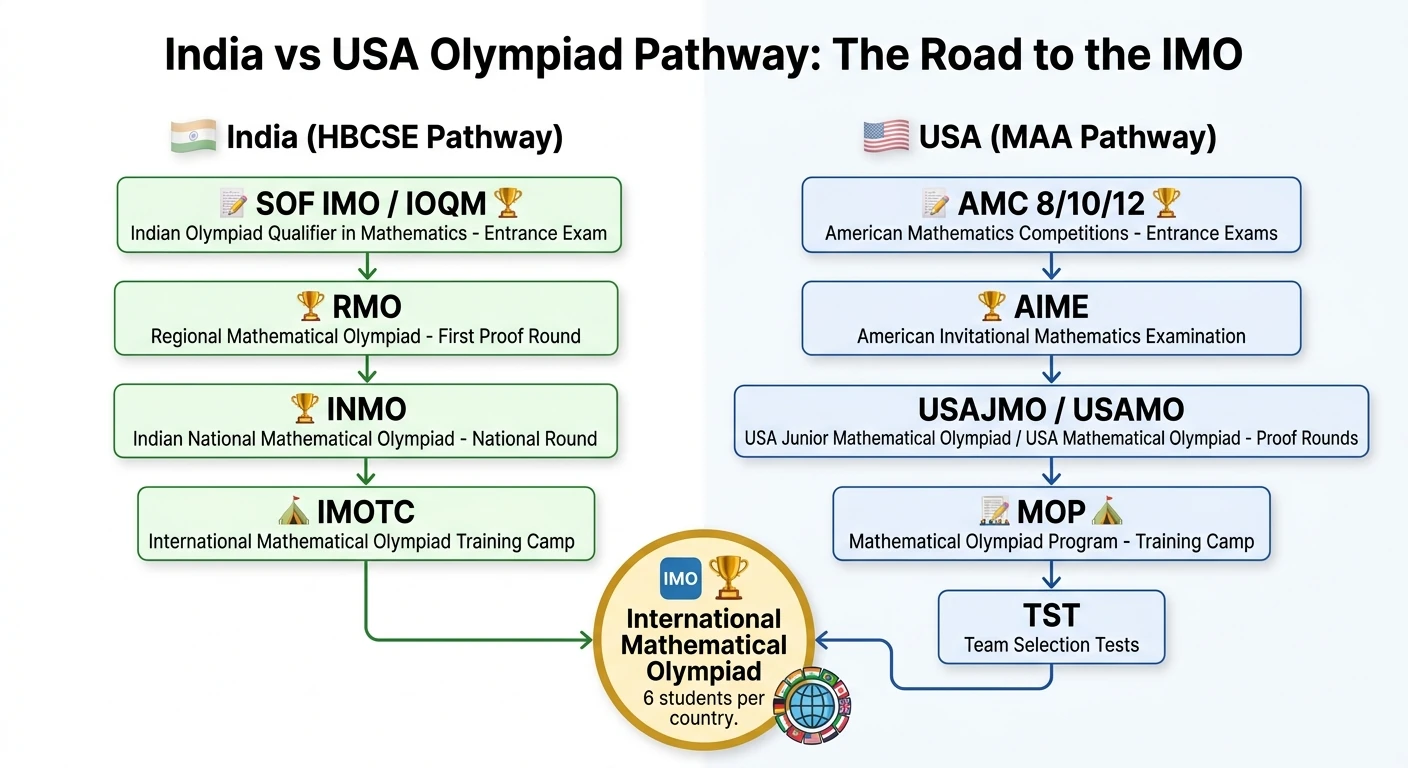
| Stage | India | United States |
|---|---|---|
| Entry round | SOF IMO Level 1 or SilverZone IOM, at school | AMC 8, then AMC 10 or AMC 12, at school |
| Second round | SOF IMO Level 2 at a centre, or IOQM for national track | AIME, by invitation to top AMC scorers |
| Proof round | RMO, then INMO | USAJMO for younger students, USAMO for seniors |
| Training camp | IMOTC | MOP (Mathematical Olympiad Program) |
| Final selection | Selection from IMOTC | Team Selection Tests after MOP |
| International final | IMO, six students | IMO, six students |
How the Math Olympiad Works in India
The Indian national pathway is run by HBCSE, and each stage filters harder than the one before it:
- IOQM (Indian Olympiad Qualifier in Mathematics): the entry point, with integer answers and no negative marking
- RMO (Regional Mathematical Olympiad): the first proof-based round
- INMO (Indian National Mathematical Olympiad): the national round
- IMOTC: the training camp for INMO awardees
- IMO: the international final
Separately from that chain, school-level Olympiads such as SOF IMO and SilverZone IOM run two levels. Level 1 is written at your own school during the school day, and top performers are invited to Level 2 at designated centres. These do not feed into the IOQM track, which is the point most parents miss.
Each stage has its own page: IOQM, IOQM syllabus, RMO, INMO, the SOF IMO exam pattern, SOF IMO Level 2 and SilverZone IOM. Dates and regional cutoffs change every cycle, so check the official HBCSE announcement for the current year before planning around them.
How the Math Olympiad Works in the USA
The American pathway is run by the Mathematical Association of America, and it also narrows at every step:
- AMC 8, AMC 10 or AMC 12: the entry round, a 25-question multiple-choice paper written at school
- AIME (American Invitational Mathematics Examination): 15 questions over three hours, each answer an integer from 0 to 999, open only to top AMC 10 and AMC 12 scorers
- USAJMO or USAMO: six proof problems across two days, roughly nine hours in total, for the top AIME performers
- MOP (Mathematical Olympiad Program): a residential summer training camp for the strongest USAMO and USAJMO students
- Team Selection Tests: a series of exams at and after MOP that decide the six-student teams for the IMO and the European Girls’ Mathematical Olympiad
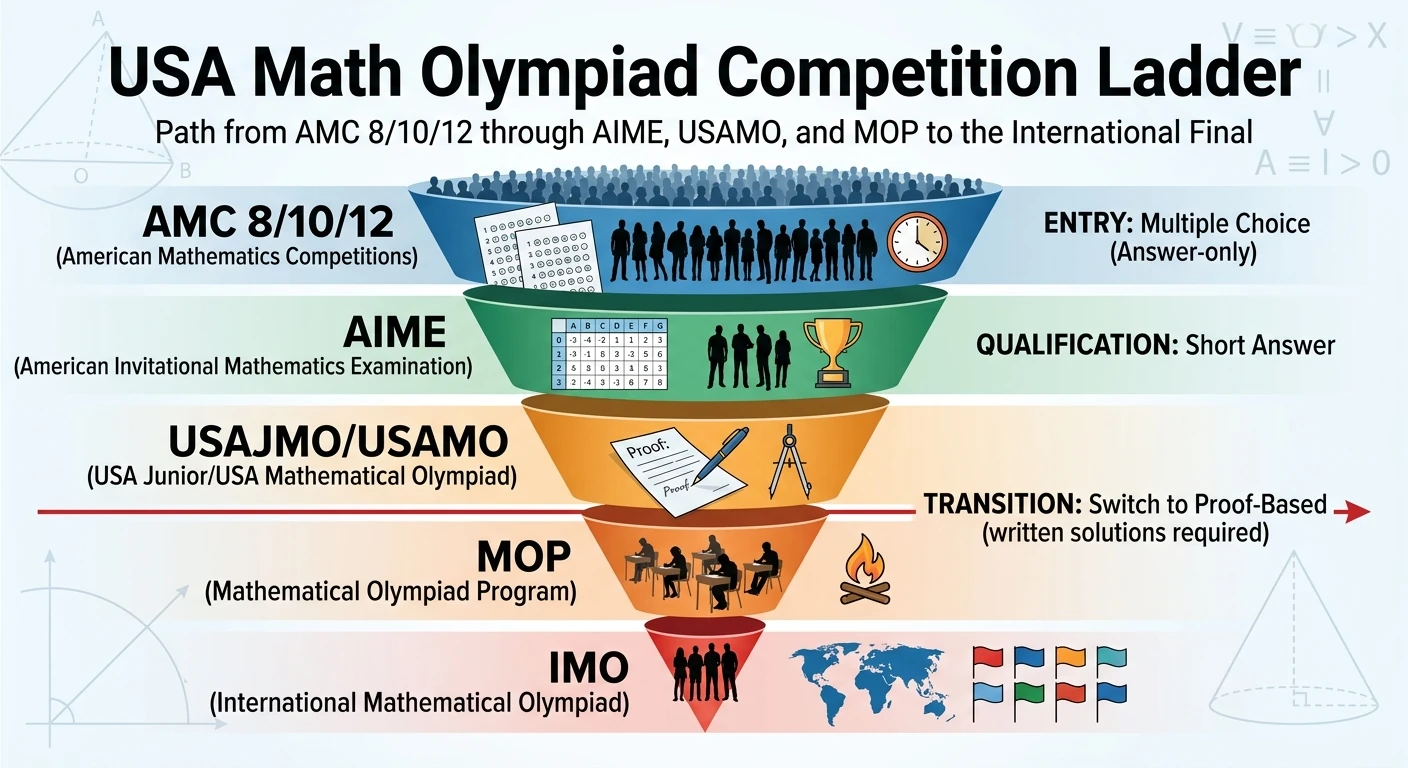
AIME qualification has historically been based on a percentage cutoff of AMC scorers rather than a fixed mark, and the MAA has not published official cutoffs for every recent year, so treat any specific number you read online as an estimate. Our guides to AMC 8 vs AMC 10, AMC 10 vs AMC 12, what is a good AMC score and AIME problems cover each stage in detail, and how to qualify for the IMO in the USA covers the full route.
American students also have a parallel entry point outside the AMC series. The USA Mathematical Talent Search is a free, untimed, proof-based round-by-round contest, and strong performance there can also lead to USAMO or USAJMO invitation.
Other Countries
Outside India and the USA the structure is the same even where the acronyms are not: a national qualifier, a national olympiad, a training camp, and then a team of six. Our guide on how to qualify for the IMO from Bangladesh covers one of the common South Asian routes, and CEMC covers the Canadian contests.
There is no single “the Math Olympiad.” There is a family of competitions, many of them completely independent of each other, and the right one depends on the student’s age, country and ambition.
Math Olympiad Levels by Grade and Class
Math Olympiad levels are grouped by age, and competitions exist from Grade 1 right through Grade 12. Picking the level that matches the student’s year matters more than picking the most prestigious name, because an Olympiad set three years above a child’s grade teaches frustration rather than reasoning.
| Stage | Grades / Classes | India | United States | What the round looks like |
|---|---|---|---|---|
| Early primary | 1 to 4 | SOF IMO, SilverZone IOM | Math Kangaroo, Noetic Learning | Multiple choice, 40 to 60 minutes, pattern and logic heavy |
| Upper primary | 5 to 6 | SOF IMO, SilverZone IOM | MOEMS, Math Kangaroo, Continental Math League | Multiple choice plus short word problems |
| Middle school | 7 to 8 | SOF IMO, SilverZone IOM | AMC 8, MATHCOUNTS | Harder multiple choice, some speed and team rounds |
| Senior school | 9 to 12 | IOQM, RMO, INMO | AMC 10 and 12, AIME, USAJMO, USAMO | Integer answers first, then full written proofs |
Younger students usually start with the junior math olympiad guide and middle schoolers with competition math for middle school. On the US side, MOEMS and MATHCOUNTS are the two most common school entry points before the AMC, and Math Kangaroo vs AMC explains which suits a younger child.
Who Can Participate in a Math Olympiad?
Almost any school student from Grade 1 to Grade 12 can take part, and no minimum score or prior qualification is needed to enter the first round. Math Olympiad is not only for high school students, which is the most common assumption parents make in both countries.
Most school-level Olympiads simply require your school to register, and in some cases parents can enrol a child directly. For the youngest students in India, how to apply for the maths olympiad for Class 1 walks through the process, and the full class-by-class rules are in the IMO exam eligibility criteria for Classes 1 to 12. In the USA, age and grade rules are set per competition, and the AMC age limit page covers the AMC series specifically.
Math Olympiad vs IMO vs SOF IMO: What IMO Actually Means
“IMO” in maths means two completely different exams, which is the single biggest source of confusion for Indian parents. The International Mathematical Olympiad is the global final for senior students. SOF IMO is a separate school-level Indian competition run by the Science Olympiad Foundation for Classes 1 to 12. They share an acronym and nothing else.
| SOF IMO (India) | International Mathematical Olympiad (IMO) | |
|---|---|---|
| Run by | Science Olympiad Foundation, India | IMO Board, hosted by a different country each year |
| Who enters | Classes 1 to 12, through their school | Six students per country, selected through national rounds |
| Format | Multiple choice, Level 1 and Level 2 | Six proof problems across two days |
| Entry route | School registration | India: IOQM, RMO, INMO, IMOTC. USA: AMC, AIME, USAMO, MOP |
| Typical age | 6 to 17 | 15 to 19 |
| What it signals | Strong school-level maths | World-class mathematical ability |
American families rarely hit the SOF IMO confusion, because SOF does not operate in the United States. The equivalent mix-up there is between the AMC and the IMO. The AMC is an entry-level multiple-choice contest taken by hundreds of thousands of students. The IMO is the six-person national team event at the very top of the same ladder. Qualifying for the AIME is a genuine achievement, but it is stage two of five, not the Olympiad itself.
Our guide to the IOQM full form explains the naming across the Indian system, and SOF IMO vs IOQM compares the two Indian tracks directly.
What Kind of Questions Appear in a Math Olympiad?
Olympiad problems draw from four main areas, and only one of them overlaps heavily with the school syllabus. This is true of the AMC and the IOQM alike, which is why training material crosses borders well even when the exams do not.
- Number theory: divisibility, remainders, prime numbers, digit patterns
- Combinatorics: counting, arrangements, pigeonhole principle, graph problems
- Geometry: angle chasing, similar triangles, circles, constructions
- Algebra: inequalities, functional equations, polynomials
At junior levels the problems look more familiar: pattern sequences, logical puzzles, simple geometry, and word problems with a twist. At senior levels they become proof-based, and a correct final answer with no reasoning earns nothing.
There is one practical difference worth knowing. American contests up to the AIME are answer-only, so speed and accuracy carry real weight. Indian school Olympiads are also answer-only, but the IOQM is closer in style to the AIME than to SOF IMO. Both systems switch to proofs at the same point: RMO in India, USAJMO and USAMO in the USA.
To see what real problems look like at each level, our collection of math olympiad questions has examples from both systems, and how to solve math olympiad problems covers the strategies that actually work.
What is the Purpose of the Math Olympiad?
The purpose of the Math Olympiad is to identify students with real mathematical ability, build their problem solving and logical reasoning skills, and keep them interested in mathematics beyond the school syllabus. A school exam can only tell you who studied. An Olympiad tells you who can think.
That purpose breaks down into a few things the competition actually does for a student, and it holds whether the child is sitting SOF IMO in Delhi or the AMC 8 in Ohio.
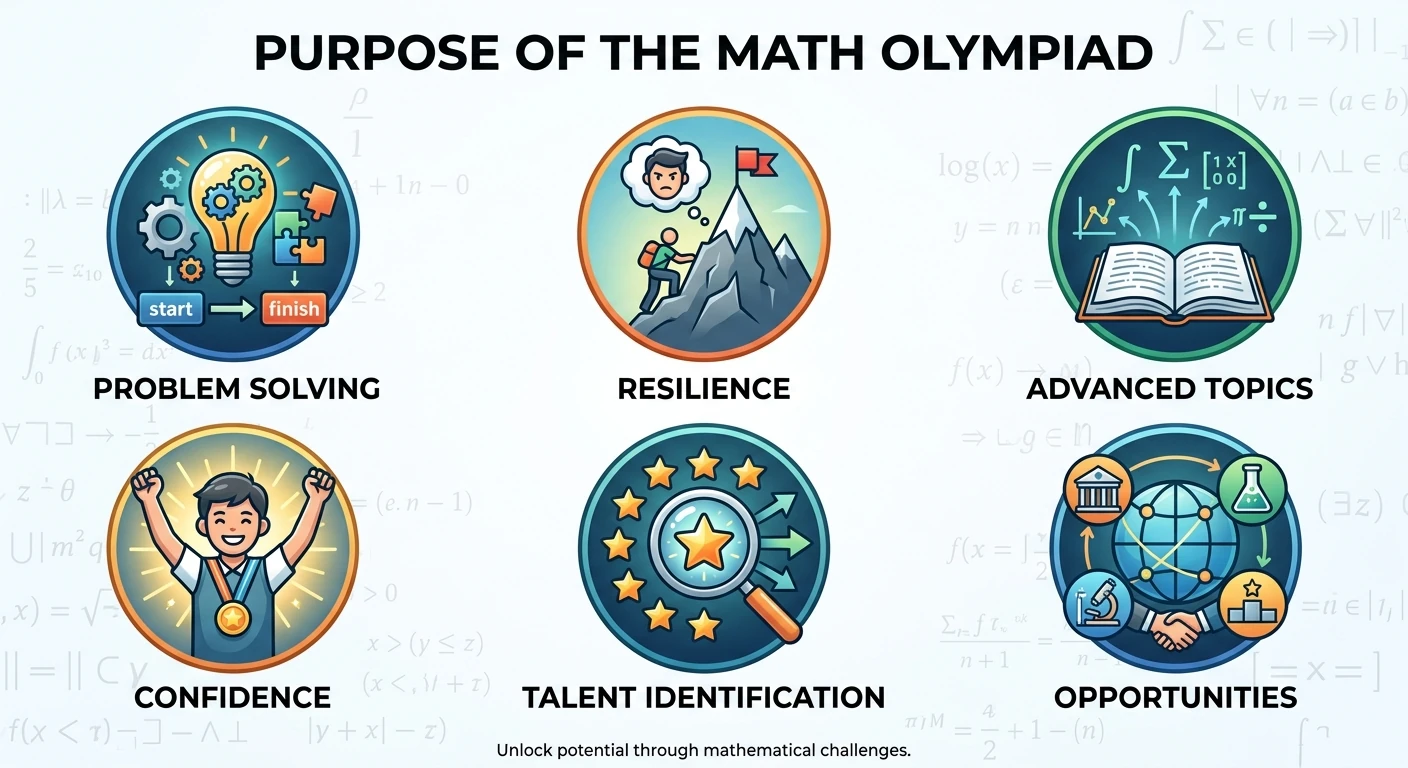
Builds Problem Solving and Logical Reasoning
Olympiad problems force students to analyse a situation, break it into manageable parts, and build a method from scratch. This is the core skill the competition exists to develop, and it transfers directly to science, engineering and everyday decision making. Our guide on how to improve problem solving skills for IMO covers the practice habits that build it fastest.
Teaches Resilience Through Hard Problems
Not every problem has an easy solution, and most students will fail to solve several in every paper. Learning to sit with a hard problem, analyse the mistake and try again is a lesson that carries well past school. Math Olympiad enhances a child’s persistence as much as their arithmetic.
Exposes Students to Advanced Mathematics Early
Olympiad maths introduces number theory, combinatorics, graph theory and advanced algebra long before either the CBSE or the US Common Core curriculum reaches them. For a student who enjoys maths, this early exposure is often what turns an interest into a direction.
Builds Confidence Through Real Achievement
Solving a genuinely hard problem alone is a confidence event that a worksheet of routine sums cannot replicate. Even students who never qualify for a second round usually come away believing they are better at maths than they thought.
Identifies and Nurtures Mathematical Talent
National bodies use Olympiads to find young talent and route it towards mentorship, training camps and scholarships. HBCSE does this through IMOTC in India, and the MAA does it through MOP in the United States. This is the original institutional reason these competitions exist.
Opens Academic and International Opportunities
Strong Olympiad results carry weight with selective universities and scholarship committees, and the top performers represent their countries on a global stage. In the USA, AIME qualification and above is a recognised signal on a college application. In India, INMO awards carry similar weight and open doors to institutions like ISI and CMI.
How to Apply for a Math Olympiad
Most Math Olympiad registration runs through the school, not the student. The school signs up with the organising body, collects a fee, and conducts the first round on campus during the school day. That is true in India and the United States alike.
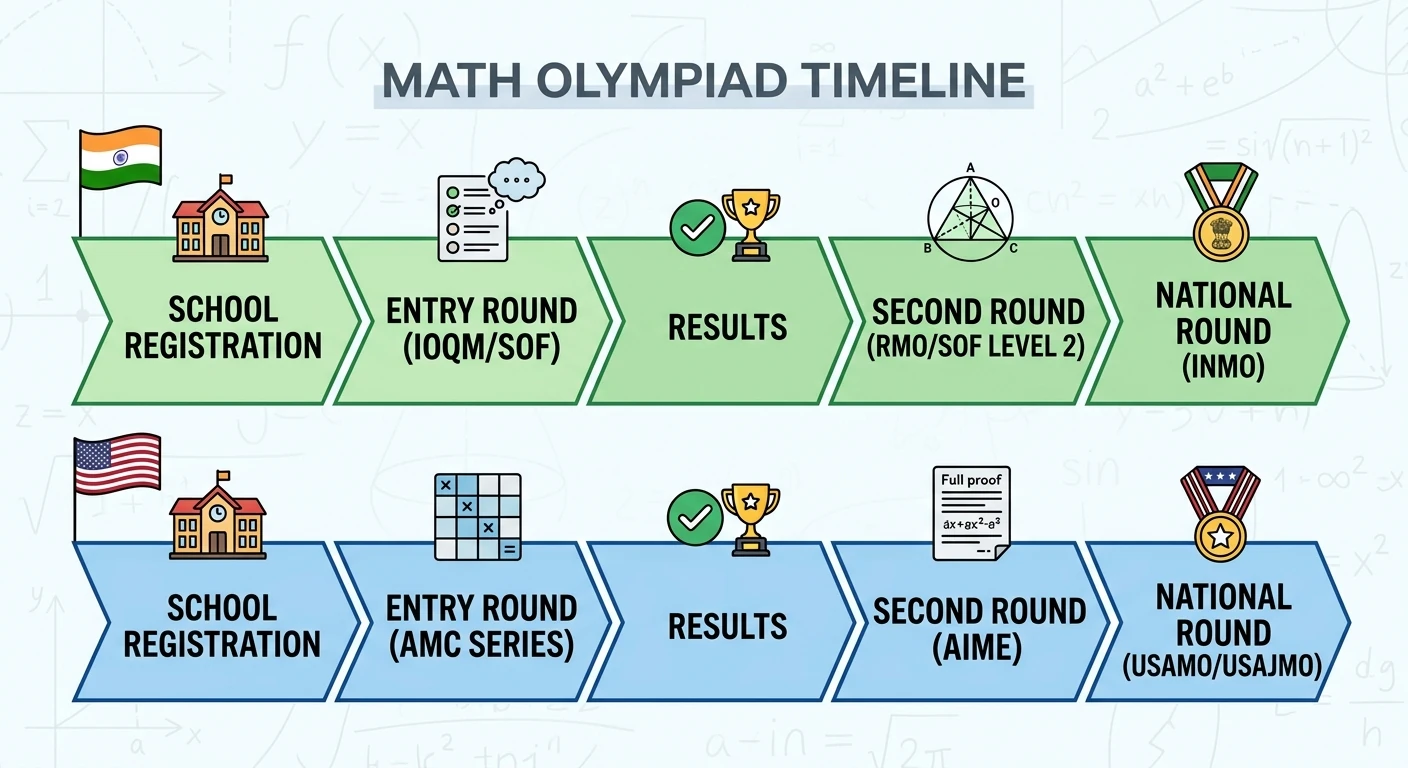
The practical steps look like this:
- Ask the school coordinator which Olympiads it registers for. SOF and SilverZone are the most common in India. In the USA it is usually MOEMS or MATHCOUNTS in middle school and the AMC from Grade 8 upwards.
- Check the grade or class eligibility for the competition you want, since each one groups students differently.
- Register before the cut-off date, which is usually a few months before the first round.
- For national rounds, register for IOQM directly through the official portal in India. In the USA, AIME invitations are automatic for qualifying AMC scorers, so there is no separate application.
- If your school does not participate, look for competitions that allow individual or home-school registration, such as Math Kangaroo registration, AMC registration at a partner test centre, or USAMTS, which is free and open to any US student.
Fees, dates and registration windows change every cycle, so confirm them on the official website of the organising body before paying. AMC test dates covers the US calendar.
Is the Math Olympiad Worth It for My Child?
For most students, yes, provided the goal is the practice rather than the medal. The reasoning skills transfer to school maths, science, and later to competitive entrance exams, whether that is the JEE in India or the SAT and AP calculus sequence in the USA, and whether or not the child ever qualifies for a second round.
It is worth being honest about the trade-offs, though.
| Consideration | The case for taking part | What to watch for |
|---|---|---|
| Skill building | Reasoning improves measurably, even for non-qualifiers | Only if the child engages; forced practice teaches little |
| Confidence | Solving a hard problem alone is a real confidence event | A poor result can dent confidence if expectations were set too high |
| Time | Two to three hours a week is enough at junior levels | Senior training competes with board exams in India and AP courses in the USA |
| Cost | School-level entry fees are usually modest | Coaching classes can be expensive and are often unnecessary |
| Academic record | Strong results help with scholarships and admissions | Participation alone carries little weight; results matter |
The most common mistake parents make is treating the Olympiad as another exam to be crammed for. It is not. A child who spends twenty minutes a week enjoying one hard problem will go further than one who works through a hundred routine sums.
If you are weighing which competition suits your child, SOF IMO vs IOQM and SOF or SilverZone compare the Indian school-level options, Math Kangaroo vs AMC compares the two most common US entry points, and math olympiad vs Math Kangaroo covers the difference in question style.
How to Get Started with Math Olympiad Preparation
Preparation has three stages, and most students skip straight to the third. The sequence is the same regardless of which country’s ladder you are on.
- Build the habit first. Set aside one problem a day. Not a worksheet, one problem, worked properly. Free resources are collected in free math olympiad training online and free AMC practice resources.
- Learn the four topic areas. Number theory, combinatorics, geometry and algebra each have their own toolkit. Working through past papers by topic beats working through them chronologically. The AMC syllabus and the SOF IMO syllabus both break the content down by level.
- Practise under time. Only once the methods are familiar. How to get full marks in maths olympiad covers exam-day technique, how to prepare for SOF IMO covers the Indian school route, and how to prepare for AMC covers the American one.
Apps help with daily reps, and the best apps for SOF IMO preparation reviews the main options honestly.
Make Preparing for Math Olympiad Simple!


Frequently Asked Questions
What is the Math Olympiad?
A Math Olympiad is a competitive mathematics exam where students solve problems requiring creative reasoning rather than memorised formulas. Top performers advance through school, regional, national and international rounds. It is open to students from Grade 1 to Grade 12, depending on the competition and country.
What is the purpose of the Math Olympiad?
To identify and develop mathematical talent, build problem solving and logical reasoning skills, and encourage genuine interest in mathematics beyond the school syllabus. For most students the real value is the reasoning practice, not the medal.
What does “Olympiad” mean in maths?
It means a structured competition with qualifying rounds, borrowed from the Olympic Games. In maths it covers everything from school-level exams like SOF IMO and the AMC 8 to the International Mathematical Olympiad. The same format exists in science, physics and informatics.
How does the Math Olympiad work?
Students take a first round, usually at their own school. Top scorers advance to later rounds, which get progressively harder and, at senior levels, require full written proofs rather than just answers. In India the chain is IOQM, RMO, INMO. In the USA it is AMC, AIME, USAMO.
What is the Math Olympiad called in the USA?
There is no single American equivalent. The ladder is the AMC 8, 10 and 12, then the AIME, then the USAJMO or USAMO, all run by the Mathematical Association of America. The USAMO is the closest thing to a national Math Olympiad, and its top performers go on to the US IMO team.
Is Math Olympiad only for high school students?
No. Competitions run from Grade 1 upwards. SOF IMO, SilverZone IOM, Math Kangaroo and MOEMS all have papers for primary students, while IOQM, RMO, INMO, AMC 10, AMC 12 and USAMO are for the senior years. The proof-based rounds are the senior ones.
How many levels does the Math Olympiad have?
It depends on the competition. School-level Olympiads like SOF IMO have two levels. The Indian national pathway has five stages: IOQM, RMO, INMO, IMOTC and the IMO. The American pathway also has five: AMC, AIME, USAMO or USAJMO, MOP and the IMO.
Is the Math Olympiad harder than school maths?
Yes, but in a different way. The topics are often simpler than senior school maths. The difficulty comes from having to find the method yourself rather than applying one you were taught.
What is the difference between the Math Olympiad and IMO?
IMO means two different things. The International Mathematical Olympiad is the global final for senior students. SOF IMO is a separate school-level Indian competition for Classes 1 to 12. Our guide to the IOQM full form explains the naming across the Indian system.
गणित ओलंपियाड क्या है?
गणित ओलंपियाड एक प्रतियोगी परीक्षा है जिसमें छात्र तार्किक सोच और समस्या समाधान कौशल से कठिन प्रश्न हल करते हैं। यह स्कूल स्तर से लेकर अंतर्राष्ट्रीय स्तर तक आयोजित होती है।
Does the Math Olympiad help with college admissions?
Strong results do. AIME qualification and above is a recognised signal for US universities, and INMO awards carry similar weight in India. Mere participation carries very little in either country.
What topics come in a Math Olympiad?
Number theory, combinatorics, geometry and algebra. Junior levels also include pattern recognition and logical puzzles.
Key Takeaways
- A Math Olympiad is a competitive maths exam built around unfamiliar problems, not syllabus recall, which is why Olympiad maths feels so different from school maths.
- The purpose of the Math Olympiad is to find mathematical talent and build problem solving and logical reasoning skills that school exams cannot measure.
- Math Olympiad levels run from Grade 1 to Grade 12, so the competition is not only for high school students.
- India’s route runs SOF IMO at school level and IOQM, RMO, INMO, IMOTC for the national track. The US route runs AMC, AIME, USAMO or USAJMO, then MOP.
- IMO means two different exams in India: SOF IMO for Classes 1 to 12, and the International Mathematical Olympiad for the global final. In the USA the common mix-up is between the AMC and the IMO.
- One hard problem a day beats a hundred routine sums, and the reasoning practice pays off whether or not the child qualifies for a second round.
If you are ready to take the next step, start with how to prepare for the IMO or browse math olympiad questions to see what the problems actually look like.

Contributor at Gonit Worksheets, writing about math learning that works for real kids.



There are no comments posted here yet.
Sign in to leave a comment