


To compare two decimals, compare the whole number parts first, then the digits after the decimal point one place at a time: tenths, then hundredths, then thousandths. Stop at the first place where the digits differ.
- Decimal Place Value in One Chart
- How to Compare Two Decimals, Step by Step
- When Two Decimals Are Equal: Trailing Zeros
- Evening Up the Decimal Places
- Checking on a Number Line: Is 0.5 Greater Than 0.45?
- Why Comparing Decimals Is Harder Than It Looks
- Which Mistake Is Your Child Making? A Four-Pair Check
- Common Mistakes When Comparing Decimals
- Comparing Decimals in Real Life
- Ordering Decimals From Least to Greatest
- Where Comparing Decimals Sits by Grade
- Try This at Home: Decimal Showdown
- Practice Questions: Comparing Decimals
- Decimals in Early Competition Problems
- Conclusion
The decimal with the larger digit in that place is greater. More digits does not mean bigger: 0.5 is greater than 0.45. Zeros added at the end change nothing, so 0.5 equals 0.50.
Written for parents and teachers of Grade 4 and Grade 5 students (Class 4 and Class 5) who keep choosing the wrong decimal and are sure they are right.
Decimal Place Value in One Chart
A decimal is a number with a decimal point, where the digits to the right of the point stand for parts of one whole. The first place after the point is tenths, the second is hundredths and the third is thousandths. Each place is worth one tenth of the place to its left, so 1 tenth is 10 hundredths.
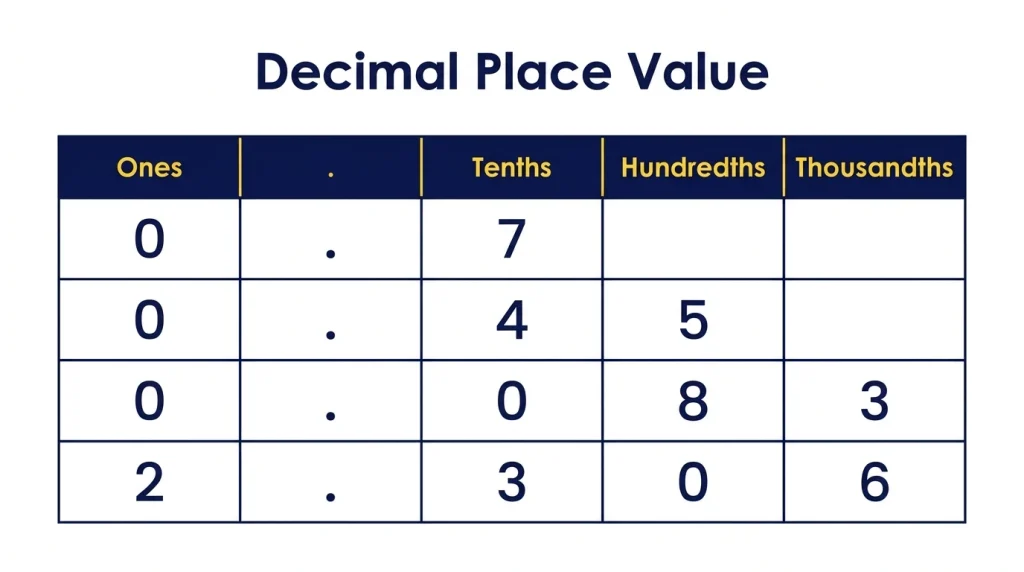
| Number | Ones | Tenths | Hundredths | Thousandths | Say it as |
|---|---|---|---|---|---|
| 0.7 | 0 | 7 | 7 tenths | ||
| 0.45 | 0 | 4 | 5 | 45 hundredths | |
| 0.083 | 0 | 0 | 8 | 3 | 83 thousandths |
| 2.306 | 2 | 3 | 0 | 6 | 2 and 306 thousandths |
Always write a zero before the point when there is no whole number: 0.45, never .45. The leading zero shows at a glance that the number is less than 1.
How to Compare Two Decimals, Step by Step
Comparing decimals means deciding whether one decimal is greater than (>), less than (<) or equal to (=) another. The open side of the symbol faces the larger number, so 0.7 > 0.45 reads “0.7 is greater than 0.45”.
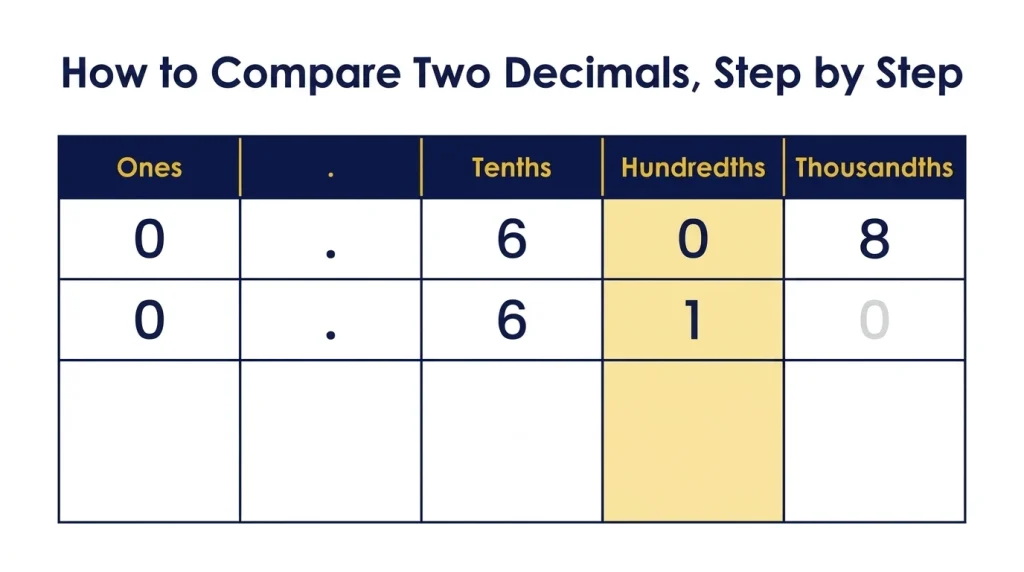
The method mirrors comparing large numbers on a place value chart, with one change: for whole numbers more digits means bigger, and after the point it does not.
- Write the two numbers one under the other, with the decimal points lined up.
- Compare the whole number parts. If they differ, the larger one wins and you can stop.
- If the whole number parts match, compare the tenths digits.
- If the tenths match, compare the hundredths, then the thousandths.
- Count an empty place as 0.
- Stop at the first place where the digits differ. The larger digit belongs to the larger number.
- Write the result with >, < or =.
Try it: Which is greater, 0.608 or 0.61?
Both have 0 ones. Then compare the tenths: both have 6 tenths. Then compare the hundredths: 0 hundredths against 1 hundredth. 1 hundredth beats 0 hundredths, so the 8 thousandths never get a say.
0.608 < 0.61. The shorter number is the greater one.
When Two Decimals Are Equal: Trailing Zeros
Two decimals are equal when every place holds the same digit, counting empty places as zeros. A trailing zero is a zero at the far right of the digits after the point, and trailing zeros never change a value: 0.5 = 0.50 = 0.500. A zero straight after the point is different, so 0.05 is not 0.5.
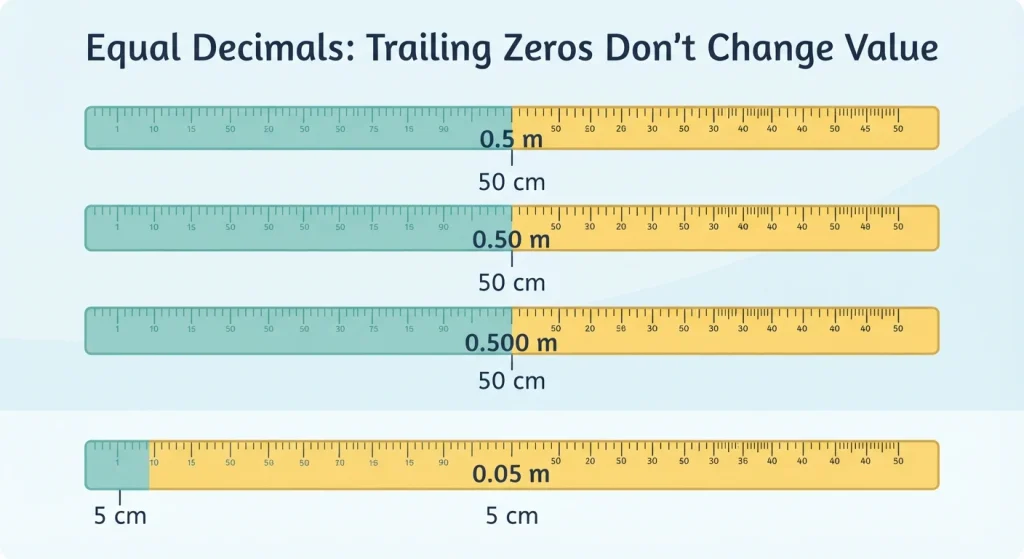
Why a zero at the end changes nothing
0.5 means 5 tenths. 0.50 means 5 tenths and 0 hundredths. Adding zero hundredths adds nothing, the way 5 apples and 0 oranges is still 5 apples. The same idea sits behind equivalent fractions: 5/10 and 50/100 name one amount.
Why a zero after the point changes the value
In 0.05, the zero fills the tenths place and pushes the 5 into the hundredths place. So 0.05 is 5 hundredths, while 0.5 is 5 tenths, or 50 hundredths. 0.5 is ten times as large: 0.5 m is 50 cm and 0.05 m is 5 cm. A zero between the point and another digit holds a place open, so 0.305 is not 0.35.
The trailing zero rule works only after the decimal point. Put a zero on the end of a whole number and it changes completely: 5 and 50 are very different numbers.
[CTA BLOCK: mid-article app install]
Suggested copy: Comparing decimals sticks with short, regular practice. The Gonit app gives a hint before your child answers and a full explanation after a wrong one. Free on iOS and Android.
Evening Up the Decimal Places
Evening up means adding trailing zeros so both decimals have the same number of decimal places, then comparing. To compare 0.5 and 0.45, write 0.5 as 0.50. Now both count hundredths: 50 hundredths against 45 hundredths, so 0.5 > 0.45.
Evening up works only because trailing zeros leave the value unchanged, so the zeros always go at the right-hand end. For thousandths, even up to three places: 0.7 and 0.693 become 0.700 and 0.693, which is 700 thousandths against 693 thousandths, so 0.7 > 0.693.
[IMAGE: Two hundredths grids side by side, the left with 50 of 100 squares shaded and labelled 0.5 = 0.50, the right with 45 of 100 squares shaded and labelled 0.45. Alt text: Hundredths grids showing 50 shaded squares for 0.5 and 45 shaded squares for 0.45]
Evening up feels like finding a common denominator because every decimal is also a fraction over 10, 100 or 1000. Your child does not need fractions to compare decimals, but each decimal place already names its denominator, as our guide to converting a decimal to a fraction shows.
Checking on a Number Line: Is 0.5 Greater Than 0.45?
On a number line, the number further to the right is greater. To check 0.45 and 0.5, draw a line from 0.4 to 0.5 and split it into ten equal steps of one hundredth: 0.41, 0.42 and so on, up to 0.50.
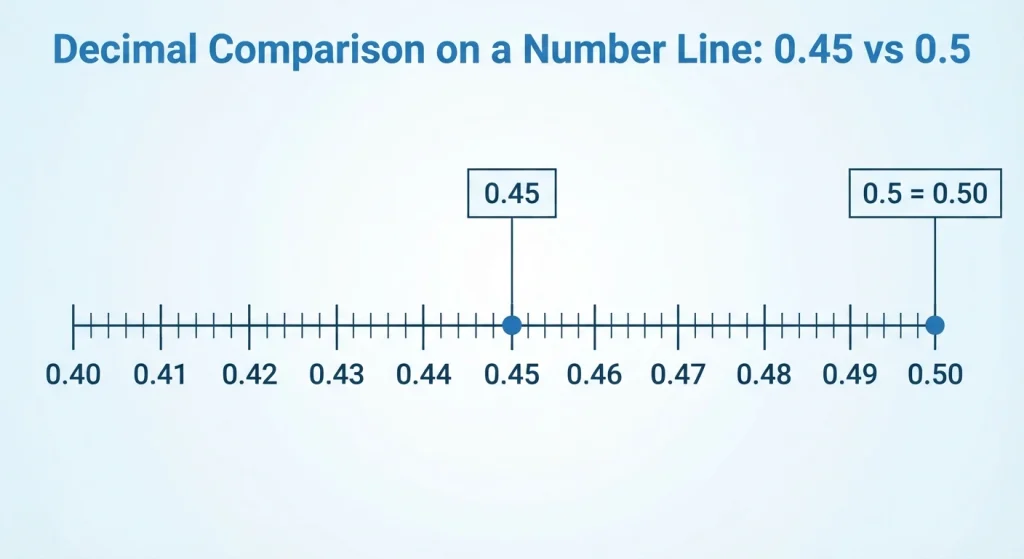
0.45 sits at the fifth step, halfway along. 0.5 is the same point as 0.50, the right-hand end. 0.5 is further right, so 0.5 > 0.45.
Why Comparing Decimals Is Harder Than It Looks
Children get decimal comparisons wrong because a rule that served them for years, longer numbers are bigger, stops working after the point. The errors are predictable and very common at this age. They come from reasoning, not carelessness, which is why a child defends a wrong answer so firmly.
The most detailed research is the Teaching and Learning About Decimals project at the University of Melbourne. Kaye Stacey, Vicki Steinle and colleagues tested over 3,000 students in Years 4 to 10 at 12 schools in Victoria, Australia, between 1995 and 1999, and named each consistent pattern of wrong answers. Australian Year 4 children are about 9 to 10 years old.
[IMAGE: Three thought bubbles above a child’s desk, each holding one wrong comparison crossed out in red (0.45 bigger than 0.7, 0.4 bigger than 0.83, 0.35 bigger than 0.7) with the correct statement written underneath. Alt text: Three common decimal comparison errors drawn as a child’s thoughts, each crossed out and corrected]
Whole number thinking: 0.45 looks bigger than 0.7
A whole number thinker reads the digits after the point as an ordinary number. 45 is bigger than 7, so 0.45 must be bigger than 0.7. In the project’s sample, about 35% of Year 4 students thought this way, falling to about 3% by Year 10.
Tenths beat hundredths: 0.4 looks bigger than 0.83
A denominator focussed thinker knows one tenth is bigger than one hundredth, then stretches the idea too far: any number of tenths must beat any number of hundredths. So 0.4 looks bigger than 0.83. The project found this in about 4% of students in Years 5 and 6.
Right only when a zero follows the point
Some children choose the longer decimal almost every time, yet get 0.07 against 0.5 right. The project calls the main version column overflow thinking: the child reads 0.35 as 35 tenths, squeezing two digits into one column, so 0.35 beats 0.7. But 0.07 reads as 7 hundredths, which feels small, so 0.5 wins. Being right often hides the error. About 5% of students in Years 4 and 5 showed this pattern.
All three children need the same habit: say each decimal as tenths, hundredths or thousandths, then compare like units with like.
Which Mistake Is Your Child Making? A Four-Pair Check
Ask your child to circle the larger number in each pair, or write “same”. Don’t correct anything until all four are done, then match the answers to the second table.
| Pair | Correct answer | Common wrong answer | What the wrong answer reveals |
|---|---|---|---|
| A: 0.7 or 0.45 | 0.7 | 0.45 | Reading 45 as a whole number, or squeezing 45 into the tenths column |
| B: 0.07 or 0.5 | 0.5 | 0.07 | Whole number thinking: 7 beats 5 |
| C: 0.4 or 0.83 | 0.83 | 0.4 | Tenths always beat hundredths |
| D: 0.5 or 0.50 | Same | 0.50, or 0.5 | 0.50: longer means bigger. 0.5: shorter means bigger |
| Your child’s answers | Likely thinking | What to try next |
|---|---|---|
| All four right | Secure | Thousandths pairs, then the practice set below |
| A wrong, B wrong, C right, D picks 0.50 | Whole number thinking | Say both in hundredths: 70 hundredths against 45 hundredths |
| A wrong, B right, C right, D picks 0.50 | Column overflow thinking | Rebuild each number on a place value chart, one digit per column |
| A right, B right, C wrong, D picks 0.5 | Tenths beat hundredths | Even up to 0.40 and 0.83, then shade both on hundredths grids |
| No clear pattern | Guessing, or thinking that is changing | Ask “how did you decide?” pair by pair |
Four pairs make a quick check, not a formal diagnosis. A child whose thinking is shifting may fit no row.
Common Mistakes When Comparing Decimals
Mistake 1: Reading the decimal part as a whole number, so 0.45 looks bigger than 0.7. Fix: Say both in the same unit. 0.7 is 70 hundredths and 0.45 is 45 hundredths, so 0.7 is greater.
Mistake 2: Ignoring the whole number part, so 1.89 looks bigger than 2.3 because 89 > 3. Fix: Compare the ones first. 2 ones beats 1 one, so 2.3 > 1.89.
Mistake 3: Assuming more digits means larger, so 0.125 looks bigger than 0.25. Fix: Start at the tenths. 2 tenths beats 1 tenth, so 0.25 > 0.125.
Mistake 4: Assuming 0.5 and 0.05 are the same. Fix: Put both on a place value chart. The 5 in 0.5 is in the tenths column and the 5 in 0.05 is in the hundredths column, so 0.5 is ten times as large.
Mistake 5: Turning the symbol the wrong way round. Fix: Decide which number is greater first, point the narrow end at the smaller number, then read the statement aloud.
Comparing Decimals in Real Life
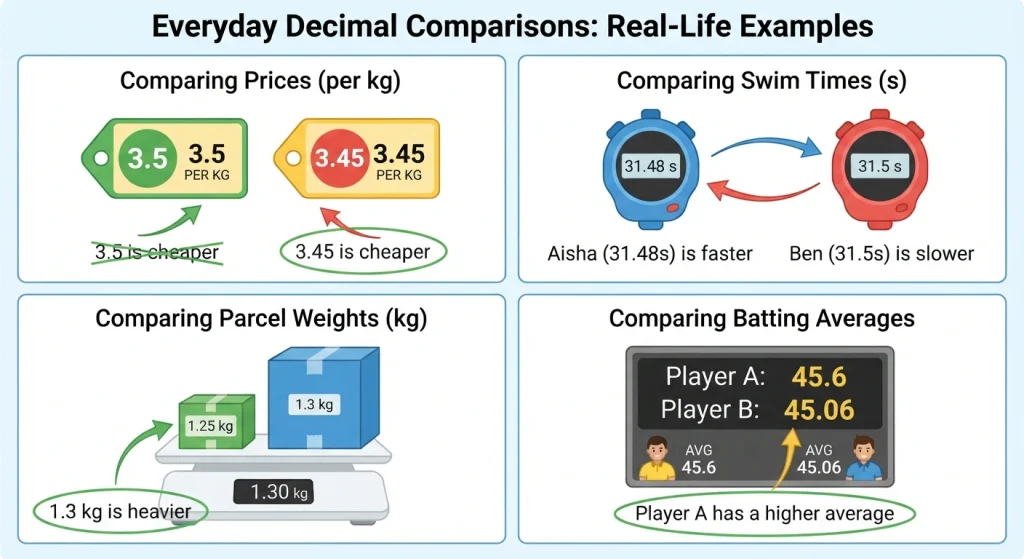
Decimals appear wherever something is priced, timed or measured, and the method never changes. Prices compare the same way in any currency.
Two price tags
One stall sells mangoes at 3.5 per kg and the stall opposite charges 3.45 per kg. Both have 3 ones. Then compare the tenths: 5 tenths beats 4 tenths. So 3.5 > 3.45, and the stall charging 3.45 per kg is cheaper.
Two swim times
In a 50 m race, Aisha finishes in 31.48 s and Ben in 31.5 s. Both have 31 whole seconds. Then compare the tenths: 4 tenths against 5 tenths. So 31.48 < 31.5. The smaller time wins, so Aisha is faster.
Two parcels
One parcel weighs 1.25 kg and another 1.3 kg. Both have 1 whole kilogram. Then compare the tenths: 2 tenths against 3 tenths. So 1.3 > 1.25, and the 1.3 kg parcel is heavier, though 1.25 has more digits.
Two batting averages
A cricket batting average is runs scored per dismissal. Player A averages 45.6 and Player B 45.06. Both have 45 whole runs. Then compare the tenths: 6 tenths against 0 tenths. So 45.6 > 45.06, and Player A has the higher average. A whole number thinker reads 6 and 06 as equal.
Ordering Decimals From Least to Greatest
Ordering arranges three or more decimals by size, and least to greatest means smallest first. Even up every number to the same number of places, then compare.
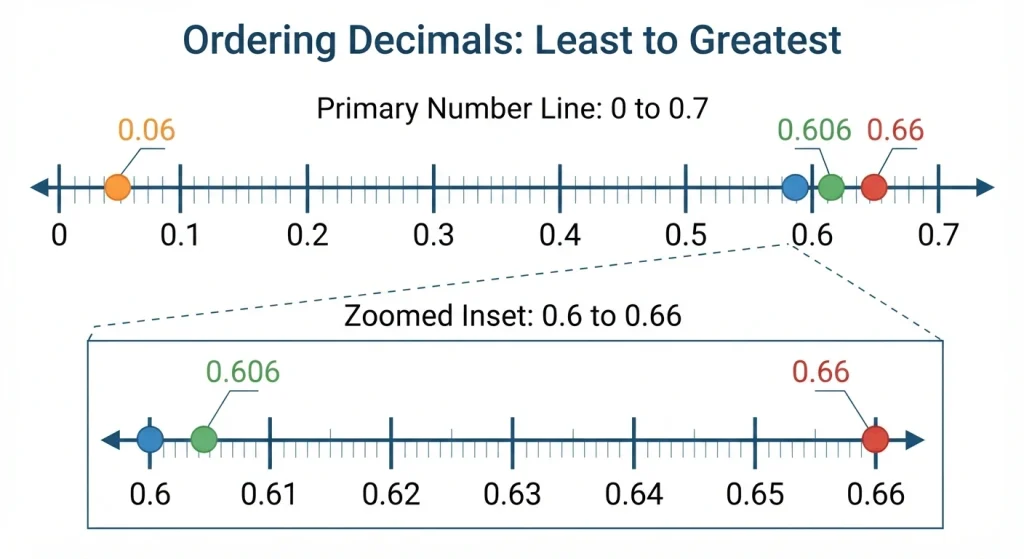
Order 0.6, 0.06, 0.66 and 0.606 from least to greatest.
- Even up to thousandths: 0.600, 0.060, 0.660 and 0.606.
- Compare the tenths. Only 0.060 has 0 tenths, so 0.06 is the smallest.
- Compare the hundredths of the rest: 0, 6 and 0. So 0.66 is the largest.
- Compare the thousandths of 0.600 and 0.606: 0 against 6. So 0.6 comes first.
0.06 < 0.6 < 0.606 < 0.66
Where Comparing Decimals Sits by Grade
Comparing decimals is typically taught to hundredths in Grade 4 and to thousandths in Grade 5 in the US, and later in some other curricula. Schools vary.
| Curriculum | Where it typically appears | Scope |
|---|---|---|
| Common Core (US) | Grade 4, standard 4.NF.C.7 | Two decimals to hundredths, recorded with >, = or <, justified with a model |
| Common Core (US) | Grade 5, standard 5.NBT.A.3b | Two decimals to thousandths, using what each digit is worth |
| NCERT (India) | Class 7, Ganita Prakash Part 1, Chapter 3 | Current textbooks. Older NCERT books taught it in Class 6 |
| NCTB (Bangladesh) | Class 5, Elementary Mathematics | The edition we checked compares decimal fractions. The primary curriculum is under revision |
Standard 4.NF.C.7 also says a comparison only makes sense when both decimals refer to the same whole: 0.5 of a small pizza is not necessarily more than 0.45 of a large one.
Decimal arithmetic comes after comparison, in our guides on multiplying decimals and dividing decimals step by step. It returns in percentages, since 45% is 0.45, as in finding a percent of a number.
Try This at Home: Decimal Showdown
Decimal Showdown is a ten-minute card game for two players.
Materials: a deck of playing cards without picture cards (aces count as 1, tens count as 0), two paper strips each marked 0 . ☐ ☐, and a pencil.
- Each player draws two cards and lays them in order: first card in the tenths box, second in the hundredths box.
- Each player reads their number aloud: “zero point four five, that’s 4 tenths and 5 hundredths.”
- The larger decimal wins all four cards. Equal decimals are a tie.
- After five rounds, draw both cards first, then choose which box each goes in.
The point: reading aloud attaches a place value name to every digit, the step whole number thinking skips. The choosing rounds raise a good question: why does the bigger card belong in the tenths box? For Grade 5, add a thousandths box.
Practice Questions: Comparing Decimals
Fill each blank with >, < or =. Most questions are built to catch one specific mistake.
- 0.6 ___ 0.4
- 0.3 ___ 0.30
- 0.8 ___ 0.65
- 1.2 ___ 0.95
- 0.09 ___ 0.1
- 0.5 ___ 0.72
- 3.08 ___ 3.8
- Put in order from least to greatest: 2.05, 2.5, 2.055, 2.505
Answers
- 0.6 > 0.4. Both have 0 ones. 6 tenths beats 4 tenths.
- 0.3 = 0.30. 0.30 is 3 tenths and 0 hundredths. Catches “longer is larger”.
- 0.8 > 0.65. 8 tenths beats 6 tenths. Catches whole number thinking, which sees 65 > 8.
- 1.2 > 0.95. 1 one beats 0 ones, so the digits after the point never matter. Catches ignoring the whole number part.
- 0.09 < 0.1. Both have 0 ones. 0 tenths against 1 tenth. Catches whole number thinking, which sees 9 > 1.
- 0.5 < 0.72. 5 tenths against 7 tenths. Catches “tenths beat hundredths”, which picks the shorter 0.5.
- 3.08 < 3.8. Both have 3 ones. 0 tenths against 8 tenths. Catches treating 0.08 as if it were 0.8.
- 2.05 < 2.055 < 2.5 < 2.505. Even up to 2.050, 2.500, 2.055 and 2.505. The tenths (0, 5, 0, 5) put 2.050 and 2.055 first. In each pair, the thousandths (0 against 5) decide the order.
Decimals in Early Competition Problems
Competition problems test the same comparison, with the wrong choices set as traps for longer-is-larger thinking.
A 1989 problem from the AJHSME, the contest now called the AMC 8, asked which of 0.99, 0.9099, 0.9, 0.909 and 0.9009 is largest.
Even up to four places: 0.9900, 0.9099, 0.9000, 0.9090 and 0.9009. All five have 9 tenths. In the hundredths, only 0.9900 has a 9. 0.99 is the largest, though it is one of the shortest.
A 1990 AJHSME problem asked which digit of 0.12345, changed to a 9, gives the largest number. Changing the tenths digit gives 0.92345. Any other change leaves 1 tenth, keeping the number below 0.2. The answer is the first digit after the point.
A warm-up in the same spirit, written by Gonit: using 3, 0 and 7 once each, make the smallest and largest decimals of the form 0. The smallest puts 0 in the tenths place: 0.037. The largest puts 7 there: 0.730, which equals 0.73.
Deciding by place value instead of length is a habit our guide on how to solve math olympiad problems builds on. The AMC syllabus shows where the AMC 8 fits, and math olympiad questions has more samples by grade.
Make Preparing for Math Olympiad Simple!


Is 0.5 greater than 0.45?
Yes, 0.5 is greater than 0.45. Both have 0 ones, and 0.5 has 5 tenths while 0.45 has only 4 tenths, so the tenths place settles it. Writing 0.5 as 0.50 shows the same thing: 50 hundredths against 45 hundredths.
Which is bigger, 0.5 or 0.05?
0.5 is bigger. 0.5 is 5 tenths and 0.05 is 5 hundredths, so 0.5 is ten times as large. The zero straight after the point in 0.05 moves the 5 one place to the right.
Is 0.5 the same as 0.50?
Yes, 0.5 and 0.50 are equal. 0.50 means 5 tenths and 0 hundredths, and zero hundredths adds nothing. Zeros at the right-hand end, after the decimal point, never change a value.
Is a decimal with more digits always bigger?
No. 0.7 is greater than 0.6999, because the tenths are compared first and 7 tenths beats 6 tenths. The number of digits shows how precisely a number is written, not how large it is.
Why does my child say 0.45 is bigger than 0.7?
Your child is most likely reading the digits after the point as a whole number, so 45 beats 7. Researchers call this whole number thinking, and it is one of the most common decimal errors at this age. Asking your child to say both numbers in hundredths, 45 hundredths and 70 hundredths, usually brings the problem into the open.
What grade learns comparing decimals?
Under the US Common Core, children compare decimals to hundredths in Grade 4 and to thousandths in Grade 5. Current Indian NCERT textbooks teach it in Class 7, and the Bangladesh NCTB Elementary Mathematics book includes it in Class 5. Individual schools often move it earlier or later.
What is the difference between comparing and ordering decimals?
Comparing looks at two decimals and decides which is greater, or whether they are equal. Ordering arranges three or more decimals from least to greatest, or greatest to least, by repeating the same comparison.
Can you compare decimals by changing them into fractions?
Yes, though your child rarely needs to. Every decimal is a fraction over 10, 100 or 1000, so 0.45 is 45/100 and 0.5 is 50/100. Lining up the decimal points gives the same answer faster.
Should my child write 0.5 or .5?
Write 0.5. The leading zero shows at once that the number is less than 1, and it makes the decimal point hard to miss. A missed point turns .5 into 5, which is ten times too big.
Conclusion
Comparing decimals comes down to one habit: line up the points and let place value decide, never length. A child who says each decimal as tenths, hundredths or thousandths will rarely be fooled by 0.45 and 0.7 again.
Three quick checks tell you where your child stands. Can they explain why 0.5 is greater than 0.45? Do they know that 0.5 and 0.50 are equal but 0.5 and 0.05 are not? Can they order 0.6, 0.06, 0.66 and 0.606 without guessing? If any answer is no, go back to the four-pair check and the place value chart before giving more practice sums.

Mikha Piregu is a Content Writer with experience spanning educational content, including math and math olympiad topics, as well as advocacy writing, research-based articles, and SEO-driven web content. He creates high-quality blog content, web copy, and feature articles that support brand visibility, audience engagement, and long-term organic growth through data-informed storytelling. Skilled in WordPress, WooCommerce, and modern digital tools, Mikha adapts content across various platforms, including blogs, websites, campaigns, and advocacy initiatives, with clarity and purpose.

There are no comments posted here yet.
Sign in to leave a comment