


Multiplying decimals means multiplying numbers that contain a decimal point. You do it in three steps:
- Before you start: what your child already knows
- The decimal point placement rule
- Proof 1: why the rule works, using fractions
- Proof 2: checking with estimation
- Case 1: multiplying a decimal by a whole number
- Case 2: multiplying a decimal by a decimal
- Case 3: the zeros-in-product trap
- Case 4: multiplying decimals by 10, 100 and 1000
- Case 5: multiplying by 0.1, 0.01 and 0.001
- The mistake almost every child makes
- Multiplying decimals in real life
- Where this leads: fractions, place value and Olympiad problems
- Eight activities and games
- Tips for parents
- Tips for teachers
- Practice questions with answers
- Putting it all together
- Ignore the decimal points. Multiply the numbers as if they were whole numbers.
- Count the decimal places. Add up the digits to the right of the decimal point in both original numbers.
- Place the decimal point. Count that many places from right to left in your product and write the point there.
So 2.5 × 1.4 becomes 25 × 14 = 350. One decimal place plus one decimal place is two, so the answer is 3.50, or 3.5.
This guide fixes that. You get the rule, two separate proofs that it is correct, every case your child will meet from Class 5 to Class 7, the mistakes to watch for, and practice with answers.
Before you start: what your child already knows
Here is the reassuring part. Multiplying decimals is not a new operation. It is whole number multiplication with one extra step tacked on at the end. If your child can multiply 325 by 15, she can multiply 32.50 by 1.5. Nothing about the multiplication changes.
Whole number multiplication, in sixty seconds
To multiply 325 by 15, your child stacks the numbers, multiplies by the ones digit, multiplies by the tens digit, and adds the two partial products.
    325
  ×  15
  -----
   1625      (325 × 5)
  3250       (325 × 10)
  -----
   4875
That is the whole engine. Decimal multiplication uses it untouched, so if your child’s tables are shaky, shore up the multiplication table before going further.
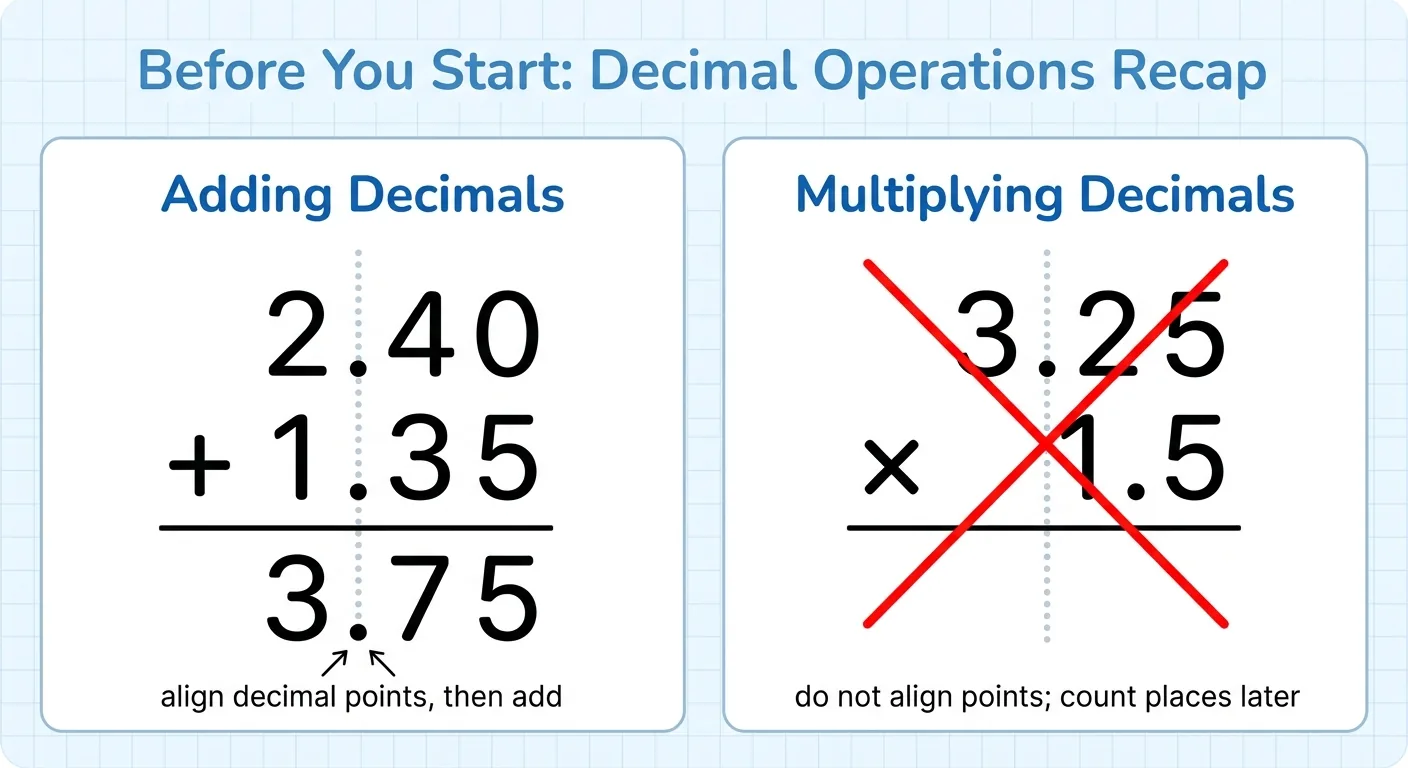
One thing to flag early, because it causes real trouble: when you add decimals, you line up the decimal points. When you multiply decimals, you do not. You line the numbers up on the right, exactly as you would with whole numbers, and you ignore the decimal points completely until the very last step. Children who have just finished a chapter on adding decimals often carry the lining-up habit across, and it produces wrong answers immediately.
What a decimal place actually means
The second piece of background is place value. In 32.50, the 3 is tens, the 2 is ones, the 5 is tenths, and the 0 is hundredths. Each step to the right of the decimal point divides by 10.
So a decimal place is not decoration. It is a statement about how many times the digits have been divided by ten. The number of decimal places in a number tells you how small the pieces are. Hold on to that sentence: it is the whole reason the rule you are about to learn works.
The decimal point placement rule
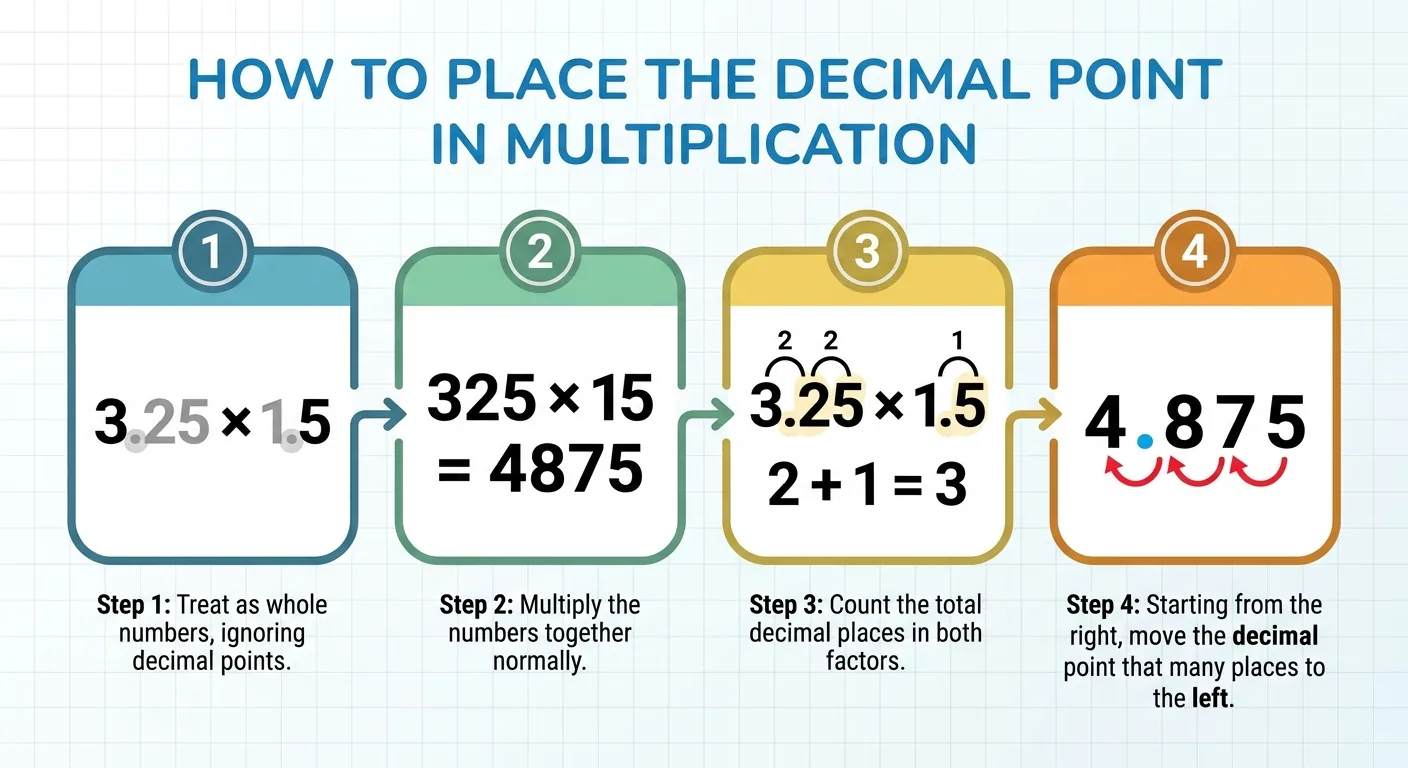
Here is the rule, stated as plainly as it can be stated.
Count the total number of decimal places in both numbers you are multiplying. The answer has exactly that many decimal places. Count them from the right.
That is it. There is no second rule, no exception, no special case. Every example in this guide is this one sentence applied again and again.
How to multiply decimals: the rule in four steps
- Ignore the decimal points. Treat both numbers as whole numbers.
- Multiply as usual. Line the numbers up on the right, not on the decimal points.
- Count the decimal places in both original numbers and add them together. Call that total n.
- Starting from the right of your answer, count n places to the left and put the decimal point there. Add leading zeros if you run out of digits.
Try it on the tomatoes. 32.50 × 1.5. Ignore the points: 3250 × 15 = 48750. Count places: 32.50 has two, 1.5 has one, so n = 3. Count three places from the right of 48750 and place the point: 48.750, which is ₹48.75.
Reading the rule out loud
Get your child to say the counting step aloud, every time, until it becomes a tic. Something like: “Two here, one there, that’s three. One, two, three from the right.”
This sounds trivial. It is the highest-value habit in the whole topic. Almost every wrong answer in decimal multiplication comes from a child who did the counting silently in her head, or did not do it at all. Saying it out loud forces the count to actually happen, and it makes the error visible to you if you are sitting nearby.
One detail that trips children up: you count decimal places in the original numbers, not in the answer you are hoping for. A child who looks at 48750 and thinks “a price should have two decimal places” has stopped doing mathematics and started guessing again.
Proof 1: why the rule works, using fractions
Most guides state the rule and move on. That is why children forget it. A rule you have proved is a rule you can rebuild when you forget it, and rebuilding is what mathematics actually is.
The proof uses something your child already knows: every decimal is a fraction with 10, 100 or 1000 on the bottom.
Working 0.3 × 0.4 the long way
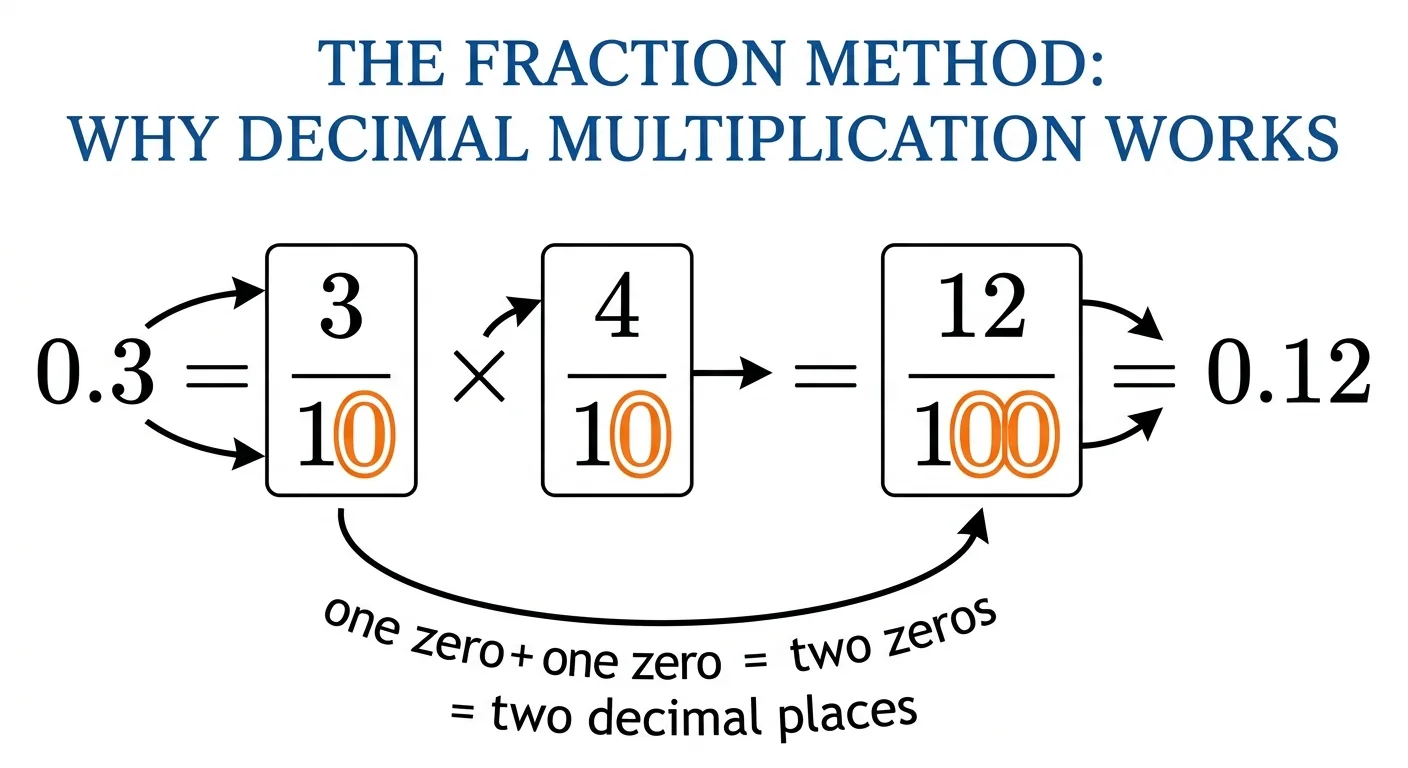
Take 0.3 × 0.4. Instead of using the rule, convert both numbers to fractions and multiply the fractions.
Now look at what happened on the bottom of that fraction. One tenth multiplied by one tenth gave one hundredth. The denominators multiplied together, which turned 10 × 10 into 100, and 100 means two decimal places.
That is the rule, falling straight out of the fractions. 0.3 has one decimal place because its denominator is 10. 0.4 has one decimal place because its denominator is 10. Multiply them and the denominator becomes 100, which is two decimal places. One place plus one place equals two places, because one zero plus one zero equals two zeros.
The rule is not a trick somebody invented to make marking easier. It is just a statement about what happens to the zeros in the denominator.
A second look: 0.25 × 0.2
One example could be a coincidence. Do it again with different numbers.
0.25 has two decimal places because its denominator is 100, which has two zeros. 0.2 has one decimal place because its denominator is 10, which has one zero. Multiplying the denominators gives 1000, which has three zeros, so the answer has three decimal places: 0.050.
Notice that trailing zero. The answer genuinely has three decimal places, and writing 0.050 is correct. We usually tidy it to 0.05 because a trailing zero changes nothing about the value, but while your child is learning, let her write the untidied 0.050 first and tidy afterwards. If she tidies too early she loses the evidence that she counted correctly.
Show this proof once and come back to it whenever your child says “but why?” You do not need her to reproduce it on demand. You need her to have seen that the rule has a reason.
Proof 2: checking with estimation
The fraction proof tells your child the rule is true. Estimation tells her, in about four seconds, whether she applied it correctly on this particular sum. It is the single most useful checking habit in decimal multiplication, and almost nobody teaches it properly.
The method: round both numbers to something easy, multiply them in your head, and check that your real answer sits near that estimate.
How estimation catches a misplaced point
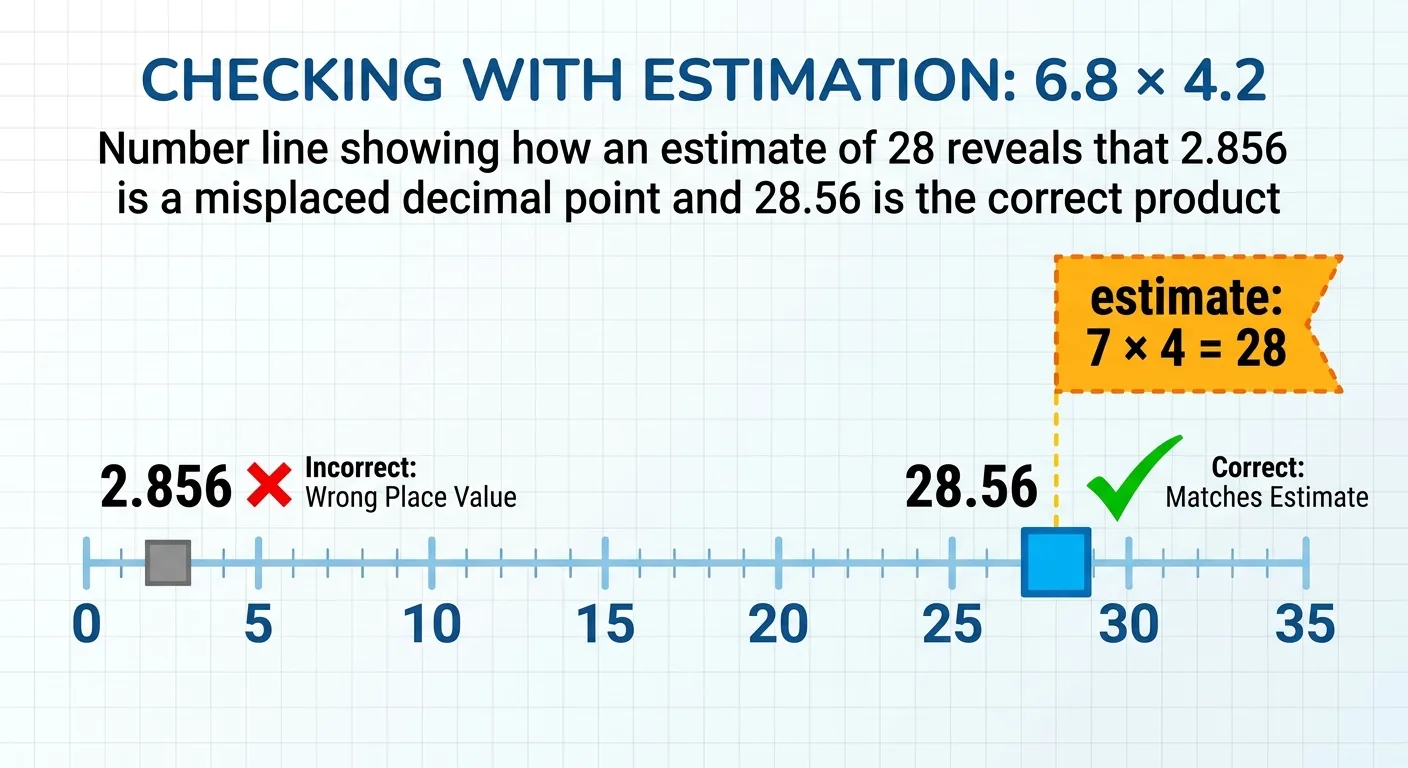
Take 6.8 × 4.2. Your child multiplies 68 × 42 = 2856, then has to place the point. Suppose she rushes and writes 2.856.
Now estimate. 6.8 is nearly 7. 4.2 is nearly 4. And 7 × 4 = 28. So the answer should be somewhere around 28.
2.856 is nowhere near 28. It is ten times too small. She goes back, counts properly: one place plus one place is two places, and gets 28.56. That sits right beside the estimate of 28, so it is correct.
Here is the key point, and it is worth saying to your child directly: a misplaced decimal point is never a small error. It always makes the answer ten, a hundred or a thousand times wrong. That is exactly the kind of error estimation is built to catch. A rough estimate cannot tell you whether the answer is 28.56 or 28.57, but it will catch 2.856 instantly.
Try a second one. 0.48 × 19.6. Round: 0.5 × 20 = 10. So the answer should be near 10. The real calculation gives 48 × 196 = 9408, and with three decimal places, 9.408. That is close to 10, so it is right. If she had written 94.08 or 0.9408, the estimate would have flagged it in a second.
When estimation is hard
Estimation gets slippery when one of the numbers is very small. For 0.004 × 0.6, rounding does not give your child a comfortable whole number to work with.
In those cases, switch to a different sanity check: multiplying by a number less than 1 always makes things smaller. So 0.004 × 0.6 must be less than 0.004. If your child’s answer is bigger than 0.004, something has gone wrong. (The right answer is 0.0024.)
That single idea multiplying by less than one shrinks a number is worth teaching on its own. Children spend years learning that multiplication makes things bigger, and decimals are where that belief stops being true. Making the belief explicit, and then correcting it, prevents a lot of confusion later.
Case 1: multiplying a decimal by a whole number
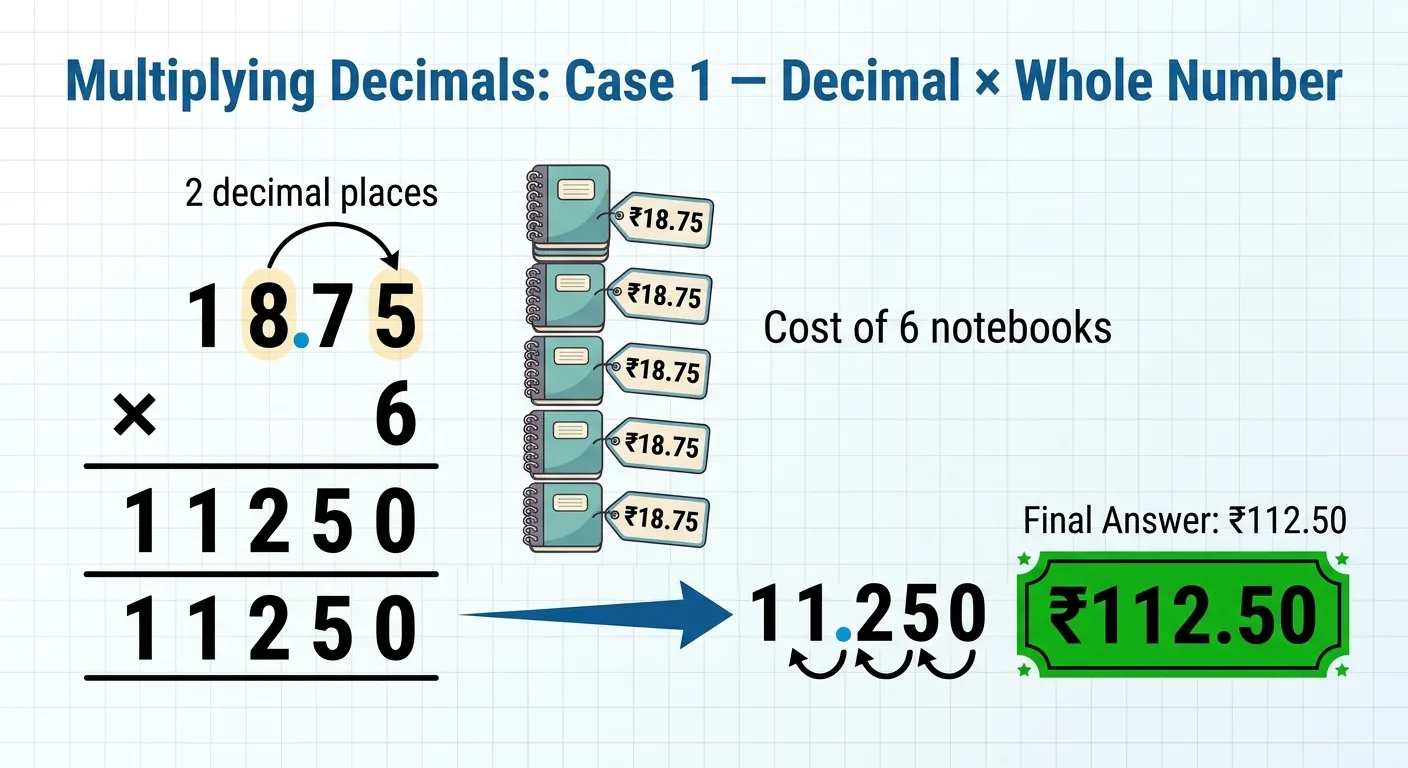
This is where every child should start, because only one of the two numbers contributes decimal places. A whole number has zero decimal places, so the answer has exactly as many decimal places as the decimal you started with.
Say that to your child before the first example: when you multiply a decimal by a whole number, the answer has the same number of decimal places as the decimal. It gives her something solid to hold while she gets used to the counting.
Example 1: 4.3 × 6
Ignore the point: 43 × 6 = 258. Count places: 4.3 has one, 6 has none. Total = 1. Count one place from the right of 258: 25.8. Check by estimating: 4 × 6 = 24, and 25.8 is close to 24. Correct.
Example 2: ₹18.75 × 6
Six notebooks at ₹18.75 each. Ignore the point: 1875 × 6 = 11250. Count places: 18.75 has two, 6 has none. Total = 2. Count two places from the right of 11250: 112.50, so ₹112.50. Check by estimating: 19 × 6 = 114, and 112.50 is close to 114. Correct.
Example 3: 12.75 × 4 (watch what happens at the end)
Ignore the point: 1275 × 4 = 5100. Count places: 12.75 has two, 4 has none. Total = 2. Count two places from the right of 5100: 51.00.
The answer is 51.00, which is simply 51. The two zeros after the point are real they came from counting correctly, but they add nothing to the value, so we drop them. Your child should still count them first and drop them second. Children who try to skip straight to 51 usually start dropping digits that matter.
Check by estimating: 13 × 4 = 52, and 51 is close to 52. Correct.
Example 4: 2.045 × 7
Ignore the point: 2045 × 7 = 14315. Count places: 2.045 has three, 7 has none. Total = 3. Count three places from the right of 14315: 14.315. Check by estimating: 2 × 7 = 14, and 14.315 is just above 14. Correct.
Case 2: multiplying a decimal by a decimal
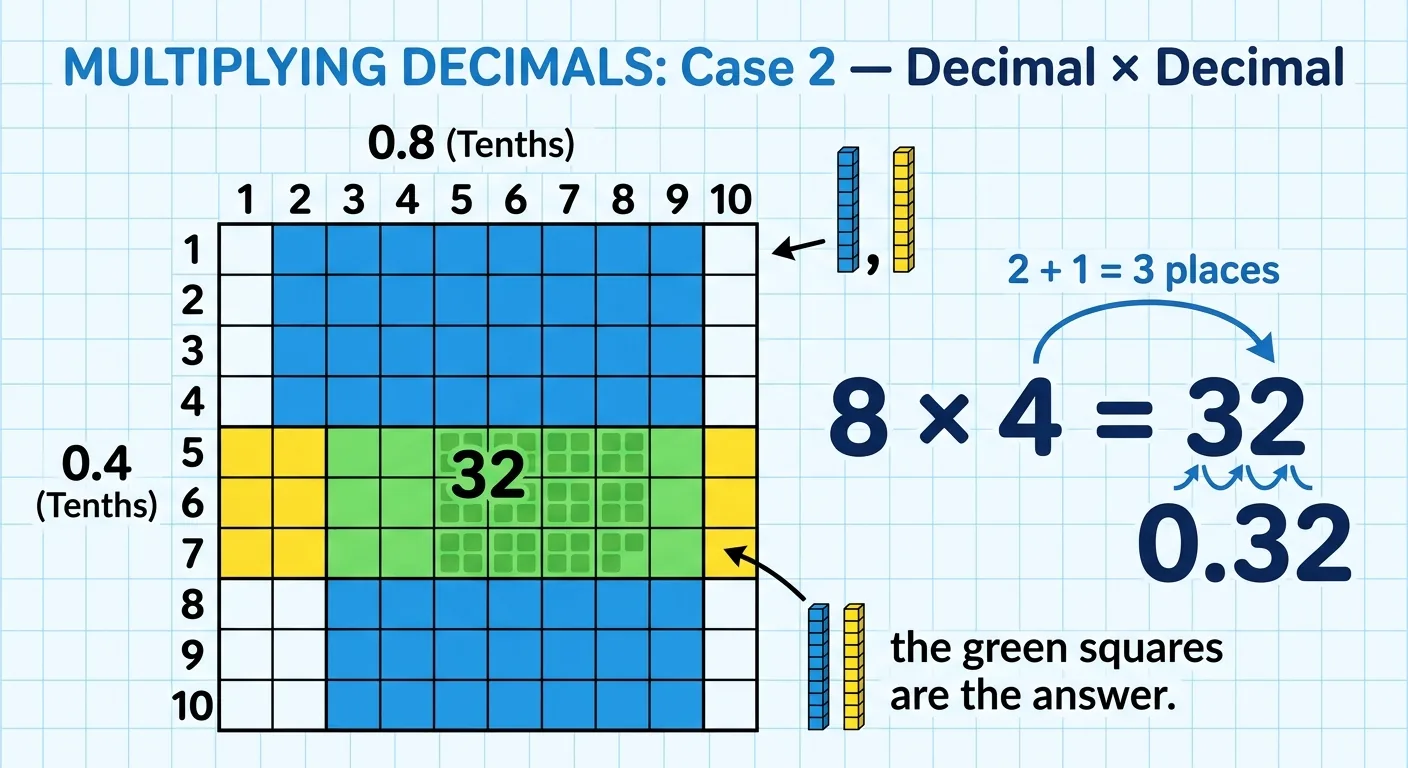
Now both numbers contribute decimal places, and the two counts add together. Nothing about the method changes. The only new thing is that your child has two numbers to count instead of one.
Example 1: 0.8 × 0.4
Ignore the points: 8 × 4 = 32. Count places: 0.8 has one, 0.4 has one. Total = 2. Count two places from the right of 32: 0.32. Sanity check: both numbers are less than 1, so the answer must be smaller than either of them. 0.32 is smaller than both. Correct.
Example 2: 3.4 × 2.5
Ignore the points: 34 × 25 = 850. Count places: 3.4 has one, 2.5 has one. Total = 2. Count two places from the right of 850: 8.50, which is 8.5. Check by estimating: 3 × 3 = 9, and 8.5 is close to 9. Correct.
Example 3: 12.6 × 0.45
Ignore the points: 126 × 45 = 5670. Count places: 12.6 has one, 0.45 has two. Total = 3. Count three places from the right of 5670: 5.670, which is 5.67. Check by estimating: 13 × 0.5 is about 6.5, and 5.67 is in that neighbourhood. Correct. Notice that multiplying by 0.45 made 12.6 much smaller, exactly as it should, because 0.45 is less than 1.
Example 4: 1.642 × 3.7
Ignore the points: 1642 × 37 = 60754. Count places: 1.642 has three, 3.7 has one. Total = 4. Count four places from the right of 60754: 6.0754. Check by estimating: 1.6 × 4 is about 6.4, and 6.0754 is close. Correct.
This last one is worth doing slowly with your child, because it is the first example where the answer needs a digit immediately after the decimal point that is a zero: 6.0754. Children who are counting carelessly often drop that zero and write 6.754, which is ten times too big. Counting out loud catches it.
What to watch for in this case. Two errors dominate. First, counting the places in only one of the two numbers, usually the first one, and ignoring the second. Second, lining up the decimal points before multiplying, carried over from decimal addition. If you see your child write the sum with the points stacked vertically, stop and reset before she multiplies anything.
Case 3: the zeros-in-product trap
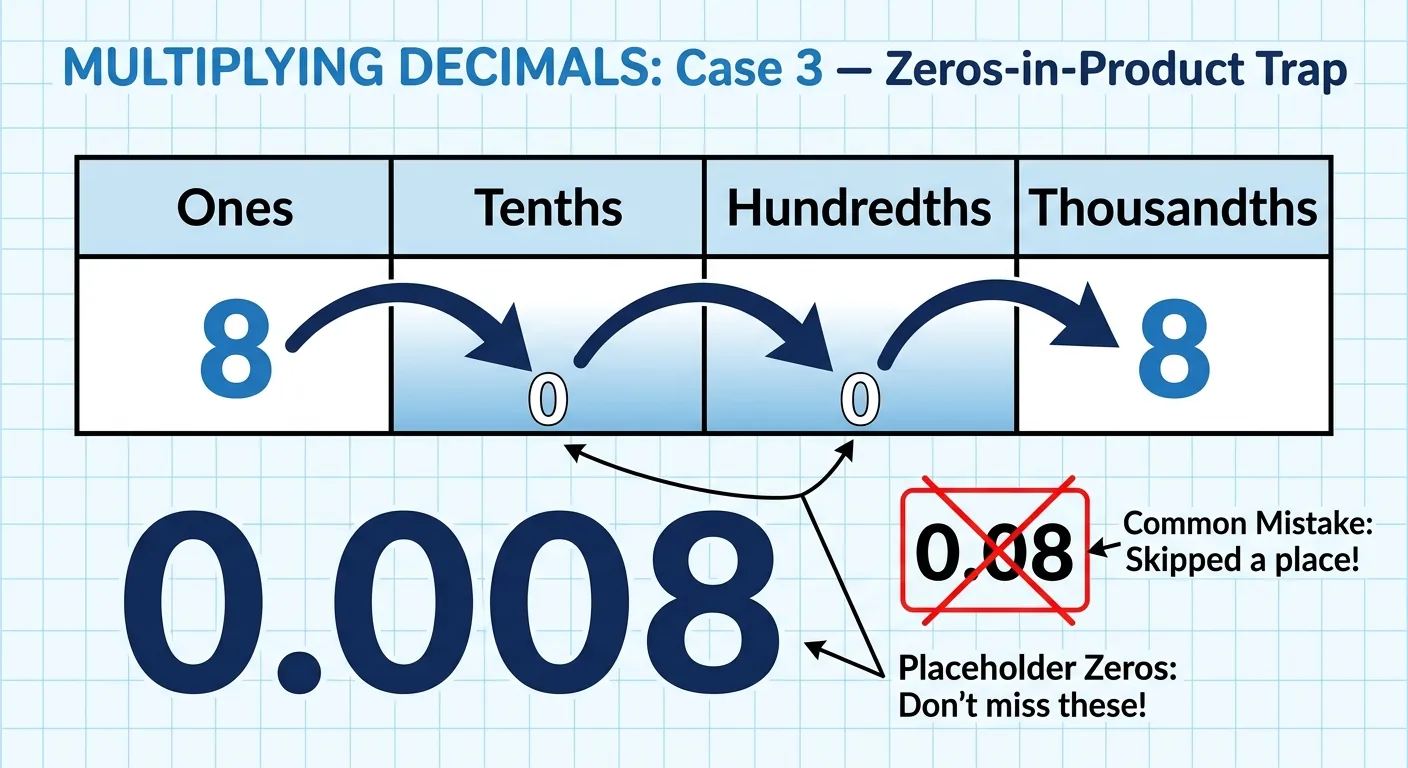
This is the case most guides leave out, and it is the one where a child who has genuinely understood the rule still gets the wrong answer.
Here is the situation. Your child multiplies correctly, counts correctly, and then discovers that the answer does not have enough digits to count across. She needs to move four places from the right, but the answer only has two digits. What now?
The fix is simple once stated: when you run out of digits, add zeros on the left until you have enough. Those zeros are not decoration. They are placeholders that push the digits into their correct place values.
Example 1: 0.04 × 0.2
Ignore the points: 4 × 2 = 8. Count places: 0.04 has two, 0.2 has one. Total = 3. Now count three places from the right of 8. There is only one digit. Starting at the right of the 8, step left: one place takes you to 0.8, two places takes you to 0.08, three places takes you to 0.008.
So 0.04 × 0.2 = 0.008. Two zeros had to be inserted to make room.
Does it make sense? 0.04 is a very small number, and we are taking only two tenths of it, so the answer should be much smaller still. 0.008 is much smaller. Correct.
Example 2: 0.3 × 0.02
Ignore the points: 3 × 2 = 6. Count places: 0.3 has one, 0.02 has two. Total = 3. Three places from the right of 6 gives 0.006.
A child who writes 0.6 here has counted one place. A child who writes 0.06 has counted two. Only 0.006 counts all three.
Example 3: 1.2 × 0.004
Ignore the points: 12 × 4 = 48. Count places: 1.2 has one, 0.004 has three. Total = 4. Four places from the right of 48: one place gives 4.8, two gives 0.48, three gives 0.048, four gives 0.0048.
A trick that makes this painless. Before counting, have your child write the answer digits and draw one short dash to the left for every place she still needs. For 1.2 × 0.004 she writes _ _ 4 8, fills the dashes with zeros, and puts the point at the front: 0.0048.
Why children get this wrong. They stop counting as soon as the digits run out. The counting does not stop at the digits. It continues into empty places, and empty places get zeros. Make sure your child says all the numbers out loud: “one, two, three” not “one, two… oh, there’s nothing left.”
Case 4: multiplying decimals by 10, 100 and 1000
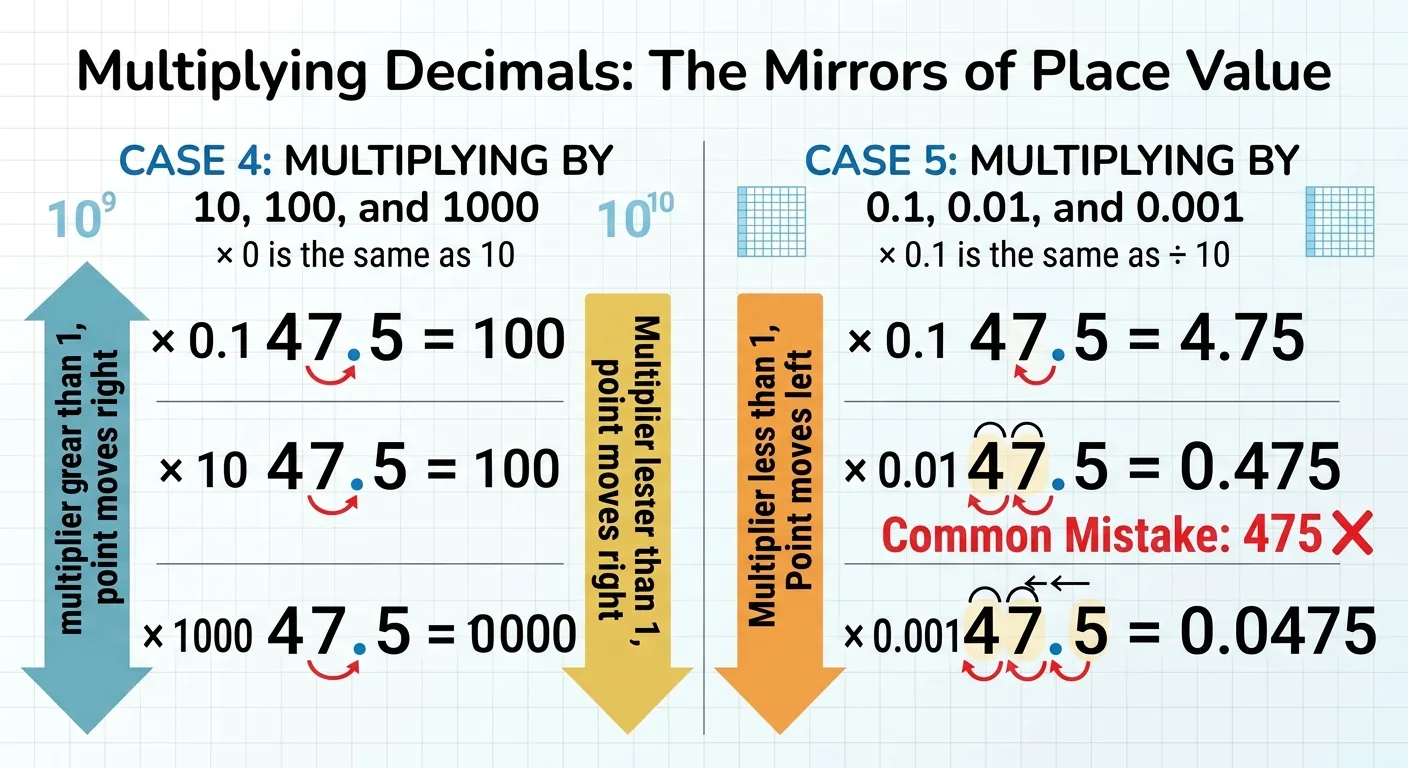
This case has a shortcut, and the shortcut is not a separate rule. It is the same rule wearing different clothes.
The shortcut: to multiply by 10, 100 or 1000, move the decimal point to the right by as many places as there are zeros.
| Multiply by | Zeros | Decimal point moves | Example |
|---|---|---|---|
| 10 | 1 | 1 place right | 6.35 × 10 = 63.5 |
| 100 | 2 | 2 places right | 6.35 × 100 = 635 |
| 1000 | 3 | 3 places right | 6.35 × 1000 = 6350 |
Work through the last one slowly. 6.35 has only two decimal places, but we need to move three. Move one: 63.5. Move two: 635. Move three: there is nothing left after the point, so add a zero on the right: 6350. Running out of digits on this side is handled the same way as running out on the other side: fill with zeros.
Why it works. Go back to the fraction proof. 6.35 is 635/100. Multiplying by 100 gives 635 × 100 / 100, and the hundreds cancel, leaving 635. Each zero in the multiplier cancels one zero in the denominator, and cancelling a zero in the denominator is exactly what moving the point one place right does.
Worked examples
- 0.53 × 10 = 5.3 (one place right)
- 0.53 × 100 = 53 (two places right)
- 0.53 × 1000 = 530 (three places right, one zero added)
- 1.919 × 10 = 19.19
- 0.2852 × 100 = 28.52
- 10.006 × 1000 = 10006
A useful connection for Indian measurements. This shortcut is why metric conversions feel easy once you see it. 2.75 metres in centimetres is 2.75 × 100 = 275 cm. 1.5 kilograms in grams is 1.5 × 1000 = 1500 g. 3.4 kilometres in metres is 3.4 × 1000 = 3400 m. Every metric conversion your child meets is a decimal multiplied by a power of ten, which means every one of them is a decimal point that moves.
Case 5: multiplying by 0.1, 0.01 and 0.001
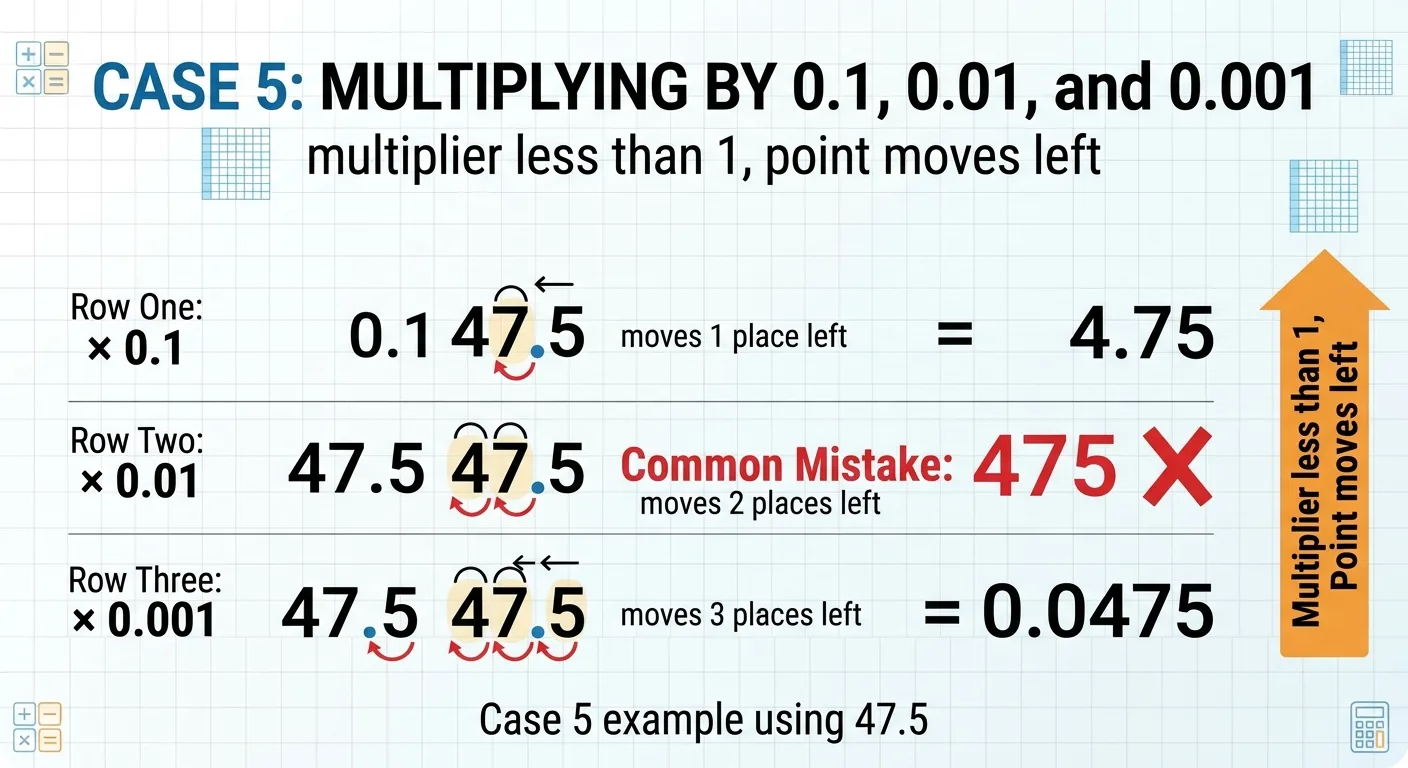
Here is the pattern that trips up children who have just mastered Case 4. They have learned that multiplying by 10 moves the point right. Now they meet 0.1 and assume it does something similar. It does the opposite.
The rule: to multiply by 0.1, 0.01 or 0.001, move the decimal point to the LEFT by as many places as there are decimal places in the multiplier.
| Multiply by | Decimal places | Decimal point moves | Example |
|---|---|---|---|
| 0.1 | 1 | 1 place left | 47.5 × 0.1 = 4.75 |
| 0.01 | 2 | 2 places left | 47.5 × 0.01 = 0.475 |
| 0.001 | 3 | 3 places left | 47.5 × 0.001 = 0.0475 |
Why it works, and why it is not actually a new rule. Apply the count-and-place rule to 47.5 × 0.1. Ignore the points: 475 × 1 = 475. Count places: 47.5 has one, 0.1 has one, total two. Two places from the right of 475 gives 4.75. The shortcut and the rule agree, as they must.
The deeper reason is that 0.1 is one tenth. Multiplying by one tenth is the same as dividing by ten, and dividing by ten moves the point left. Say this to your child in exactly those words: multiplying by 0.1 is dividing by 10 because it connects three ideas she is learning in the same year.
Worked examples
- 8 × 0.1 = 0.8
- 8 × 0.01 = 0.08
- 63 × 0.001 = 0.063
- 2.4 × 0.1 = 0.24
- 0.6 × 0.01 = 0.006
The check that always works here. 0.1, 0.01 and 0.001 are all less than 1, so the answer must always be smaller than the number you started with. If your child multiplies by 0.01 and the answer gets bigger, she has moved the point the wrong way.
The mistake almost every child makes
There is one error that outnumbers all the others combined: placing the decimal point by eye instead of by counting.
It looks like this. Your child works out 4.5 × 2.31. She multiplies 45 × 231 = 10395 correctly. Then, instead of counting, she looks at the two original numbers, notices they are “about four and a bit” and “about two and a bit”, decides the answer should be around nine or ten, and writes 10.395.
This time she is right. 4.5 × 2.31 really is 10.395. And that is precisely the problem the guess was rewarded, so the habit survives.
Now give her 0.45 × 0.231. Same digits, same 10395. Eyeballing gives nothing useful, because both numbers are small and unfamiliar. Counting gives the answer in three seconds: two places plus three places is five places, so 0.10395.
A child who guesses correctly has not done the sum. She has done a different, easier sum and got lucky. The counting takes four seconds and works on numbers she has never seen before, under exam pressure, in Olympiad problems, and ten years from now when she is checking an invoice. Guessing works only on numbers she can already picture.
Common mistakes at each stage, and the fix
| Where it happens | What the child does | What you will see | The fix |
|---|---|---|---|
| Setting up | Lines up the decimal points vertically, as in addition | The sum looks neat and the answer is wrong | Say it out loud: add: line up; multiply: line up on the right |
| Counting places | Counts only the first number | Answer is right but 10 or 100 times too big | Point at each number in turn: “two here, one there” |
| Counting places | Counts the digits in the whole number too | Answer is far too small | Only digits after the point count |
| Placing the point | Counts from the left | Answer wildly wrong | Always count from the right-hand end |
| Zeros in product | Stops counting when digits run out | 0.08 instead of 0.008 | Draw dashes first, fill with zeros |
| Trailing zeros | Drops them before counting is finished | Loses a decimal place | Count first, tidy second |
| Powers of 10 | Moves the point left for ×10 | Answer 100 times too small | Bigger multiplier, bigger answer, point moves right |
| ×0.1 and ×0.01 | Moves the point right | Answer much too big | Multiplier less than 1, so the answer shrinks |
| Checking | Does not check at all | Errors go unnoticed | One rounded estimate before writing the final answer |
Multiplying decimals in real life
Children take a skill more seriously when they see it doing work. Decimal multiplication is everywhere in ordinary Indian life, usually attached to money or measurement.
Problem 1: Filling the tank
Petrol costs ₹104.80 a litre. Your father fills 12.5 litres. How much does he pay?
- The sum is 104.80 × 12.5.
- Ignore the points: 10480 × 125 = 1310000.
- Count places: 104.80 has two, 12.5 has one. Total = 3.
- Three places from the right: 1310.000, so ₹1310.
- Estimate check: 100 × 12 = 1200, and 1310 is close. Correct.
Problem 2: Carpeting a room
A room is 4.5 metres long and 3.2 metres wide. What is its area?
- The sum is 4.5 × 3.2.
- Ignore the points: 45 × 32 = 1440.
- Count places: one plus one = 2.
- Two places from the right: 14.40 square metres, which is 14.4 m².
- Estimate check: 5 × 3 = 15, and 14.4 is close. Correct.
Area is the best context for decimal multiplication because it is genuinely two-dimensional. If your child draws the rectangle on squared paper, she can see the 14 full squares and the bits left over.
Problem 3: Buying cloth
Cloth costs ₹185.50 a metre. Your mother buys 2.25 metres. What does it cost?
- The sum is 185.50 × 2.25.
- Ignore the points: 18550 × 225 = 4173750.
- Count places: two plus two = 4.
- Four places from the right: 417.3750, so ₹417.375, which the shopkeeper will round to ₹417.40.
- Estimate check: 185 × 2 = 370, plus a quarter more, so somewhere above 400. Correct.
This is a good place to mention rounding. Money in India goes to two decimal places, so an answer like 417.375 has to be rounded before anyone can pay it. Your child should still calculate the exact answer first and round afterwards.
Problem 4: Scaling a recipe
A kheer recipe for four people uses 0.75 kg of rice. You are cooking for ten people, which is 2.5 times the recipe. How much rice do you need?
- The sum is 0.75 × 2.5.
- Ignore the points: 75 × 25 = 1875.
- Count places: two plus one = 3.
- Three places from the right: 1.875 kg.
- Estimate check: 0.75 is about 1, and 1 × 2.5 is 2.5, so the answer should be a bit under 2. Correct.
More contexts worth using at home. Distance at a given speed, metres to kilometres, the cost of half a kilo of something priced per kilo, an electricity bill at a rate per unit, splitting a restaurant bill. These are the same four steps with a different story attached, and the usual advice on solving word problems and on money word problems applies here too.
Where this leads: fractions, place value and Olympiad problems
Decimal multiplication is not a dead-end topic. It sits in the middle of a web of ideas your child is building through Classes 5 to 8.
It is fraction multiplication in disguise. This is the point of the fraction proof earlier, and it means multiplying fractions and multiplying decimals are one skill, not two. Every decimal is a fraction with a power of ten underneath, so every decimal multiplication is a fraction multiplication your child already knows how to do. A child who sees this connection has two methods for every problem, and can use one to check the other.
It is place value, applied. Children learn place value as a labelling exercise, much as they learn expanded form: this digit is tenths, that one is hundredths. Decimal multiplication is where place value does something. The reason tenths times tenths gives hundredths is a place-value fact, and once a child has felt that, place value stops being vocabulary and becomes a tool.
It is the entry point to powers of ten. Case 4 and Case 5 are really about exponents. Multiplying by 1000 and multiplying by 0.001 are the same operation with opposite signs on the exponent. A Class 7 child does not need that language yet, but the pattern she builds now is what makes exponents feel obvious in Class 8.
It shows up constantly in Olympiad problems. Olympiad questions rarely ask “multiply these two decimals.” They ask the kinds of questions that need it along the way:
- Finding the number of zeros after the decimal point in a product, without computing the product. (The decimal place count answers this directly.)
- Problems where a careless decimal placement makes a plausible-looking wrong answer one of the given options.
- Questions mixing fractions, decimals and percentages, where converting between them is the fast route.
- Pattern problems built on repeated multiplication by 0.1 or by 10.
A child who counts decimal places by habit and estimates before committing to an answer has a real advantage when solving Olympiad problems, because the time pressure punishes guessing far more than it punishes slow careful work.
Eight activities and games
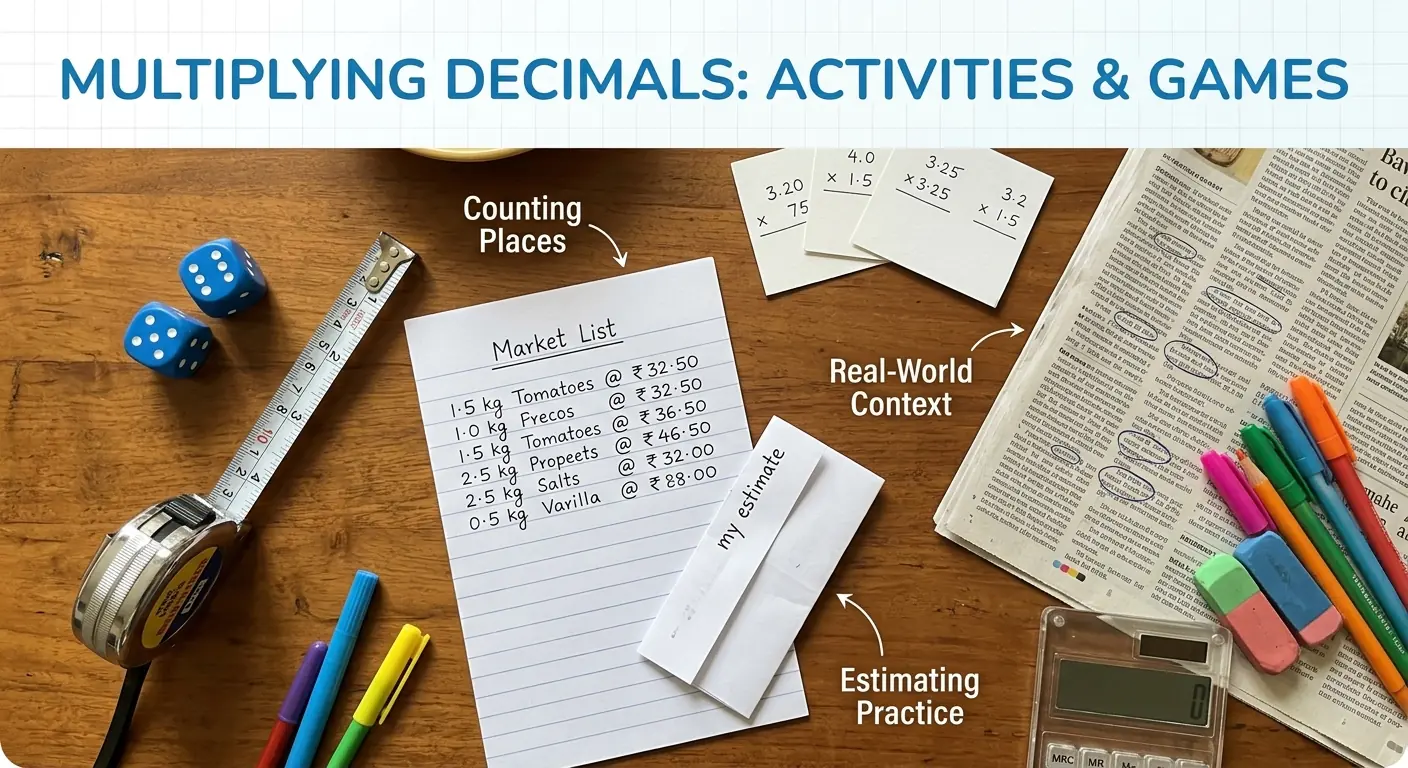
All of these use things already in the house: paper, a pen, dice, old newspapers, a measuring tape, coins. None of them needs printing or buying anything.
1. The market bill. Give your child a shopping list with decimal quantities and decimal prices 1.5 kg onions at ₹38.50, 0.75 kg dal at ₹142.00, 2.25 kg atta at ₹46.80 and ask for the total bill. Then check it against the real bill from the shop. Getting the same number as the shopkeeper is more convincing than any tick on a worksheet.
2. Decimal dice. Roll four dice. Use the first two digits to build a number with one decimal place (a 4 and a 7 become 4.7) and the next two to build another. Multiply. Whoever gets the larger product wins the round. After a few rounds, change the rule so the smaller product wins. Children have to think differently, and they discover that small decimals shrink things.
3. Where does the point go? Write a product with the decimal point missing, say 4.6 × 2.3 = 1058 and ask your child to place the point. Do ten of these in two minutes. Because the multiplication is already done, this drills the counting step alone, which is the step that actually fails.
4. Estimate first, then check. Give a decimal multiplication. Before any calculation, your child writes down her estimate on a slip of paper and folds it. Then she works the sum out. Then she unfolds the slip. Scoring: a point for a correct answer, a bonus point if the estimate was within ten per cent. This builds the checking habit without it feeling like extra work.
5. The newspaper hunt. Give your child the newspaper and ten minutes to find five decimal numbers petrol prices, cricket averages, rainfall figures, exchange rates, share prices. For each one, invent a question that needs multiplying it by something. The hunting is half the fun and it makes the point that decimals are not a school invention.
6. Measure the house. Hand over a measuring tape. Your child measures the lengths and widths of three rooms to one decimal place and calculates the floor area of each. Then she totals them to find the floor area of the whole house. This is Case 2 applied repeatedly, with a result nobody in the family knows.
7. Powers of ten relay. Call out a number 3.47. Your child says it multiplied by 10. Then by 100. Then by 1000. Then back down: by 0.1, by 0.01, by 0.001. Go as fast as she can manage without mistakes. Three minutes of this a few times a week makes Cases 4 and 5 completely automatic.
8. Find the deliberate mistake. Write out five solved decimal multiplications, with the decimal point placed wrongly in two of them. Your child has to find the wrong ones and say why. Spotting other people’s errors is easier than spotting your own, and it transfers: a child who has hunted misplaced points in someone else’s work notices them in her own.
A note on how often. Ten minutes of one of these beats an hour of worksheets. The aim is repeated contact with the counting step, not volume.
Tips for parents
Check the multiplication before you check the decimal point. When an answer is wrong, parents instinctively blame the decimal placement. Often the whole number multiplication was wrong and the point was placed perfectly. Ask your child to redo only the multiplication first.
Do not supply the answer. When she is stuck, ask “how many decimal places in this number?” and point at each factor in turn. The question does the teaching; the answer does not.
Let the trailing zeros stay, at first. 51.00 and 0.050 look untidy, but they are evidence that the counting happened. Tidying is a separate, later step.
Use money, but not only money. Rupees make decimals concrete, and paise give a natural two-place anchor. But money always has exactly two decimal places, so a child who only practises with money never meets three or four places. Mix in measurement.
Insist on one estimate per sum. Not a full check, just a rounded guess written beside the answer. If you enforce only one habit from this guide, make it this one.
Expect the ×0.1 confusion. Almost every child, at some point, multiplies by 0.1 and makes the number bigger. It is not carelessness; it is the reasonable belief that multiplication makes things bigger. Name the belief, correct it, and move on without making it a failure.
Tips for teachers
Teach the fraction derivation before the rule, not after. When the rule arrives as a conclusion rather than an instruction, far fewer students treat it as arbitrary. Ten minutes on 0.3 × 0.4 as 3/10 × 4/10 saves weeks of re-teaching.
Use an area model on squared paper for the first decimal × decimal. A 10 × 10 grid where one factor shades columns and the other shades rows makes “tenths times tenths gives hundredths” visible rather than asserted. The overlap is the product.
Separate the two skills when diagnosing. Give a short set where the multiplication is already done and only the point must be placed. Students who fail that set have a counting problem; students who pass it but still get full questions wrong have an arithmetic problem. The remediation is completely different.
Put the zeros case in early, not as an extension. If it appears only in the last exercise of the chapter, weaker students never reach it and then meet it cold in an exam. Teach 0.04 × 0.2 in the same lesson as 0.4 × 0.2.
Build estimation into the marking scheme. If a correct answer with no estimate scores less than a correct answer with an estimate, students will estimate. Nothing else reliably produces the habit.
Practice questions with answers
Thirty questions, five for each case and five harder ones at the end. Answers follow each block, so cover them before starting.
Case 1: decimal × whole number
- 3.6 × 4
- 7.25 × 8
- 0.9 × 12
- 15.07 × 6
- 2.408 × 5
Answers: 14.4 · 58 · 10.8 · 90.42 · 12.04
Case 2: decimal × decimal
- 0.5 × 0.6
- 2.4 × 1.5
- 6.3 × 0.42
- 12.5 × 3.04
- 1.025 × 2.6
Answers: 0.3 · 3.6 · 2.646 · 38 · 2.665
Case 3: zeros in the product
- 0.2 × 0.3
- 0.05 × 0.4
- 0.03 × 0.02
- 1.1 × 0.006
- 0.004 × 0.25
Answers: 0.06 · 0.02 · 0.0006 · 0.0066 · 0.001
Case 4: multiplying by 10, 100, 1000
- 4.73 × 10
- 0.062 × 100
- 1.5 × 1000
- 0.8 × 100
- 23.456 × 1000
Answers: 47.3 · 6.2 · 1500 · 80 · 23456
Case 5: multiplying by 0.1, 0.01, 0.001
- 56 × 0.1
- 3.2 × 0.01
- 0.9 × 0.001
- 450 × 0.01
- 7.8 × 0.1
Answers: 5.6 · 0.032 · 0.0009 · 4.5 · 0.78
Challenge questions
- 0.025 × 0.04
- Rice costs ₹68.40 a kilo. What do 2.5 kilos cost?
- 1.08 × 0.0025
- A rectangular plot is 3.75 m by 2.4 m. What is its area?
- 0.6 × 0.5 × 0.4
Answers: 0.001 · ₹171 · 0.0027 · 9 m² · 0.12
A note on question 28. Count carefully: 1.08 has two places, 0.0025 has four, so the answer has six. 108 × 25 = 2700, and six places from the right gives 0.002700, which tidies to 0.0027. A child who stops counting at four gets 0.2700, which is a hundred times too big.
Make Preparing for Math Olympiad Simple!


Where do you put the decimal point when multiplying decimals?
Count the decimal places in both numbers you are multiplying and add them together. The answer has exactly that many decimal places, counted from the right-hand end. If 2.45 has two places and 1.3 has one, the answer has three.
How do you multiply decimals step by step?
Four steps. Ignore the decimal points and multiply the numbers as whole numbers. Count the decimal places in both original numbers. Add those two counts. Starting from the right of your answer, count that many places to the left and write the decimal point there, adding zeros on the left if you run out of digits.
Why does the decimal point rule work?
Because every decimal is a fraction with a power of ten underneath. 0.3 is 3/10 and 0.4 is 4/10. Multiplying them gives 12/100, and 100 has two zeros, which means two decimal places. The decimal places add up because the zeros in the denominators multiply together.
What do you do when the answer has fewer digits than the decimal places needed?
Add zeros on the left until there are enough. For 0.04 × 0.2, the whole number multiplication gives 8 but you need three decimal places, so the answer becomes 0.008. The zeros are placeholders, and leaving them out makes the answer a hundred times too big.
What happens when you multiply a decimal by 10, 100 or 1000?
The decimal point moves to the right by as many places as there are zeros in the multiplier. 6.35 × 10 = 63.5, 6.35 × 100 = 635, 6.35 × 1000 = 6350. If you run out of digits on the right, add zeros there.
What happens when you multiply by 0.1, 0.01 or 0.001?
The point moves to the left instead one place for 0.1, two for 0.01, three for 0.001. So 47.5 × 0.1 = 4.75. Multiplying by 0.1 is the same as dividing by 10, which is why the answer gets smaller.
Can multiplying make a number smaller?
Yes. Whenever you multiply by a number less than 1, the answer is smaller than what you started with. 8 × 0.5 = 4. This surprises most children, because they spent Classes 2 to 4 learning that multiplication makes things bigger.
Do trailing zeros count when counting decimal places?
Yes, while you are counting. In 2.50 × 0.04 you count two places plus two places, which is four, giving 0.1000. Only afterwards do you tidy that to 0.1. Count first, tidy second.
In which class is decimal multiplication taught?
In the CBSE and NCERT sequence, decimals are introduced in Class 5 and place value, comparison, addition and subtraction are settled in Class 6. Decimal multiplication is formally taught in Class 7, covering decimal × whole number, decimal × decimal, and multiplication by 10, 100 and 1000. Many schools introduce simple cases earlier.
Putting it all together
Multiplying decimals comes down to one habit and one sentence. The habit is counting out loud. The sentence is: the answer has as many decimal places as both factors put together.
Everything else in this guide hangs off that. The fraction proof explains where the sentence comes from. Estimation tells you, in four seconds, whether you applied it correctly. The five cases are the same sentence meeting different numbers a whole number, another decimal, a product too short to count across, a power of ten, a tenth.
Your child does not need to memorise five rules. She needs one rule she believes in, and the habit of checking. Give her those, and the decimal point stops being a guess.

Mikha Piregu is a Content Writer with experience spanning educational content, including math and math olympiad topics, as well as advocacy writing, research-based articles, and SEO-driven web content. He creates high-quality blog content, web copy, and feature articles that support brand visibility, audience engagement, and long-term organic growth through data-informed storytelling. Skilled in WordPress, WooCommerce, and modern digital tools, Mikha adapts content across various platforms, including blogs, websites, campaigns, and advocacy initiatives, with clarity and purpose.

There are no comments posted here yet.
Sign in to leave a comment