


Dividing decimals means splitting a number that has a decimal point (the dividend) by another number (the divisor). Here is the whole method in five steps.
- What dividing decimals actually means
- First, a quick recap of long division
- The one rule that solves every decimal division
- Why the rule works: Proof 1, equivalent fractions
- Why the rule works: Proof 2, estimation
- Case 1: Dividing a decimal by a whole number
- Case 2: Dividing a decimal by a decimal
- Case 3: Dividing a whole number by a decimal
- Case 4: When there is a remainder, add zeros
- Case 5: When the division never ends
- Case 6: Dividing by 10, 100, 1000 and by 0.1, 0.01, 0.001
- Where students go wrong, and how to fix it
- Real-life decimal division problems
- How decimal division connects to everything else
- activities and games
- Tips for parents
- Tips for teachers
- Practice questions with answers
- Putting it all together
- Check the divisor. If it is already a whole number, skip to step 3.
- Shift both decimal points. Move the divisor’s point right until it is whole, then move the dividend’s point right by exactly the same number of places, adding zeros if you run out of digits.
- Place the point in the answer. Put it in the quotient directly above the new decimal point in the dividend.
- Divide as normal. Divide, multiply, subtract, bring down.
- Add zeros if needed. If a remainder is left, add a zero to the end of the dividend and keep dividing until the remainder is zero or you reach the place you are rounding to.
So 2.5 kg of rice costing ₹187.50 becomes 1875 ÷ 25 = ₹75 per kilogram.
So this guide gives the reason first, proved two ways, and then works through all six situations your child meets in Class 5, 6 and 7, with worked examples you can teach from.
What dividing decimals actually means
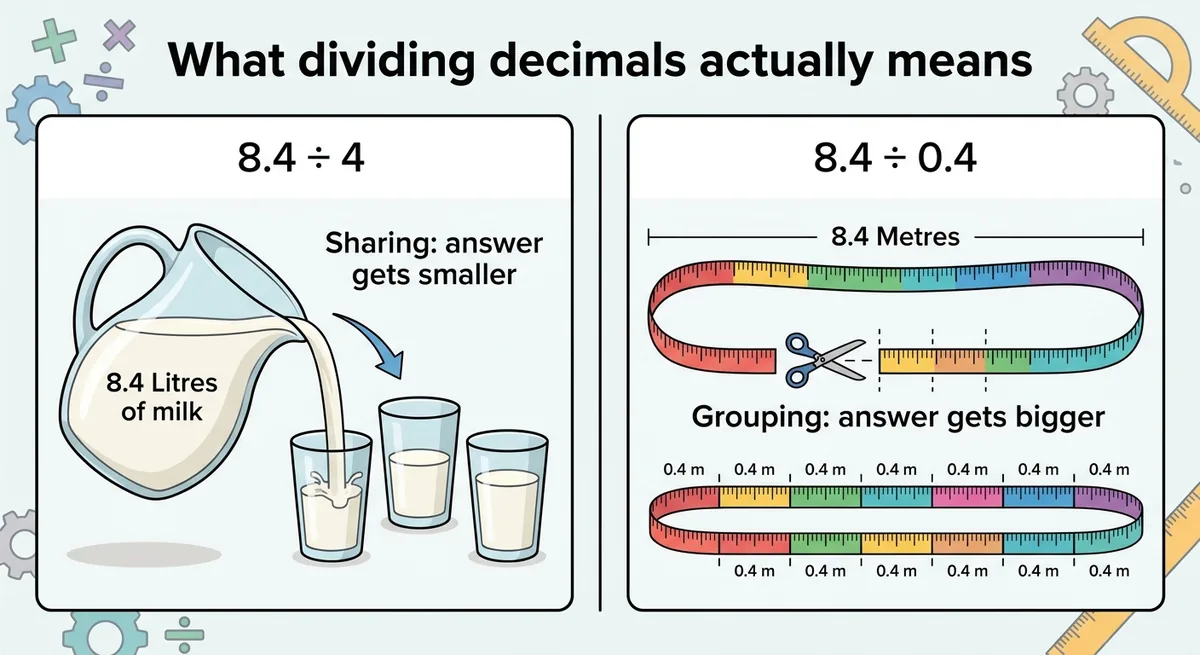
Division answers two questions that sound different and turn out to be the same.
Sharing. 8.4 litres of milk shared equally among 4 families is 8.4 ÷ 4 = 2.1.
Grouping. 8.4 metres of ribbon cut into pieces 0.4 m long is 8.4 ÷ 0.4 = 21.
Same dividend, and the answers go in opposite directions. One gets smaller, one gets much bigger. That single observation is the key to this whole topic, and it is the thing most children get wrong.
Three words make the rest easier. In 8.4 ÷ 0.4, the number being divided (8.4) is the dividend, the number you divide by (0.4) is the divisor, and the answer (21) is the quotient.
First, a quick recap of long division
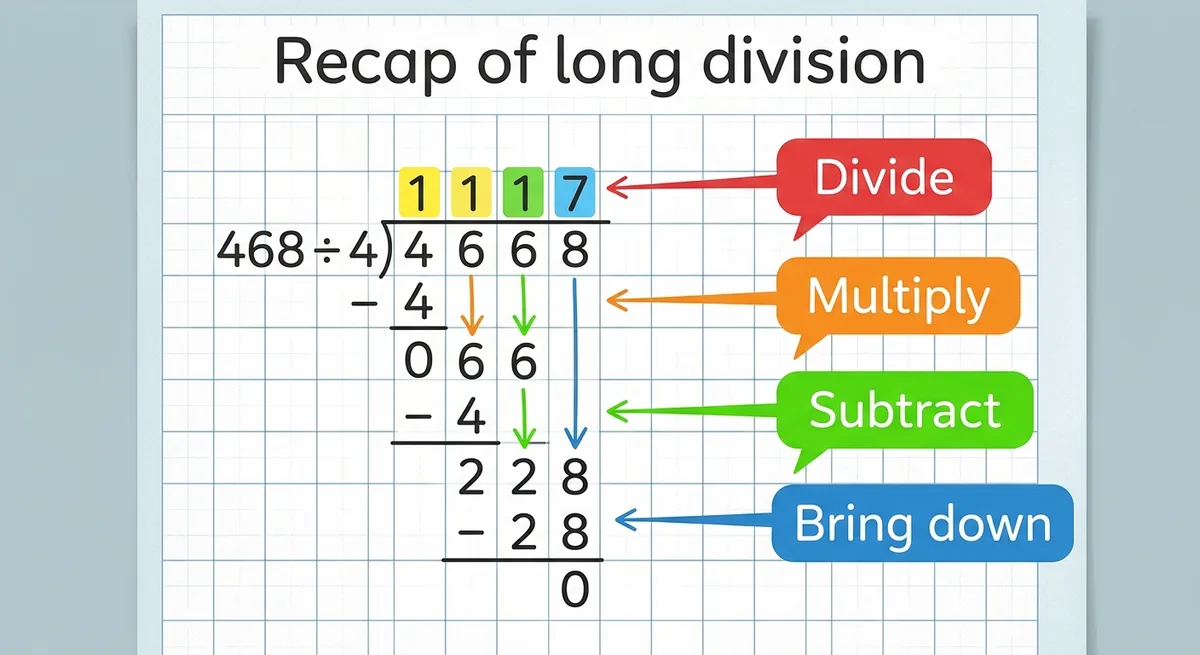
Decimal division is ordinary long division with one extra decision at the start. If long division is shaky, everything after it will be shaky too.
Long division runs on four steps that repeat: Divide, Multiply, Subtract, Bring down. Take 468 ÷ 4.
      1 1 7
    ________
 4 ) 4 6 8
     4
     ___
     0 6
       4
     ___
       2 8
       2 8
     ___
         0
4 goes into 4 once. Multiply, subtract, bring down the 6. Four goes into 6 once with 2 left over. Bring down the 8 to make 28, and 4 goes in 7 times exactly. Answer: 117.
Two habits matter more with decimals than without. Keep every digit in its own column, and write each quotient digit directly above the digit you are working on. Quick recall of times tables speeds all of this up.
The one rule that solves every decimal division
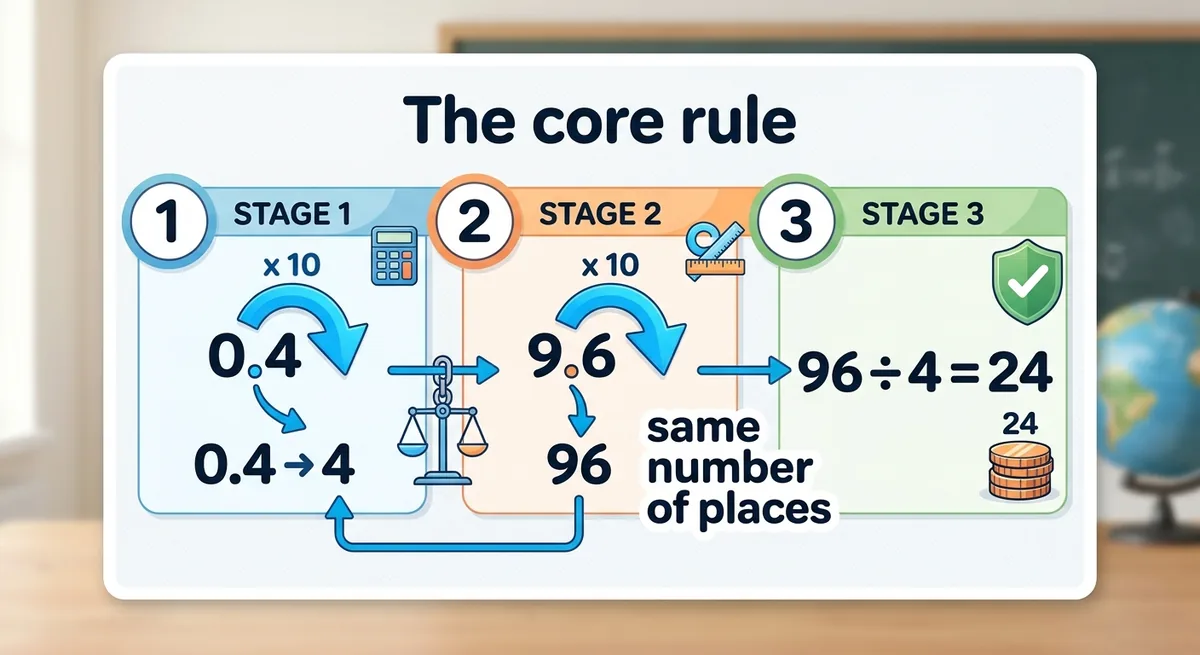
If you remember nothing else from this page, remember these three steps.
- Make the divisor a whole number. Move its decimal point right until no decimal is left. Count the places.
- Move the dividend’s decimal point the same number of places to the right, adding zeros if you run out of digits.
- Divide as usual, placing the decimal point in the quotient directly above the point in the new dividend.
If the divisor is already whole, steps 1 and 2 do nothing and you go straight to dividing.
Six different-looking cases, one method. What makes it stick is step 2, and step 2 is exactly the step children skip, because nobody has told them why it is there.
Why the rule works: Proof 1, equivalent fractions
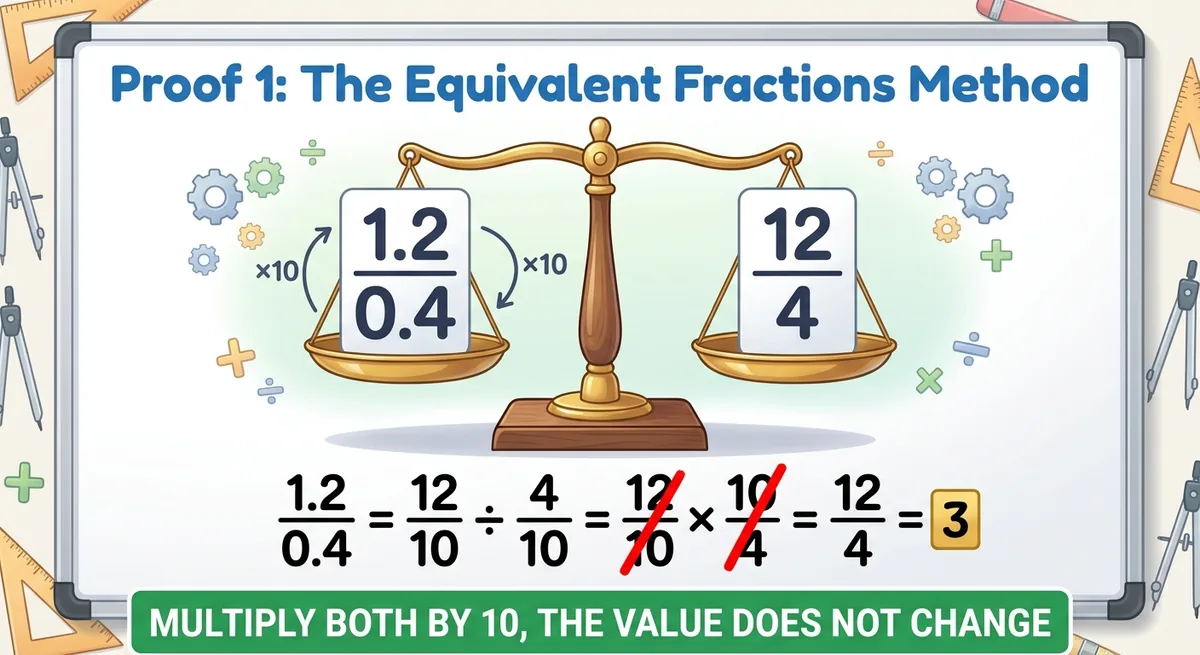
The rule works because of something your child already knows: a fraction does not change value when you multiply the top and bottom by the same number. That is the whole idea behind equivalent fractions. Your child accepts that 1/2 and 5/10 are the same amount.
A division is a fraction. 1.2 ÷ 0.4 and 1.2/0.4 are the same thing written two ways. So if scaling top and bottom is safe for fractions, it is safe for division too.
Way 1, as fractions. Write both decimals as fractions over 10, which is just converting a decimal to a fraction:
1.2 ÷ 0.4 = 12/10 ÷ 4/10
Dividing by a fraction means multiplying by its reciprocal:
12/10 × 10/4 = 120/40 = 12/4 = 3
The tenths cancel completely. What is left is 12 ÷ 4.
Way 2, scaling both numbers. Multiply both by 10: 1.2 becomes 12, 0.4 becomes 4, and 12 ÷ 4 = 3.
Way 3, counting. How many 0.4s fit inside 1.2? Count: 0.4, 0.8, 1.2. Three.
Now see what happens if your child moves only the divisor’s point, which is the most common error in this topic:
1.2 ÷ 4 = 0.3
Ten times too small, because the divisor got ten times bigger while the dividend stayed put. Say it in one sentence: both numbers grow together, so the answer stays the same.
One more thing worth knowing. There is nothing sacred about 10. For 7 ÷ 0.25, multiplying both numbers by 4 gives 28 ÷ 1 = 28, which is faster. Tens are simply the choice that always works.
Why the rule works: Proof 2, estimation
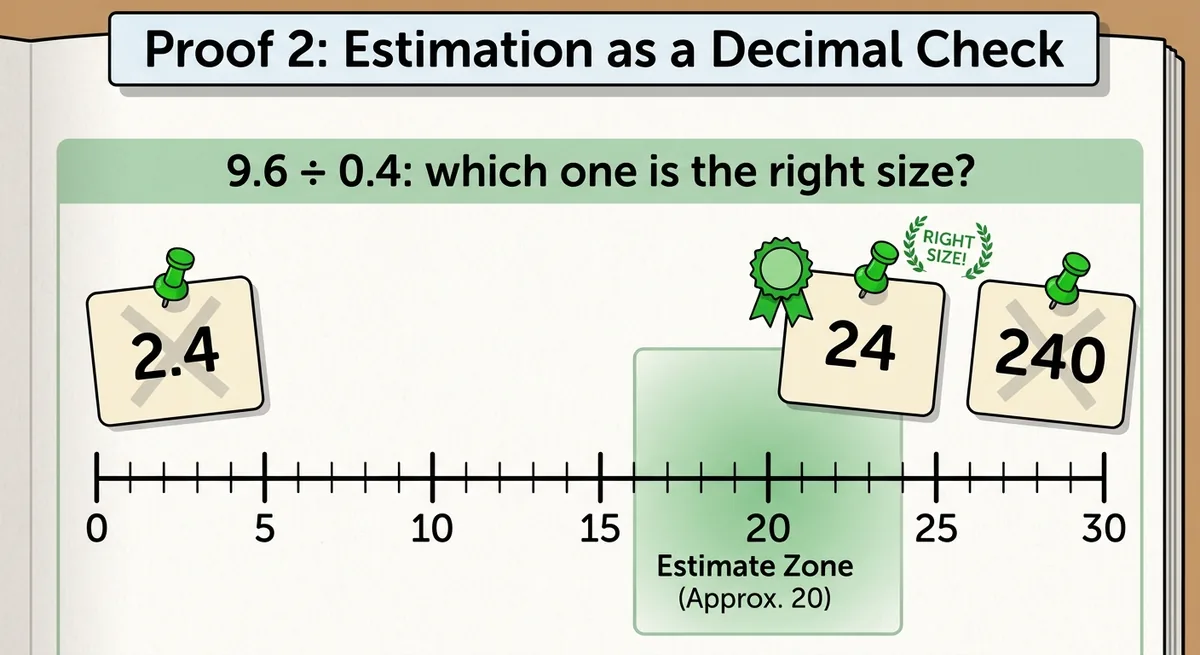
The fraction proof says the method is correct. Estimation says whether this particular answer is correct, and it takes five seconds. Round both numbers to something easy, divide those, and check that the real answer sits in the same neighbourhood. You are checking the size, not the digits.
Example. 18.6 ÷ 0.3. Move both points one place: 186 ÷ 3 = 62. Now estimate: 0.3 is roughly a third, so dividing by it roughly triples. Three times 18.6 is about 56, so an answer near 60 fits.
Catching a mistake. Suppose a child answers 9.6 ÷ 0.4 as 2.4. Estimate: 0.4 is a bit less than half, and 9.6 holds about 19 halves, so the answer should be around 20. 2.4 is nowhere near. The correct answer is 24.
Estimation did not find the mistake. It proved one exists, which is faster than rechecking every digit.
Back to the rice. ₹187.50 ÷ 2.5. Estimate: about ₹180 for about 2 kg, so roughly ₹90 per kg, definitely a two-digit amount. Now divide: 1875 ÷ 25 = 75. Rice is ₹75 per kg. Had the child written ₹7.50 or ₹750, the estimate would have caught it instantly.
Make this the house rule: estimate before you divide, check after you divide.
Case 1: Dividing a decimal by a whole number
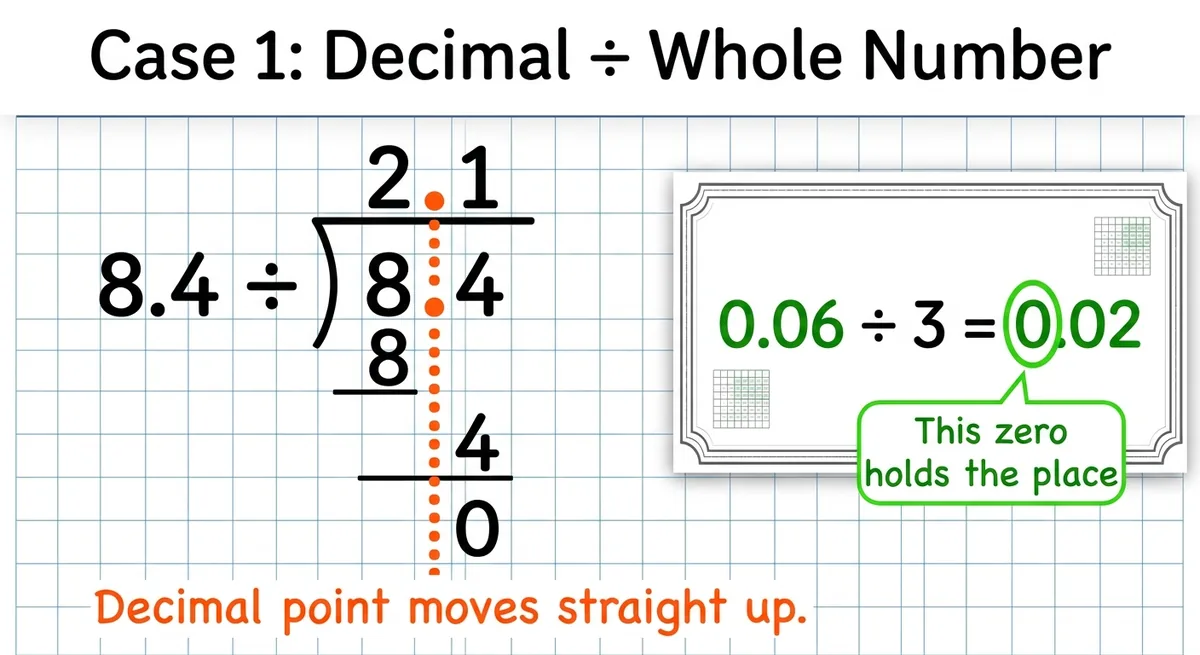
The gentlest case, and the one Class 5 meets first. The divisor is already whole, so nothing moves. The only new skill is where the decimal point goes in the answer: directly above the point in the dividend, written before you start dividing.
Example 1: 8.4 ÷ 4
      2 . 1
    ______
 4 ) 8 . 4
     8
     ___
     0 4
       4
     ___
       0
Answer: 2.1. Estimate check: 8 ÷ 4 = 2, so just over 2 is right.
Example 2: 23.52 ÷ 6. 6 does not go into 2, so start with 23: three 6s are 18, remainder 5. Bring down the 5 to make 55: nine 6s are 54, remainder 1. Bring down the 2 to make 12: two 6s exactly. Answer: 3.92
Example 3: 0.06 ÷ 3. This one catches everyone. Since 6 ÷ 3 = 2, many children write 0.2. Work the columns instead. 3 into 0 is zero. 3 into 0 again is zero, so a zero goes in the tenths place. Only then do you reach the 6, where 3 goes twice. Answer: 0.02
That zero is not decoration. It holds the 2 in the hundredths column, which is pure place value. Sense-check it: six paise shared among 3 people is two paise each, ₹0.02, not ₹0.20.
Example 4: 157.5 ÷ 25. 25 into 157 goes 6 times (150), remainder 7. Bring down the 5 to make 75: 25 goes 3 times exactly. Answer: 6.3. In the real world, 157.5 km on 25 litres is 6.3 km per litre.
Case 2: Dividing a decimal by a decimal
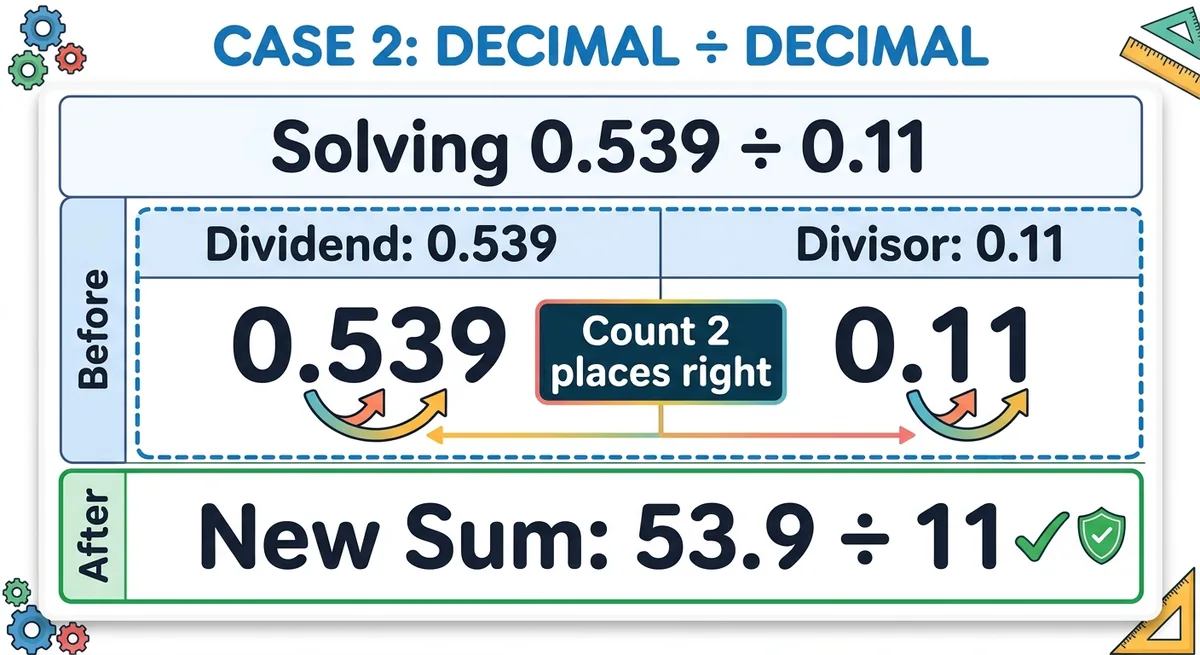
Now the divisor has a decimal point, so step 1 of the rule finally does something. Count the divisor’s decimal places, move that many places right in both numbers, then divide.
Example 5: 9.6 ÷ 0.4. One decimal place, so move one in both.
| Before | After | |
|---|---|---|
| Dividend | 9.6 | 96 |
| Divisor | 0.4 | 4 |
96 ÷ 4 = 24. Believable, since 9.6 is nearly 10 and each whole unit holds two and a half 0.4s.
Example 6: 7.38 ÷ 0.6. Move one place in both: 73.8 ÷ 6 = 12.3. Notice the dividend still has a decimal point after the move, and that is fine. The rule only needs the divisor to be whole.
Example 7: 0.539 ÷ 0.11. Two decimal places, so move two: 0.539 becomes 53.9 and 0.11 becomes 11. Then 53.9 ÷ 11 = 4.9
Example 8: 18.75 ÷ 1.25. Move two places: 1875 ÷ 125 = 15. Here the dividend lost its decimal point entirely. After the move you land on either decimal by whole or whole by whole, and both are familiar ground. That is the entire purpose of the move.
Case 3: Dividing a whole number by a decimal
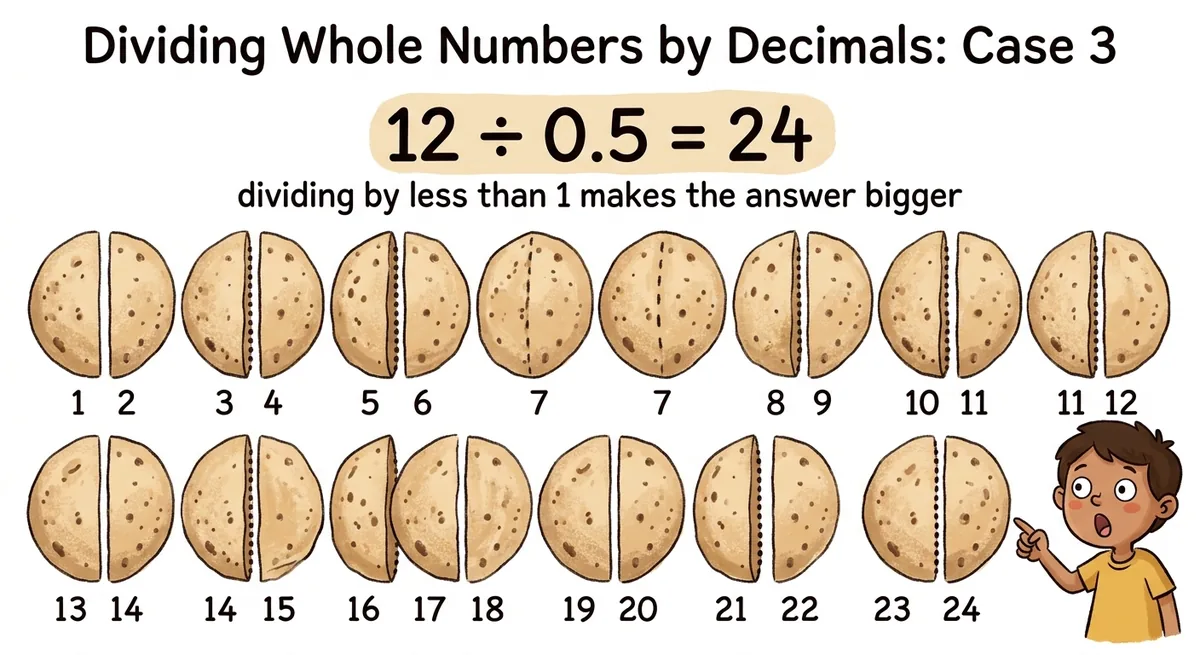
Most guides give this case one example and hurry past. It deserves more, because children’s intuition actively works against them here. The method is identical to Case 2. What changes is how strange the answer looks.
Example 9: 12 ÷ 0.5. Write 12 as 12.0 and move one place in both: 120 ÷ 5 = 24
Example 10: 45 ÷ 0.15. Move two places, adding zeros: 4500 ÷ 15 = 300
Example 11: 7 ÷ 0.25. Move two places: 700 ÷ 25 = 28. Shortcut worth showing: 0.25 is a quarter, and the number of quarters in 7 is 7 × 4 = 28.
Why the answer is bigger than the number you started with
12 became 24. 45 became 300. 7 became 28. Every answer is larger than the dividend, and a child who believes dividing makes things smaller will assume they have blundered.
Ask them this instead: how many half-rotis are there in 12 rotis? They will say 24 without pausing, because they are counting, not dividing. Then show them that they just did 12 ÷ 0.5.
The rule in one line: when you divide by a number smaller than 1, the answer is bigger than what you started with. You are asking how many small pieces fit inside something, and small pieces means lots of them. It runs the other way too. Dividing by more than 1 gives a smaller answer, and dividing by exactly 1 changes nothing.
A good drill: before solving anything, ask whether the answer will be bigger or smaller than the dividend. Just look at the divisor. 0.3? Bigger. 2.5? Smaller. 0.98? Bigger, but only slightly.
Case 4: When there is a remainder, add zeros
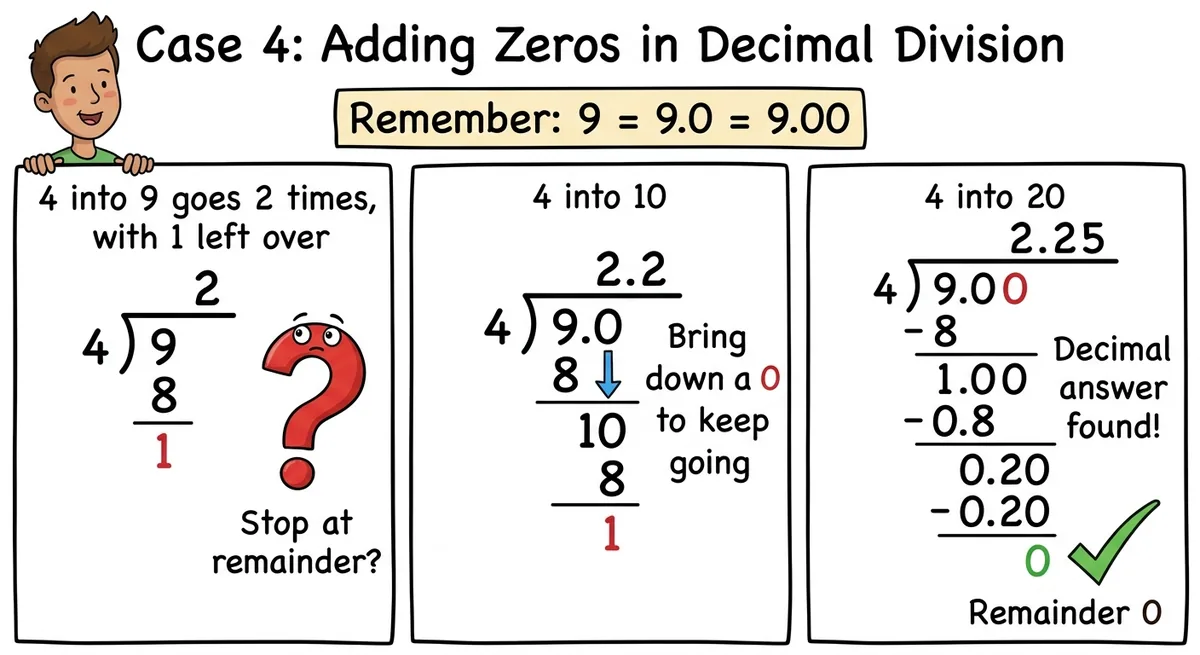
In whole number division your child learned to write “remainder 1” and stop. With decimals you keep going, because 9 and 9.0 and 9.000 are the same number. Extra zeros change nothing about the value and give you more columns to work in.
Example 12: 9 ÷ 4. 4 into 9 is 2, remainder 1. Instead of stopping, write the decimal point in the quotient and add a zero to the dividend. Now 10: 4 goes in twice, remainder 2. Another zero makes 20: 4 goes in 5 times exactly. Answer: 2.25. Check: 2.25 × 4 = 9.
Example 13: 13.5 ÷ 4. 3, then 3 remainder 3, then the digits run out. Add a zero to make 30: 4 goes 7 times, remainder 2. Another zero makes 20: 4 goes 5 times. Answer: 3.375
Example 14: 4.56 ÷ 2.3. Apply the rule first: 45.6 ÷ 23. That reaches 1.98 with remainder 6 and is still not finishing. Rounded to two decimal places the third digit is 2, below 5, so the answer is 1.98.
A shortcut: after reaching 1.98 with remainder 6, ask whether 6 is more or less than half of 23. Less, so the next digit is below 5 and no rounding up is needed.
Case 5: When the division never ends
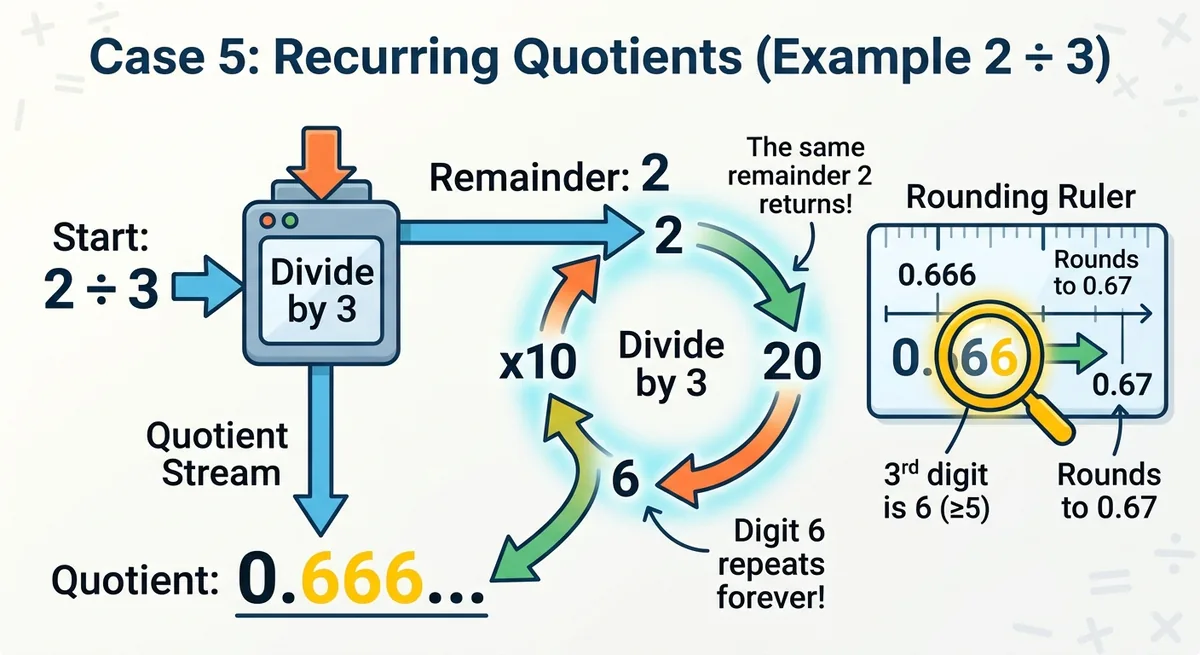
Some divisions finish neatly. Others repeat forever. Your child needs to know which is which, or they will assume the endless ones are their fault. A quotient that stops is terminating. One that repeats is recurring.
Example 15: 2 ÷ 3. Write 0 and a point, then add zeros. 20 ÷ 3 = 6, remainder 2. Add a zero: 20 again, 6 again, remainder 2 again. The remainder keeps returning, so the digit keeps repeating. 0.6666… rounds to 0.67 to 2 decimal places. Once a remainder appears twice, your child can stop.
Example 16: 10 ÷ 7. The remainders run 3, 2, 6, 4, 5, 1 and then back to 3, so the digits 142857 repeat forever: 1.142857142857… Rounded to 2 decimal places, 1.14.
To round, work out one digit more than you need, then look at it. Five or above rounds the previous digit up; below 5 leaves it alone. The logic matches rounding to the nearest 10, shifted along the place value chart.
Why do some divisions never end? A division terminates only when the divisor, in simplest form, is built from 2s and 5s. Dividing by 4, 5, 8, 20 or 25 always finishes. Dividing by 3, 7, 9 or 11 usually does not, which is easier to see once your child knows the divisibility rules.
Case 6: Dividing by 10, 100, 1000 and by 0.1, 0.01, 0.001
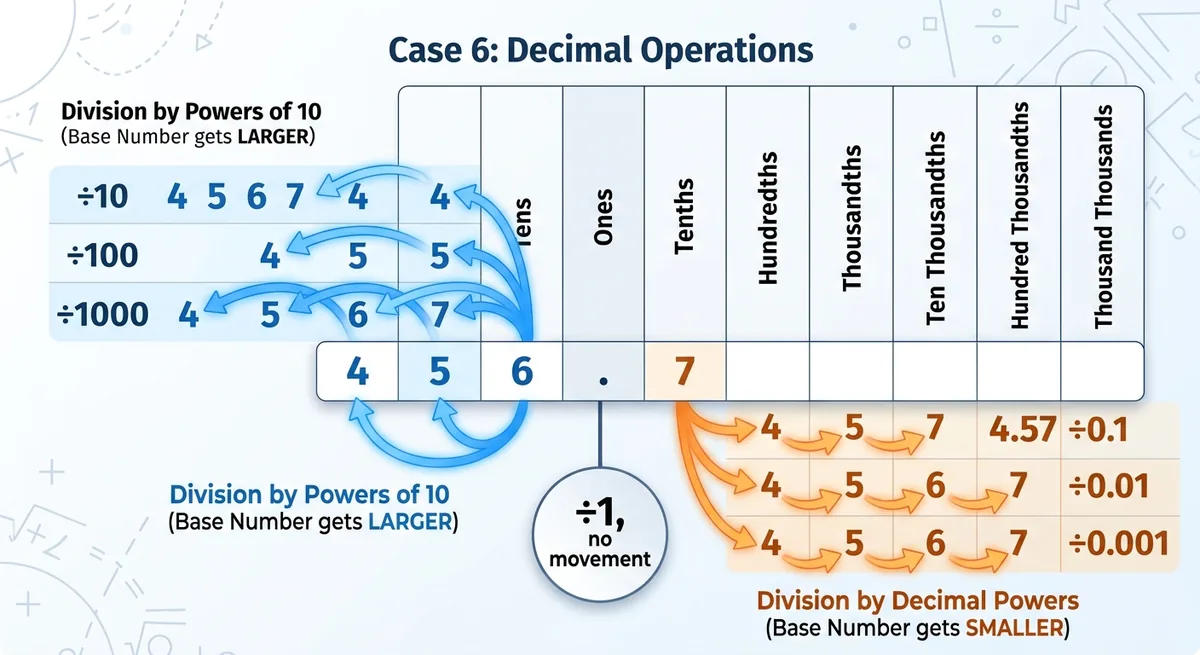
These need no long division at all. The decimal point does the work.
Shift left. Dividing by a power of 10 moves the point one place left for every zero.
| Division | Places left | Answer |
|---|---|---|
| 456.7 ÷ 10 | 1 | 45.67 |
| 456.7 ÷ 100 | 2 | 4.567 |
| 456.7 ÷ 1000 | 3 | 0.4567 |
| 8.2 ÷ 100 | 2 | 0.082 |
Why left? Because dividing makes each digit worth less. Every digit slides one column down the place value chart, exactly as it does in expanded form. The point looks like it moves; what really moves is the digits. Notice the last row: a zero had to be inserted to hold the places, giving 0.082 and not 0.82.
Shift right. Dividing by 0.1, 0.01 or 0.001 moves the point to the right.
| Division | Places right | Answer |
|---|---|---|
| 4.5 ÷ 0.1 | 1 | 45 |
| 4.5 ÷ 0.01 | 2 | 450 |
| 4.5 ÷ 0.001 | 3 | 4500 |
| 36 ÷ 0.1 | 1 | 360 |
Every answer is bigger, and children find this genuinely shocking. The reason is the one from Case 3. Asking how many tenths are in 4.5 gives 45, because every whole unit holds ten of them. Dividing by one tenth does the same job as multiplying by 10.
Set the patterns side by side and the symmetry teaches itself. Dividing by 1000, 100 and 10 moves the point 3, 2 and 1 places left. Dividing by 1 moves nothing. Dividing by 0.1, 0.01 and 0.001 moves it 1, 2 and 3 places right. It is one continuous pattern that passes straight through 1 and keeps going.
Where students go wrong, and how to fix it
Moving the point in only the divisor. 1.2 ÷ 0.4 becomes 1.2 ÷ 4 and gives 0.3 instead of 3. Fix: make the two moves one action. Say “both” out loud, and draw the two arrows together before writing anything.
Misplacing the point in the quotient. Right digits, wrong size: 6.3 written as 63 or 0.63. Fix: place the point in the quotient before dividing, then estimate afterwards.
Forgetting leading zeros. 0.06 ÷ 3 answered as 0.2. Fix: write a zero in the quotient every time the divisor does not go into a column. Treat an empty column as an error.
Assuming the answer must be smaller. A child gets 300 for 45 ÷ 0.15 and changes it to 0.3 because 300 looks wrong. Fix: the bigger-or-smaller prediction drill from Case 3.
Stopping at “remainder”. Fix: a standing rule. If the question has a decimal in it, the answer is a decimal. Add zeros and keep going.
Mixing up dividend and divisor. Children are taught the smaller number is the divisor, which fails on 0.5 ÷ 2. Fix: read the problem aloud in words. “Half a litre shared between 2 people” makes it obvious.
Losing the columns. Fix: squared paper, one digit per box. This corrects more errors than any amount of explaining.
Real-life decimal division problems
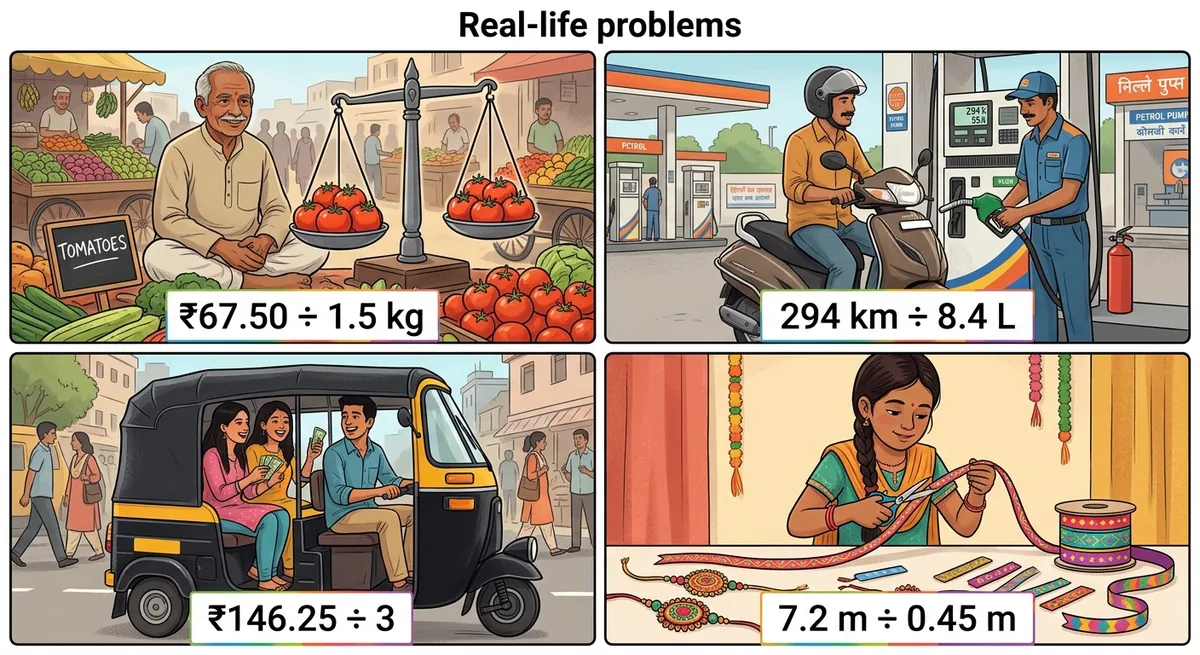
Decimal division genuinely shows up at the vegetable market. These follow the usual approach to solving maths word problems: work out what is being shared or grouped first, then divide.
1. Unit price. Tomatoes cost ₹67.50 for 1.5 kg. Move one place: 675 ÷ 15 = ₹45 per kg
2. Fuel efficiency. A scooter travels 294 km on 8.4 litres. Move one place: 2940 ÷ 84 = 35 km per litre
3. Sharing a cost. Three friends split an auto fare of ₹146.25. 146.25 ÷ 3 = ₹48.75 each
4. Cutting lengths. 7.2 m of ribbon cut into 0.45 m pieces for rakhis. Move two places: 720 ÷ 45 = 16 pieces. Ask first whether the answer will be more or less than 7.2.
5. How much can you buy? Milk is ₹42.50 a litre and you have ₹255. Move two places: 25500 ÷ 4250 = 6 litres
6. Average. A family uses 93.6 units of electricity in 4 weeks. 93.6 ÷ 4 = 23.4 units a week
Problems 1, 2 and 5 are the same question in different clothing: how much for one. That is the shape to recognise. Problems involving grams, millilitres or centimetres often need a metric conversion first.
How decimal division connects to everything else
To fractions. The proof in this guide is fraction division. A child who sees this gets both topics at once.
To place value. Moving a point is moving digits between columns. If place value is secure, decimal division is nearly free.
To long division. Nothing new happens in the arithmetic. Only the setup changed. Saying this plainly removes a lot of anxiety.
To percentages and ratio. 37 ÷ 50 = 0.74 = 74%. Unit rates and the unitary method all run on decimal division.
To Olympiad work. Olympiad questions rarely ask you to divide decimals; they ask things where dividing decimals is the move to spot. Which is larger, 1 ÷ 0.125 or 1 ÷ 0.25? A child who has internalised “smaller divisor, bigger answer” answers without calculating. Simplify 0.36 ÷ 0.006: multiply both by 1000 and it is 360 ÷ 6 = 60, done mentally. That flexible scaling habit is what Olympiad problem solving rewards.
8 activities and games
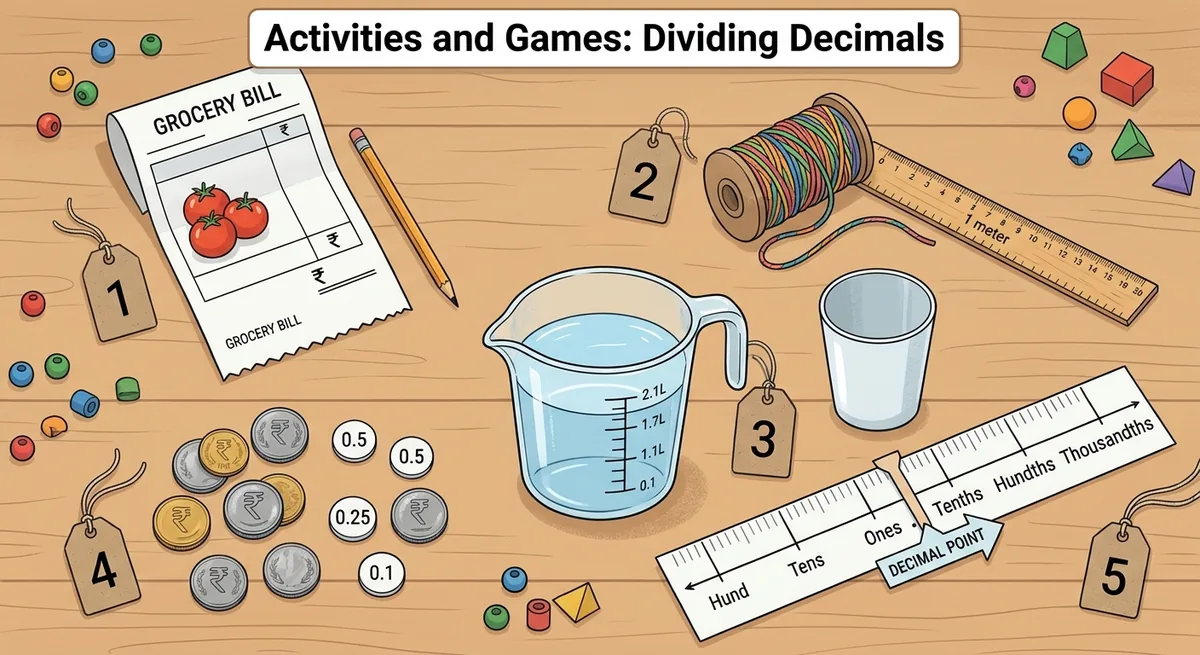
All of these use things already in the house.
1. Market bill detective. Cover the rate column on a real grocery bill and have your child work it out from the total and the quantity.
2. Ribbon cutting. Give them 1.5 m of string and ask how many 0.25 m pieces they can cut. Predict, calculate, then actually cut and count.
3. Measuring jug sharing. Pour 1.2 litres and ask them to share it equally into 4 glasses. Water makes the division visible.
4. Paise pile. Use coins or paper slips marked 0.5, 0.25 and 0.1. How many 0.25s make 2? How many 0.1s make 1.5?
5. Estimation duel. Both of you shout an estimate within five seconds, then solve properly and see who was closer.
6. Decimal point slider. Write 456.7 on a paper strip and make a sliding paper arrow for the point. Call out “divide by 100” or “divide by 0.1” and they slide it. Two minutes a day makes Case 6 automatic.
7. Petrol pump. You are the attendant, your child has ₹500, petrol is ₹104.50 a litre. How many full litres, and how much change?
8. Bigger or smaller sort. Write ten divisions on slips (8 ÷ 0.4, 8 ÷ 4, 8 ÷ 0.95, 8 ÷ 1.2) and have them sorted into two piles without calculating.
Tips for parents
Ask “why” before “what”. If the answer to why they moved the point is “because that is the rule”, go back to the fraction proof.
Do not rescue too early. When they stall, ask only two questions: what is the divisor, and is it a whole number yet?
Insist on squared paper. Most wrong answers here are correct arithmetic in the wrong columns.
Make estimation compulsory, one guess before and one check after. Thirty seconds, and it catches the errors that cost marks.
When 12 ÷ 0.5 = 24 appears, do not let them “correct” it. That answer is proof they understood something real. And keep sessions to fifteen focused minutes.
Tips for teachers
Teach the reason before the algorithm. Spend the first lesson on equivalent division (12 ÷ 4, 120 ÷ 40, 1200 ÷ 400 all give 3) before decimals appear at all.
Sequence the cases deliberately: decimal by whole number, then decimal by decimal, then whole number by decimal.
Use a hundredths grid early. Shading 1.1 and splitting it into 2 groups shows why the answer is 0.55 better than any algorithm will.
Make the bigger-or-smaller vote a routine, and mark digits and decimal placement as two separate things so students who misplace one point do not lose everything.
Budget extra time for the ÷ 0.1 lesson. It contradicts four years of intuition, so let students argue it out.
Practice questions with answers
- 6.8 ÷ 2
- 0.08 ÷ 4
- 45.36 ÷ 6
- 8.4 ÷ 0.7
- 2.76 ÷ 0.4
- 0.882 ÷ 0.21
- 9 ÷ 0.3
- 24 ÷ 0.08
- 15 ÷ 0.75
- 7 ÷ 8
- 20.4 ÷ 8
- 5 ÷ 6 (to 2 decimal places)
- 4 ÷ 11 (to 2 decimal places)
- 36.5 ÷ 1000
- 2.8 ÷ 0.01
- 0.144 ÷ 0.012
- A rope 11.25 m long is cut into 0.75 m pieces. How many pieces?
- 4.5 kg of dal costs ₹306. What is the price per kilogram?
- Without calculating, which is larger: 5 ÷ 0.2 or 5 ÷ 2?
- A car covers 487.5 km on 32.5 litres. What is its mileage?
Answers. 1. 3.4 · 2. 0.02 · 3. 7.56 · 4. 12 · 5. 6.9 · 6. 4.2 · 7. 30 · 8. 300 · 9. 20 · 10. 0.875 · 11. 2.55 · 12. 0.83 · 13. 0.36 · 14. 0.0365 · 15. 280 · 16. 12 · 17. 15 pieces · 18. ₹68 per kg · 19. 5 ÷ 0.2, because a smaller divisor gives a bigger answer (25 against 2.5) · 20. 15 km per litre
Frequently asked questions
How do you divide decimals?
Make the divisor a whole number by moving its decimal point right, move the dividend’s point the same number of places right, then divide as usual and place the point in the answer directly above the one in the dividend. If the divisor is already whole, go straight to dividing.
How do you divide a decimal by a decimal?
Count the decimal places in the divisor and move the point that many places right in both numbers. For 7.38 ÷ 0.6, the divisor has one place, so it becomes 73.8 ÷ 6 = 12.3.
Why do you move the decimal point in both numbers?
A division is a fraction, and multiplying top and bottom by the same number does not change its value. Moving the point one place right multiplies by 10. Do it to one number only and the answer comes out ten times wrong.
Can the answer be bigger than the number you started with?
Yes, whenever the divisor is less than 1. 12 ÷ 0.5 = 24, because there are 24 halves in 12.
What do you do when there is a remainder?
Add a zero to the dividend after the decimal point, bring it down and keep dividing. 9.000 is the same number as 9, so nothing has been changed.
Why does 2 ÷ 3 never finish?
The same remainder keeps returning, so the same digit repeats. Divisions end neatly only when the divisor, in simplest form, is built from 2s and 5s. Round recurring answers to the places asked for.
How do you divide by 10, 100 or 1000?
Move the point one place left for each zero. 456.7 ÷ 100 = 4.567. Write zeros in if you run out of digits: 8.2 ÷ 100 = 0.082.
What happens when you divide by 0.1?
The point moves one place right and the answer gets ten times bigger. 4.5 ÷ 0.1 = 45. Dividing by 0.01 moves it two places and by 0.001 three places.
In which class do Indian students learn this?
Under CBSE and NCERT, Class 5 introduces dividing decimals by whole numbers and by 10, 100 and 1000. Class 6 extends it, and Class 7 covers decimal by decimal in full alongside fraction division.
How can I check an answer quickly?
Multiply the quotient by the divisor. If you get the dividend back, the answer is right. 2.25 × 4 = 9, so 9 ÷ 4 = 2.25 is correct.
Putting it all together
Everything here comes from one idea: multiply the divisor and the dividend by the same number and the answer does not change. Make the divisor whole, move the dividend the same amount, divide, estimate to check.
The six cases are not six methods. They are one method meeting six different-looking sums. Once your child can explain why both points move together, and can predict whether the answer will be bigger or smaller before working it out, the confusion is finished.

Mikha Piregu is a Content Writer with experience spanning educational content, including math and math olympiad topics, as well as advocacy writing, research-based articles, and SEO-driven web content. He creates high-quality blog content, web copy, and feature articles that support brand visibility, audience engagement, and long-term organic growth through data-informed storytelling. Skilled in WordPress, WooCommerce, and modern digital tools, Mikha adapts content across various platforms, including blogs, websites, campaigns, and advocacy initiatives, with clarity and purpose.


There are no comments posted here yet.
Sign in to leave a comment