

A place value chart is a table that organises the digits of a number into columns, where each column shows the exact value of the digit placed in it. Every column is worth ten times the column immediately to its right.
- What is a place value chart?
- The Indian place value chart: ones to crores
- The international place value chart: ones to millions
- Indian vs international place value system
- Commas and periods in large numbers
- How to read any large number using a place value chart
- How to write a number in standard form
- Expanded form using the place value chart
- Word form and number names
- How zero works as a placeholder
- Comparing and ordering large numbers
- Large numbers in real life
- Common mistakes Class 4 students make
- Eight place value activities and games
- Tips for parents
- Tips for teachers
- Place value in Olympiad problems
- Conclusion
The Indian place value chart has nine columns: ones, tens, hundreds, thousands, ten thousands, lakhs, ten lakhs, crores and ten crores. The international place value chart has the same nine positions named differently: ones, tens, hundreds, thousands, ten thousands, hundred thousands, millions, ten millions and hundred millions.
To use a place value chart, write one digit per column starting from the right. The column each digit lands in tells you what that digit is worth.
This guide gives you the complete Indian chart from ones to crores, the international chart from ones to millions, and more importantly, it shows you how to actually use the chart as a teaching tool at home or in class.
What is a place value chart?
A place value chart is a table with one column for each place in a number, arranged so that every column is worth ten times the column immediately to its right. You write one digit in each column, starting from the right. The column a digit lands in tells you what that digit is worth.
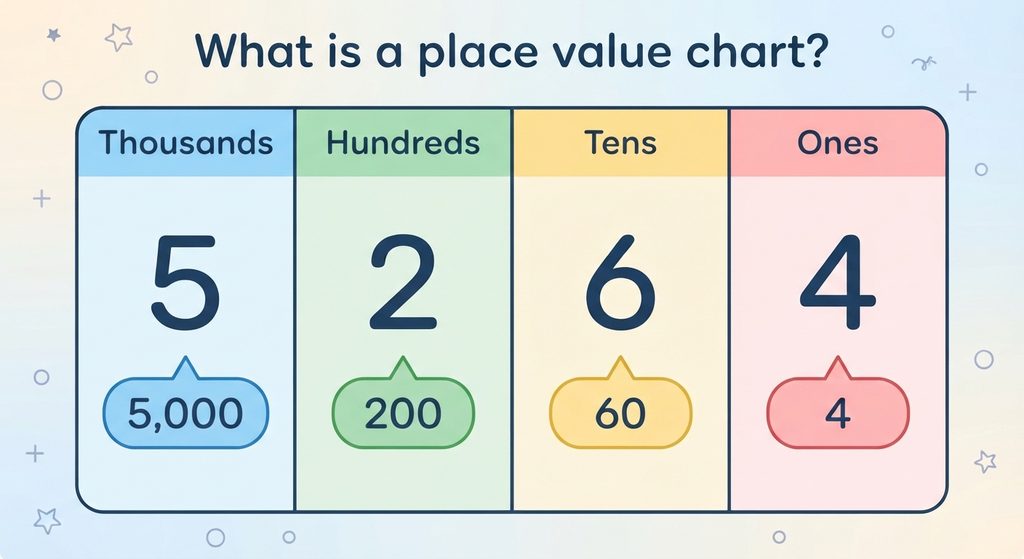
Take the number 5,264. The digit 5 sits in the thousands column, so it is worth 5,000. The 2 sits in the hundreds column and is worth 200. The 6 is worth 60 and the 4 is worth 4. The digits themselves have not changed. Their positions did all the work.
| Thousands | Hundreds | Tens | Ones |
|---|---|---|---|
| 5 | 2 | 6 | 4 |
| 5,000 | 200 | 60 | 4 |
This is the single idea a Class 4 student needs to hold on to: the same digit takes a different value depending on where it sits. The 7 in 74 is worth 70. The 7 in 7,400 is worth 7,000. The 7 in 7,00,000 is worth seven lakh. A place value chart makes that difference visible instead of abstract.
Why the chart matters more in Class 4 than it did earlier
In Classes 1 to 3, numbers stay small enough that children can often manage by memory and pattern. A three digit number has a familiar shape and children learn to read it almost like a word. Class 4 is where that stops working, because this is the year numbers cross into five, six and seven digits, and where lakhs enter the picture for the first time in most Indian textbooks.
At that size, memory fails and structure has to take over. Children who have secured place value for Class 1 with ones and tens have the foundation for this. A child who can point to a column and say “this one is the ten thousands place” can read 47,306 correctly. A child guessing from the shape of the number will read it as “four seven three zero six” or “forty-seven thousand three hundred six” with no idea whether that is right.
Face value and place value
Two words come up constantly at this stage, and mixing them up causes a lot of confusion.
- Face value is simply the digit itself. The face value of 6 in 6,842 is 6.
- Place value is the digit multiplied by the value of its column. The place value of 6 in 6,842 is 6,000.
A quick way to check understanding: ask your child for the face value and the place value of the 9 in 9,05,132. Face value is 9. Place value is 9,00,000, or nine lakh.
The Indian place value chart: ones to crores
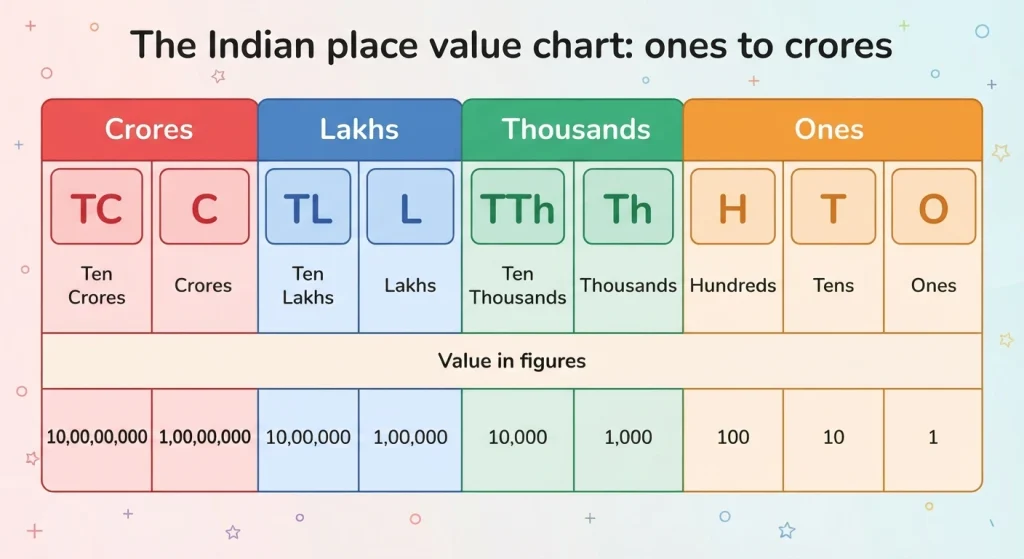
The Indian number system groups the nine places into four periods. This grouping is what makes the Indian system different from the international one, and it is the part children most often get muddled about.
The four periods
- Ones period: ones, tens, hundreds (three places)
- Thousands period: thousands, ten thousands (two places)
- Lakhs period: lakhs, ten lakhs (two places)
- Crores period: crores, ten crores (two places)
Notice the pattern. The first period holds three places. Every period after it holds two. This is why Indian commas follow a 3, then 2, then 2 rhythm.
The complete Indian place value chart
| Period | Place | Value in figures | Value in words |
|---|---|---|---|
| Crores | Ten crores | 10,00,00,000 | Ten crore |
| Crores | Crores | 1,00,00,000 | One crore |
| Lakhs | Ten lakhs | 10,00,000 | Ten lakh |
| Lakhs | Lakhs | 1,00,000 | One lakh |
| Thousands | Ten thousands | 10,000 | Ten thousand |
| Thousands | Thousands | 1,000 | One thousand |
| Ones | Hundreds | 100 | One hundred |
| Ones | Tens | 10 | Ten |
| Ones | Ones | 1 | One |
Read that table from the bottom up and you can see each value multiplying by ten, the same ten-times number sequence pattern children meet much earlier: 1, 10, 100, 1,000, 10,000, 1,00,000, 10,00,000, 1,00,00,000, 10,00,00,000.
The chart in working form
For everyday classroom use, a place value chart is usually drawn left to right with the largest place first. Here is the number 3,47,21,586 placed into it.
| TC | C | TL | L | TTh | Th | H | T | O |
|---|---|---|---|---|---|---|---|---|
| 3 | 4 | 7 | 2 | 1 | 5 | 8 | 6 |
The abbreviations are worth teaching early because textbooks and worksheets use them constantly: TC for ten crores, C for crores, TL for ten lakhs, L for lakhs, TTh for ten thousands, Th for thousands, H for hundreds, T for tens, O for ones.
The international place value chart: ones to millions
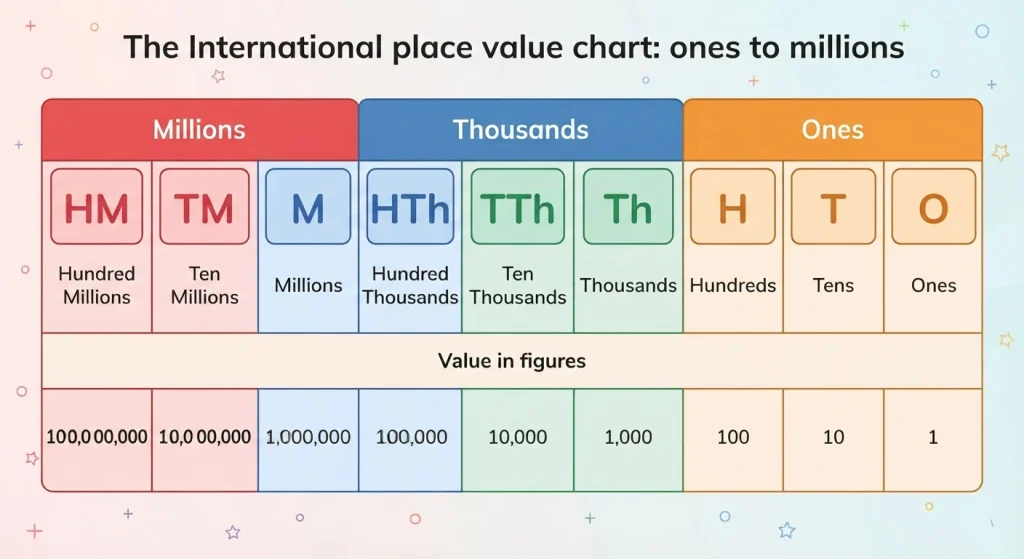
The international system uses the same nine places but groups them differently. Instead of four periods with a 3-2-2 rhythm, it uses three periods of three places each.
The three periods
- Ones period: ones, tens, hundreds
- Thousands period: thousands, ten thousands, hundred thousands
- Millions period: millions, ten millions, hundred millions
The complete international place value chart
| Period | Place | Value in figures | Value in words |
|---|---|---|---|
| Millions | Hundred millions | 100,000,000 | One hundred million |
| Millions | Ten millions | 10,000,000 | Ten million |
| Millions | Millions | 1,000,000 | One million |
| Thousands | Hundred thousands | 100,000 | One hundred thousand |
| Thousands | Ten thousands | 10,000 | Ten thousand |
| Thousands | Thousands | 1,000 | One thousand |
| Ones | Hundreds | 100 | One hundred |
| Ones | Tens | 10 | Ten |
| Ones | Ones | 1 | One |
The place that exists in one system but not the other is the tricky one. Where the Indian chart says “lakh”, the international chart says “hundred thousand”. Where the Indian chart says “ten lakh”, the international chart says “million”. Same position, different name.
Three conversions are worth memorising:
- 1 lakh = 100 thousand
- 10 lakh = 1 million
- 1 crore = 10 million
Indian vs international place value system
Here is the comparison that clears up most of the confusion, side by side.
| Feature | Indian system | International system |
|---|---|---|
| Number of periods | Four: ones, thousands, lakhs, crores | Three: ones, thousands, millions |
| Comma pattern | 3, then 2, then 2 | 3, then 3, then 3 |
| First comma | After three digits from the right | After three digits from the right |
| Later commas | After every two digits | After every three digits |
| Place after ten thousands | Lakh | Hundred thousand |
| Place after lakh | Ten lakh | Million (one place further left) |
| Where it is used | India, Bangladesh, Pakistan, Nepal, Sri Lanka | Most other countries, and in science and international reporting |
Now watch the same number written in both systems.
The number 32,45,678
| System | Written form | Read as |
|---|---|---|
| Indian | 32,45,678 | Thirty-two lakh forty-five thousand six hundred seventy-eight |
| International | 3,245,678 | Three million two hundred forty-five thousand six hundred seventy-eight |
The digits are identical. The commas and the names are not. Point this out explicitly to your child, because a number like 32,45,678 and 3,245,678 look like different numbers to a nine year old, and quite reasonably so.
Commas and periods in large numbers
Commas are not decoration. They mark the boundaries between periods, and they are the fastest route to reading a long number correctly.
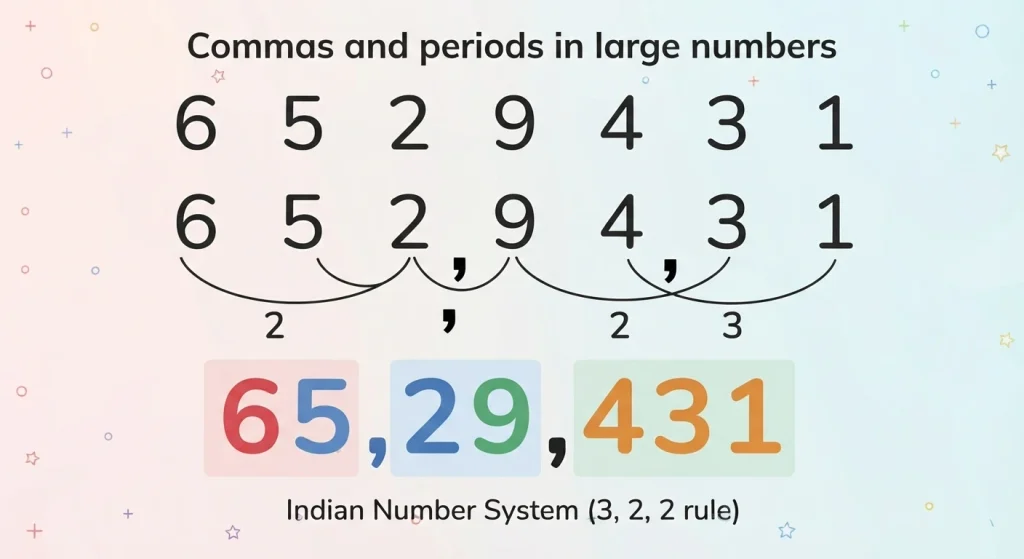
Placing commas in the Indian system
- Start from the rightmost digit.
- Count three digits and place a comma.
- From there, count two digits and place a comma.
- Keep counting two digits at a time and placing commas until you run out of digits.
Take 6529431. Count three from the right: 431. Comma. Count two: 29. Comma. Count two: 65. Result: 65,29,431.
Placing commas in the international system
- Start from the rightmost digit.
- Count three digits and place a comma.
- Repeat in threes until you run out of digits.
The same number becomes 6,529,431.
A useful classroom habit
Get children to place the commas before they attempt to read the number. Reading a naked string of seven digits is hard. Reading 65,29,431 is much easier because each chunk maps to a period name they already know.
How to read any large number using a place value chart
This is the core skill, so here it is as a repeatable procedure your child can follow every single time.
Step 1: Write the digits into the chart, one per column, starting from the right.
Always fill from the right. Filling from the left is the single most common cause of wrong answers.
Step 2: Place the commas according to the Indian period pattern.
Three digits, then two, then two.
Step 3: Read each period from left to right, saying the period name after it.
Say the digits in a period as a normal two or three digit number, then say “crore”, “lakh” or “thousand”.
Step 4: Read the ones period last, with no period name after it.
The ones period is never followed by a word.
Step 5: Skip any period that is entirely zeros.
If the thousands period reads 00, you do not say “zero thousand”. You simply move on.
Worked walkthrough
Read the number 8407291.
Place it in the chart:
| TL | L | TTh | Th | H | T | O |
|---|---|---|---|---|---|---|
| 8 | 4 | 0 | 7 | 2 | 9 | 1 |
Add commas: 84,07,291.
Read period by period: “84” is in the lakhs period, so eighty-four lakh. “07” is in the thousands period, so seven thousand. “291” is the ones period, so two hundred ninety-one.
The number reads: Eighty-four lakh seven thousand two hundred ninety-one.
How to write a number in standard form
Standard form is the number written in ordinary digits, which is what the place value chart produces directly.
Suppose a child hears “six lakh thirty thousand four hundred five” and has to write it.
Step 1: Draw a chart with columns up to lakhs.
Step 2: Fill the periods one at a time. Six lakh means 6 in the lakhs column. Thirty thousand means 3 in the ten thousands column and 0 in the thousands column. Four hundred five means 4 in the hundreds column, 0 in the tens column, 5 in the ones column.
| L | TTh | Th | H | T | O |
|---|---|---|---|---|---|
| 6 | 3 | 0 | 4 | 0 | 5 |
Step 3: Read the digits off in order and add commas: 6,30,405.
The chart does the difficult part, which is remembering that “thirty thousand” fills two columns and “four hundred five” needs a zero in the tens place.
Expanded form using the place value chart
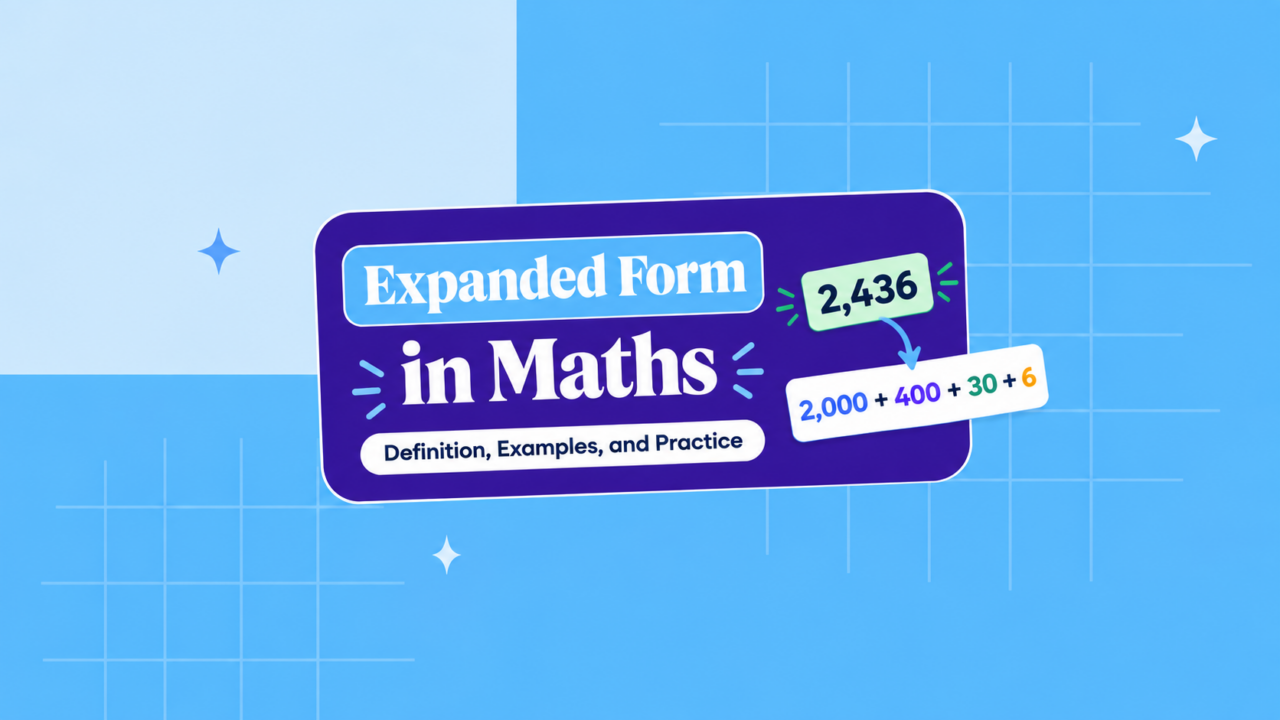
Expanded form breaks a number into the sum of its place values. Once a number is sitting in a chart, expanded form is almost automatic, because each column already tells you its value.
Example: 5,82,647
| L | TTh | Th | H | T | O |
|---|---|---|---|---|---|
| 5 | 8 | 2 | 6 | 4 | 7 |
Expanded form: 5,00,000 + 80,000 + 2,000 + 600 + 40 + 7
You can also write it in the multiplication style, which many Class 4 textbooks prefer because it makes the structure explicit:
(5 × 1,00,000) + (8 × 10,000) + (2 × 1,000) + (6 × 100) + (4 × 10) + (7 × 1)
A note on zeros. In 4,06,309, the ten thousands column and the tens column both hold zero. Those terms contribute nothing to the sum, so the expanded form is 4,00,000 + 6,000 + 300 + 9. Children often want to write “0” as a term. It is not wrong, but the shorter version is what most textbooks expect.
Word form and number names
Word form, also called number names, is the number written out in words. The place value chart handles this too, using the same period-by-period reading from earlier.
| Number | Indian word form |
|---|---|
| 7,042 | Seven thousand forty-two |
| 56,309 | Fifty-six thousand three hundred nine |
| 2,18,470 | Two lakh eighteen thousand four hundred seventy |
| 40,06,215 | Forty lakh six thousand two hundred fifteen |
| 1,23,45,678 | One crore twenty-three lakh forty-five thousand six hundred seventy-eight |
Two small rules worth reinforcing:
- Never write “and” inside a whole number name in the Indian school convention. It is “four hundred five”, not “four hundred and five”.
- Never write a period name for a period that is all zeros. In 40,06,215 there is no “zero lakh” anywhere in the answer, but the 06 in the thousands period does get read as “six thousand”.
How zero works as a placeholder
Zero is the hardest digit in the whole chart for Class 4 students, because it looks like nothing and behaves like something.
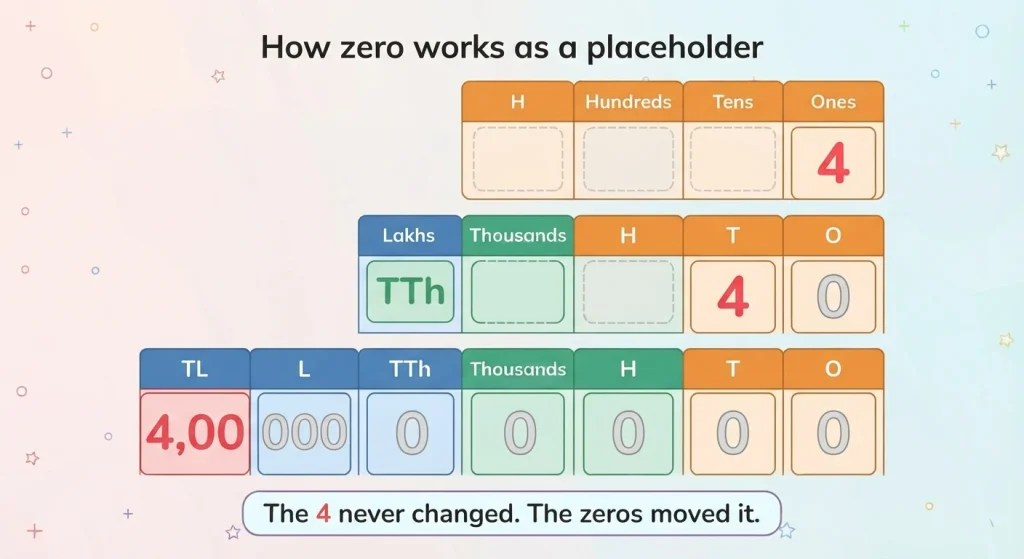
Zero holds a column open. It says “this place is empty, but it still exists, so everything to my left has to stay where it is.”
Compare these three numbers:
| Number | What the 4 is worth |
|---|---|
| 4 | Four |
| 40 | Forty |
| 4,00,000 | Four lakh |
The 4 never changed. The zeros pushed it leftward into bigger and bigger columns. Remove a zero and the 4 slides back down.
The classic zero errors
Writing “six thousand five” as 65. The child hears two chunks and writes two digits. Put it in the chart and the gap becomes obvious: 6 in thousands, nothing in hundreds, nothing in tens, 5 in ones. That means 6,005.
Writing “three lakh forty” as 3,40. Same mistake, larger scale. The chart forces six columns: 3, 0, 0, 0, 4, 0, which gives 3,00,040.
Dropping a zero from the middle. Writing 4,06,309 as 4,6,309. This is where insisting on a chart, not mental arithmetic, pays off.
A good drill: say a number out loud, have your child draw the empty chart first with the right number of columns, and only then fill digits in. The empty columns cannot be forgotten if they are drawn before the digits arrive.
Comparing and ordering large numbers
Place value gives a reliable method for comparing numbers, and it removes all guesswork. It is the same skill as number ordering in earlier classes, just with more columns.
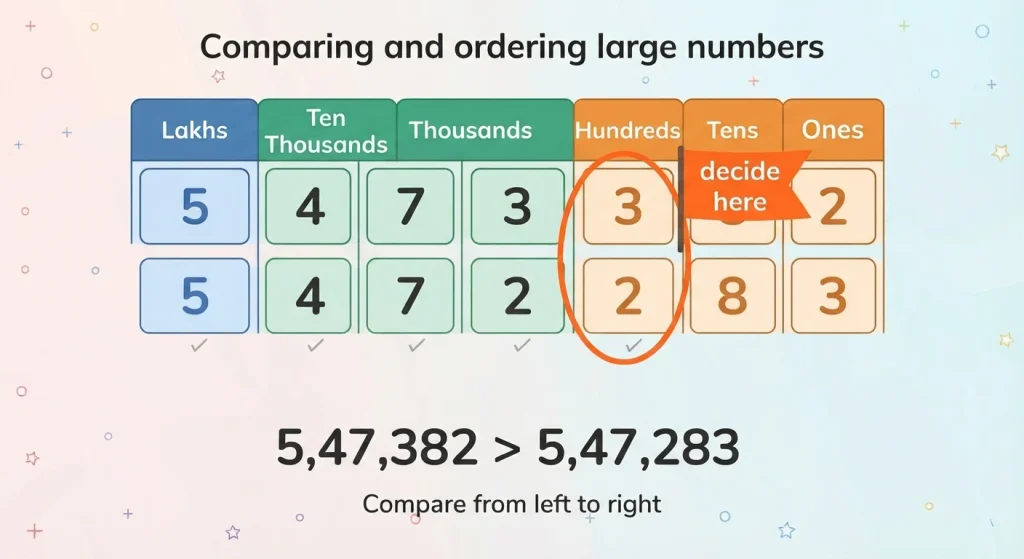
Step 1: Count the digits. The number with more digits is larger. 1,24,567 has six digits and 98,765 has five, so 1,24,567 is larger. No further work needed.
Step 2: If the digit counts match, compare from the left. Line both numbers up in a chart and compare column by column, starting with the largest place.
Step 3: Stop at the first column where they differ. That column decides the answer.
Example: compare 5,47,382 and 5,47,283
| Number | L | TTh | Th | H | T | O |
|---|---|---|---|---|---|---|
| A | 5 | 4 | 7 | 3 | 8 | 2 |
| B | 5 | 4 | 7 | 2 | 8 | 3 |
Lakhs match. Ten thousands match. Thousands match. Hundreds: 3 against 2. Number A wins. So 5,47,382 > 5,47,283.
Notice that B ends in a larger digit. Children who compare from the right get this wrong every time. Comparing from the left is the habit to build.
Ordering a set
The rules for ascending and descending order do not change with larger numbers. To arrange 4,05,612, 45,612, 4,50,612 and 4,05,162 in ascending order, first sort by digit count. 45,612 has five digits, so it is smallest. The other three all have six. Compare them from the left: all start with 4, then 0, 5 and 0. So 4,50,612 is the largest of the three. Between 4,05,612 and 4,05,162, the thousands digits match at 5, and the hundreds are 6 against 1.
Ascending order: 45,612 < 4,05,162 < 4,05,612 < 4,50,612
Worked examples from 4 digits to 7 digits
Work through these in order. Each one adds exactly one new column.
Example 1: a four digit number, 3,758
| Th | H | T | O |
|---|---|---|---|
| 3 | 7 | 5 | 8 |
- Place value of 3: 3,000
- Expanded form: 3,000 + 700 + 50 + 8
- Word form: Three thousand seven hundred fifty-eight
Example 2: a five digit number, 62,904
| TTh | Th | H | T | O |
|---|---|---|---|---|
| 6 | 2 | 9 | 0 | 4 |
- Place value of 6: 60,000
- Expanded form: 60,000 + 2,000 + 900 + 4
- Word form: Sixty-two thousand nine hundred four
- Note the zero in the tens column. It is not spoken, but it must be written.
Example 3: a six digit number, 4,73,015
| L | TTh | Th | H | T | O |
|---|---|---|---|---|---|
| 4 | 7 | 3 | 0 | 1 | 5 |
- Place value of 4: 4,00,000
- Expanded form: 4,00,000 + 70,000 + 3,000 + 10 + 5
- Word form: Four lakh seventy-three thousand fifteen
- International form: 473,015, read as four hundred seventy-three thousand fifteen
Example 4: a seven digit number, 58,20,647
| TL | L | TTh | Th | H | T | O |
|---|---|---|---|---|---|---|
| 5 | 8 | 2 | 0 | 6 | 4 | 7 |
- Place value of 5: 50,00,000, or fifty lakh
- Expanded form: 50,00,000 + 8,00,000 + 20,000 + 600 + 40 + 7
- Word form: Fifty-eight lakh twenty thousand six hundred forty-seven
- International form: 5,820,647, read as five million eight hundred twenty thousand six hundred forty-seven
By example four, a child who has followed the progression is doing nothing new. They are filling one more column than before.
Large numbers in real life
Abstract numbers stay abstract until they attach to something. These contexts work well because Class 4 children have some feel for all of them.
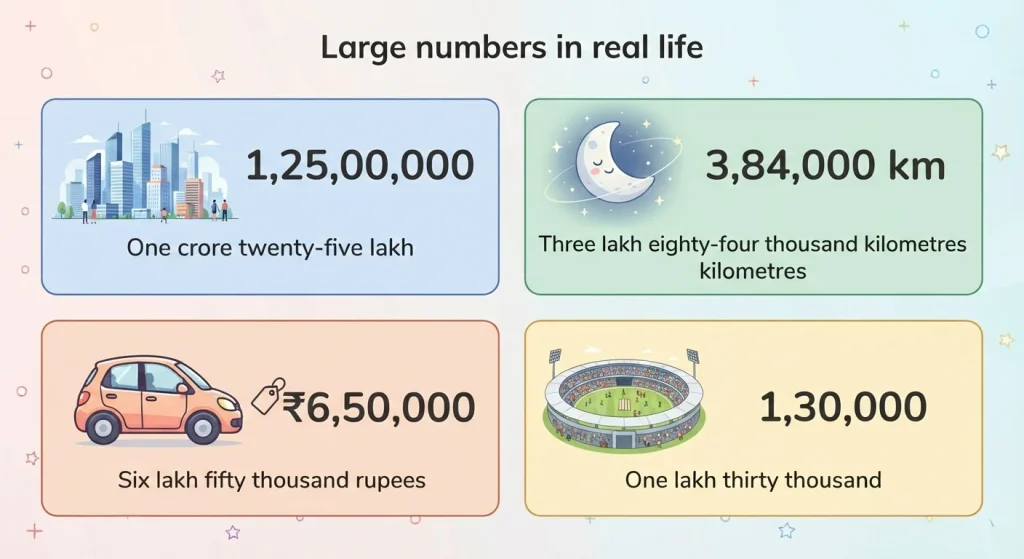
Population. Mumbai has roughly 1,25,00,000 people. Written out, that is one crore twenty-five lakh. Ask your child to place it in a chart and identify which digit sits in the crores column.
Distance. The distance from the Earth to the Moon is about 3,84,000 kilometres. Three lakh eighty-four thousand.
Money. A small family car might cost 6,50,000 rupees. Six lakh fifty thousand rupees. Children who have worked through money word problems in Class 3 will pick this up fastest. Prices in rupees are the most natural entry point of all, because children hear lakh figures used about cars, flats and school fees constantly.
Sports and events. A large cricket stadium seats about 1,30,000 people. One lakh thirty thousand.
Books and pages. A library with 45,000 books. Forty-five thousand.
Pick a number from a newspaper or a price board each day, write it in a chart together, and ask one question about it: which digit is in the lakhs place? What is the place value of the 7? How would you write this in the international system? Two minutes a day builds more fluency than an hour of worksheets on a Sunday.
Common mistakes Class 4 students make
Filling the chart from the left
A child writes 4,528 into a chart that has six columns and starts at the leftmost box, producing 4,52,800. Always fill from the right. Say it every time until it is automatic.
Confusing Indian and international commas
Writing 1234567 as 1,234,567 when the question asked for the Indian system. Fix this by having the child say the comma rule out loud before placing any commas: “three, then two, then two.”
Reading a period name for an empty period
Reading 40,06,215 as “forty lakh zero thousand six thousand two hundred fifteen”. An empty period is skipped entirely.
Mixing up face value and place value
The place value of 8 in 48,392 is 8,000, not 8. Ask for both values in the same breath so the child has to distinguish them.
Assuming more digits at the end means a bigger number
Believing 5,47,283 is larger than 5,47,382 because it ends in 3. Compare from the left.
Saying “add a zero to multiply by 10”
This works for whole numbers and then collapses the moment decimals arrive in Class 5. Teach the movement instead: multiplying by 10 shifts every digit one column to the left, and the ones column empties out, which is why a zero appears.
Losing track of the lakhs place
Many children can handle up to ten thousands and then stall. The lakh is genuinely a new idea, not just a bigger number. Spend a whole session on the lakhs column alone before moving to crores.
Eight place value activities and games
All of these use materials you already have at home or in a classroom. For more ideas beyond place value, a general set of math games works well alongside them.
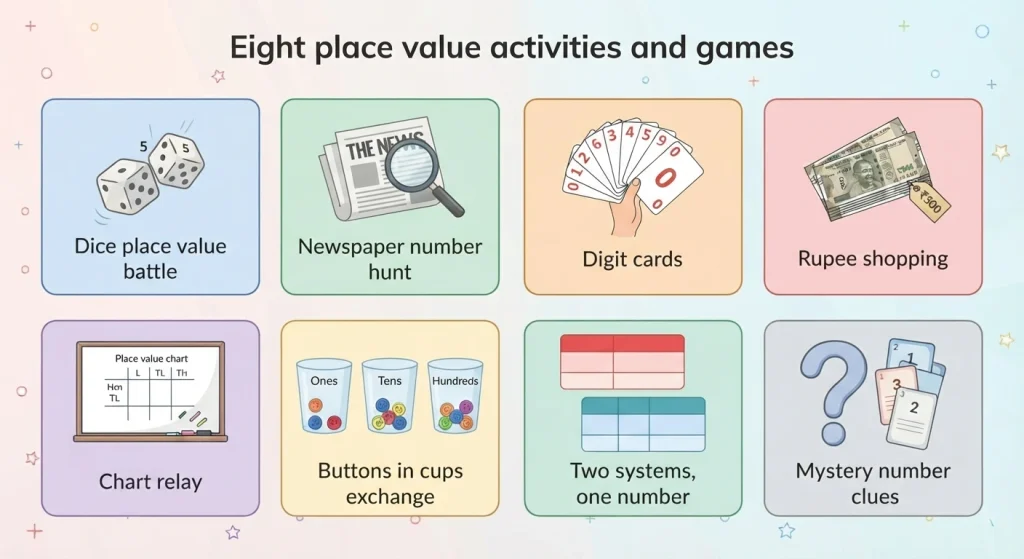
1. Dice place value battle. Roll a die five times. After each roll, the player chooses which column to write the digit in. Once written, it cannot be moved. Largest number wins. This forces children to reason about place value under uncertainty, which is much harder than filling a chart in order.
2. Newspaper number hunt. Give each child a newspaper page and five minutes to find the largest number on it. They write it into a chart, place the commas and read it out loud. Population and price figures make this rich.
3. Digit cards. Write digits 0 to 9 on paper slips. Call out a number in words and have the child build it with the cards on a hand-drawn chart. Because the cards are physical, a missing zero is immediately visible as a gap.
4. Rupee shopping. Write out five imaginary prices in lakhs (a car at 7,25,000 rupees, a scooter at 85,000 rupees and so on) and ask the child to order them from cheapest to costliest. Then ask them to read each price aloud.
5. Chart relay. Draw a large chart on a board. Call out numbers one at a time and have children take turns filling in one digit each, moving right to left. Speed is not the point. Correct column placement is.
6. Beads or buttons exchange. Use ten small objects to represent one of the next column up. Ten buttons in the ones cup become one button in the tens cup. This makes the “ten times bigger” rule physical rather than verbal, and it pairs well with skip counting practice. It works best for the first four columns, then becomes impractical, which is itself a useful thing for children to notice.
7. Two systems, one number. Write a seven digit number on a slip. One child writes it in Indian commas and reads it aloud. Another writes it in international commas and reads it aloud. Then they check each other. This is the single best activity for fixing the lakh and million confusion.
8. Mystery number clues. Give clues and have the child build the number: “I am a six digit number. My lakhs digit is 3. My hundreds digit is twice my lakhs digit. My other digits are all zero.” Answer: 3,00,600. Children can then write their own clues for each other, which requires them to reason about place value backwards. This is the same reasoning used in how to solve math word problems.
Tips for parents
Draw the empty chart first, every time. Before any number is written, have your child draw the columns and label them. Most errors happen because the chart was skipped.
Use rupees. A child who cannot feel the size of 5,00,000 can absolutely feel the size of five lakh rupees, because they have heard adults discuss such amounts.
Say the comma rule aloud. “Three, then two, then two.” Repeating it converts a fiddly procedure into a chant.
Do not race. Place value is a structural idea, not a speed skill. A child who takes thirty seconds and gets 58,20,647 right is in much better shape than one who answers in five seconds and gets it wrong.
Introduce lakhs and millions separately. Get the Indian system secure first. Bring in millions only once your child can read seven digit numbers in Indian form without hesitating. Teaching both at once is where most confusion is manufactured.
Ask “why” questions. Rather than “what is the place value of 7 in 4,72,905”, ask “why is the 7 worth seventy thousand and not seven thousand?” The second question cannot be answered by pattern matching.
Tips for teachers
Teach one new column at a time. Move from four digits to five, five to six, six to seven. Each step should feel like a small extension of something already secure.
Keep a blank laminated chart per student. Children write on it with a marker, wipe and repeat. A blank chart where students label the columns themselves is also a fast diagnostic: you learn in thirty seconds who has secured the order and who is guessing.
Use both charts on the same wall. Display the Indian and international charts one above the other, aligned column to column. The alignment is what teaches the relationship. Seeing “lakh” sitting directly above “hundred thousand” does more than a paragraph of explanation.
Diagnose with zeros. Numbers with internal zeros (4,06,309, 20,00,507) separate students who understand the structure from those who are reading by shape. Use them in assessment, not just in practice.
Connect to operations immediately. Column addition and subtraction, regrouping, rounding to the nearest 10 and multiplication by 10, 100 and 1,000 all depend on place value. Teach them as consequences of the chart rather than as separate procedures, and students will see why the columns have to line up.
Watch for the plateau at ten thousands. It is extremely common. Do not push forward to crores until lakhs are genuinely comfortable.
Place value in Olympiad problems
Olympiad and competition questions rarely ask “what is the place value of 6 in 46,215”. Look through any set of math olympiad questions and the pattern is clear.
They ask questions that require place value reasoning to be used, not just recalled. A few typical shapes, all approachable for a Class 4 student who understands the chart.
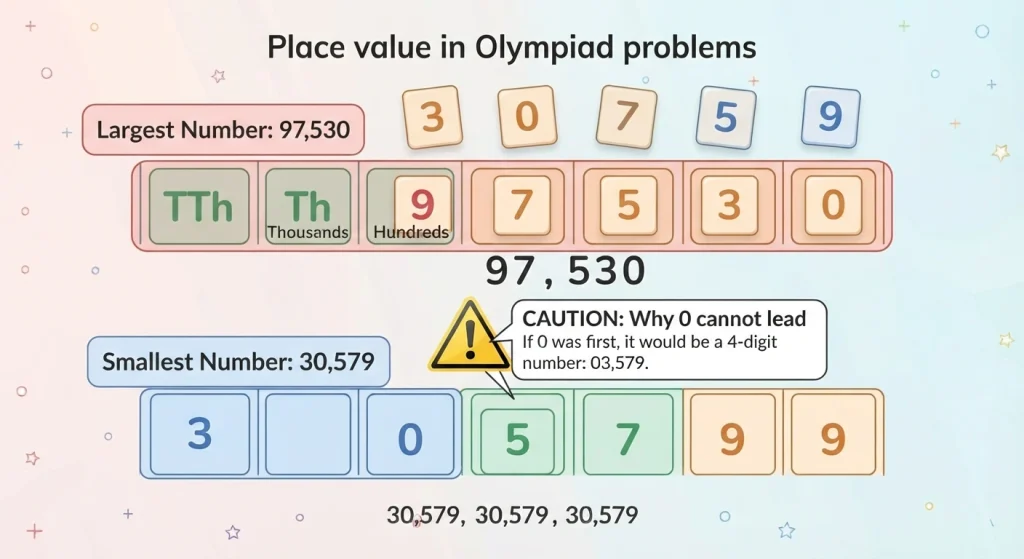
Largest and smallest from given digits. Using the digits 3, 0, 7, 5 and 9 exactly once, form the largest and smallest possible five digit numbers. Largest: put the biggest digit in the largest place, giving 97,530. Smallest: put the smallest non-zero digit first, because a leading zero would make it a four digit number, giving 30,579.
Digit sum conditions. Find the largest four digit number whose digits add up to 10. Number system questions like this appear across the SOF IMO syllabus for primary classes. Work from the left: make the thousands digit as large as possible, so 7, then 3, then 0, then 0. Answer: 7,300.
Place value swaps. In a certain three digit number, swapping the hundreds and ones digits increases the number by 297. What can the number be? Since swapping changes the value by 99 times the difference of the two digits, and 297 divided by 99 is 3, the ones digit must be 3 more than the hundreds digit. Numbers like 142, 253 and 364 all work.
Counting digits in a range. How many digits are used in total to write all the numbers from 1 to 100? Numbers 1 to 9 use 9 digits, 10 to 99 use 180, and 100 uses 3. Total: 192.
Reverse reasoning. I am a six digit number. My ten thousands digit is 4, my hundreds digit is 4 more than that, and every other digit is 0. What am I? The ten thousands digit is 4 and the hundreds digit is 8, so the number is 40,800. But that is five digits, so this number cannot be six digits, which makes the question itself a check on careful reading. The correct six digit version would need a non-zero lakhs digit.
Each of these rewards a child who thinks in columns. That is the real reason place value is worth over-teaching in Class 4: it becomes the foundation for reasoning, not just for reading. The general methods in how to solve math olympiad problems build directly on this.
Practice questions with answers
Try these with a chart on hand.
1. Write 8,04,672 in expanded form.
Answer: 8,00,000 + 4,000 + 600 + 70 + 2
2. What is the place value of 6 in 36,08,415?
Answer: 6,00,000, or six lakh
3. Write “nine lakh forty thousand six” in figures.
Answer: 9,40,006
4. Insert Indian commas into 4028519.
Answer: 40,28,519
5. Insert international commas into the same number, 4028519.
Answer: 4,028,519
6. Which is greater: 6,90,215 or 6,89,999?
Answer: 6,90,215, because the ten thousands digits are 9 and 8
7. Write 25,60,048 in words using the Indian system.
Answer: Twenty-five lakh sixty thousand forty-eight
8. Arrange in ascending order: 3,07,415, 30,741, 3,70,145, 3,07,451
Answer: 30,741 < 3,07,415 < 3,07,451 < 3,70,145
9. What is the face value and the place value of 7 in 7,32,908?
Answer: Face value 7, place value 7,00,000
10. Using the digits 2, 6, 0, 8 and 4 exactly once, write the largest possible five digit number.
Answer: 86,420
11. How many lakhs make one crore?
Answer: 100 lakh
12. Write 1,50,00,000 using the international system and read it aloud.
Answer: 15,000,000, read as fifteen million
Make Preparing for Math Olympiad Simple!



What is a place value chart?
A place value chart is a table with one column for each place in a number, where each column is worth ten times the column to its right. You write one digit per column starting from the right, and the chart shows what each digit is worth based on its position.
How do you use a place value chart?
Write the digits into the columns starting from the right, one digit per column. Place commas according to the period pattern, three digits then two in the Indian system. Then read each period from left to right, saying the period name after it, and read the ones period last with no period name.
What is the difference between the Indian and international place value charts?
The Indian chart has four periods (ones, thousands, lakhs, crores) and places commas after three digits and then after every two. The international chart has three periods (ones, thousands, millions) and places commas after every three digits. The nine places are in the same positions, but the names and the comma spacing differ.
How many places are there in a place value chart up to crores?
Nine: ones, tens, hundreds, thousands, ten thousands, lakhs, ten lakhs, crores and ten crores.
How many zeros are in one lakh, one crore and one million?
One lakh has five zeros (1,00,000). One crore has seven zeros (1,00,00,000). One million has six zeros (1,000,000).
Is one million the same as ten lakh?
Yes. One million equals ten lakh. Similarly, one crore equals ten million, and one billion equals one hundred crore.
What is the place value chart for Class 4 supposed to cover?
Most Class 4 syllabuses cover ones through lakhs, taking students up to five and six digit numbers, with ten lakhs and crores introduced at the end of the year or in Class 5. Introducing the full chart to crores early does no harm as long as lakhs are secure first. Class 4 also covers Roman numerals 1 to 100, which is a useful contrast because Roman numerals are not positional at all.
What is the place value of zero?
Zero has a place value of zero in any column, but it is not useless. It holds the column open so that the digits to its left keep their correct values. Removing a zero from 4,00,605 changes the number entirely.
How do I explain lakhs to a child who has learned thousands?
Build up in steps. Ten thousand, then ten of those makes one lakh. Show it on the chart as one column further left, and anchor it to something real, such as a scooter costing about one lakh rupees.
What is expanded form?
Expanded form writes a number as the sum of its place values. For example, 5,82,647 in expanded form is 5,00,000 + 80,000 + 2,000 + 600 + 40 + 7.
Do I need to teach the international system in Class 4?
It helps, but only after the Indian system is secure. Children meet million and billion in news, sports and online content, so a brief comparison prevents later confusion. Teaching both simultaneously usually causes more problems than it solves.
What should I do if my child keeps forgetting the column order?
Have them draw and label a blank chart from memory at the start of every practice session. Recalling the order is a different skill from using the chart, and it needs its own practice.
Conclusion
A place value chart is more than a reference table. It is the tool that turns a long string of digits into something a nine year old can read, write, expand and compare with confidence.
Three ideas carry the whole topic: every column is worth ten times the column on its right, the same digit takes a different value depending on where it sits, and zero holds a column open even though it looks like nothing.
The habit matters more than the speed. Draw the chart before writing the number, fill from the right, place the commas before reading, and compare from the left. Get the Indian system secure before bringing in millions, keep a blank chart within reach, and work through one large number a day from a price board or a newspaper. Two minutes daily will do more than a weekend of worksheets.

Mikha Piregu is a Content Writer with experience spanning educational content, including math and math olympiad topics, as well as advocacy writing, research-based articles, and SEO-driven web content. He creates high-quality blog content, web copy, and feature articles that support brand visibility, audience engagement, and long-term organic growth through data-informed storytelling. Skilled in WordPress, WooCommerce, and modern digital tools, Mikha adapts content across various platforms, including blogs, websites, campaigns, and advocacy initiatives, with clarity and purpose.

There are no comments posted here yet.
Sign in to leave a comment