


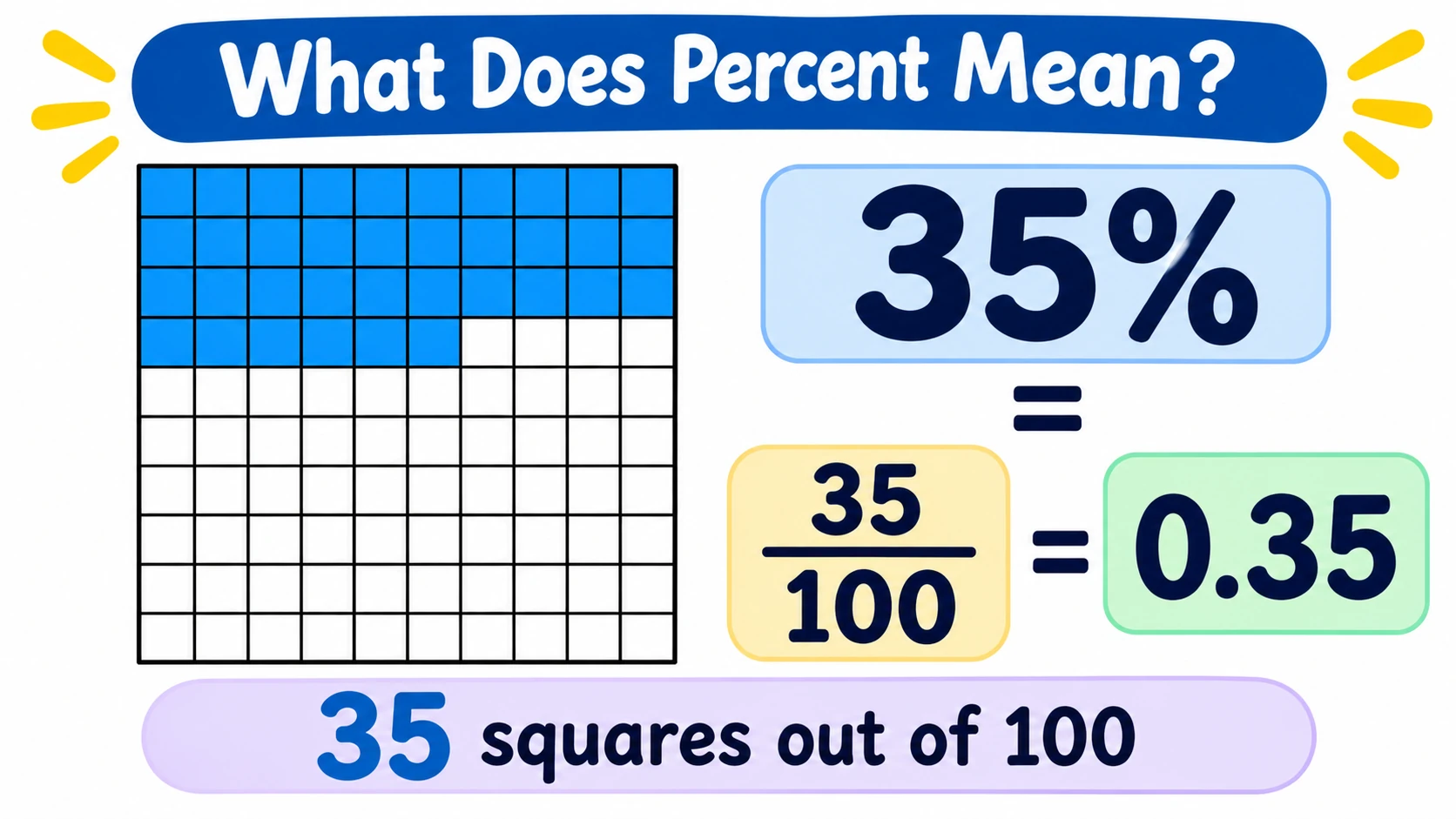
Percent means “out of 100”, so 35% is 35 out of every 100, the same as the fraction 35/100 or the decimal 0.35.
- What Does Percent Mean?
- Method 1: Use 10% and 1% as Building Blocks
- Method 2: The Fraction Method
- Method 3: The Decimal Method
- Which Method to Use When
- Estimate Before You Calculate
- Where Percent Shows Up in Real Life
- Percent of a Number in 5th Grade: Where It Sits by Curriculum
- Common Mistakes With Percent of a Number
- Try This at Home: The Shop Flyer Challenge
- Percent Word Problems for Grade 5: Practice Questions
- Percent in Early Competition Problems
- The Reverse Question: What Percent Is One Number of Another?
- Conclusion
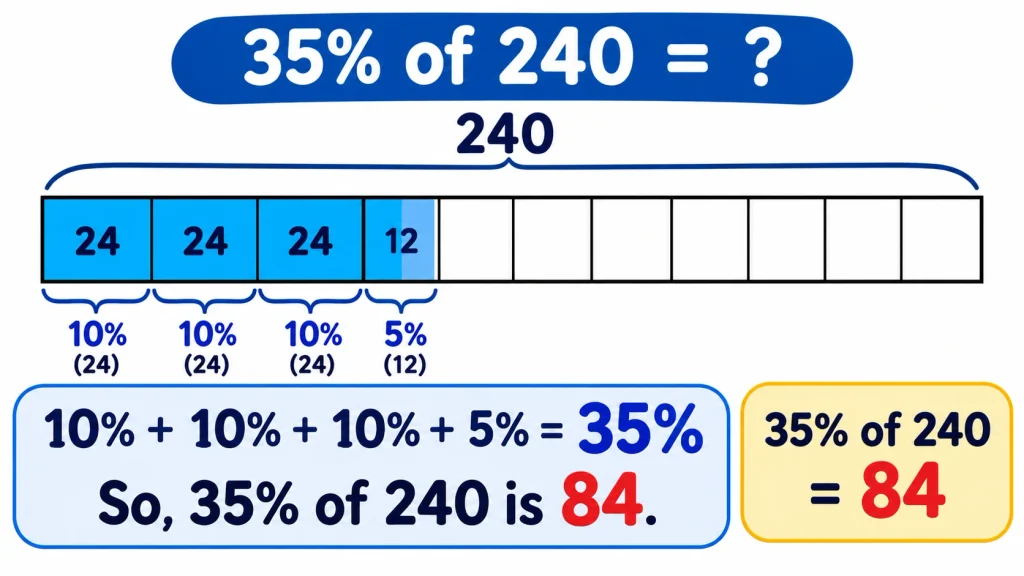
To find the percent of a number, find 10% by dividing the number by 10, then build the percent you need from easy parts. For example, 35% of 240 is three lots of 10% (24 + 24 + 24) plus 5% (12), which makes 84.
Grade 5 (Class 5) children can learn all three methods below in one sitting. Start with Method 1, because finding 10% in their head lets a child check every other answer.
What Does Percent Mean?
Percent means “per hundred”. British English often writes it as two words, per cent.
On a grid of 100 squares, 35% is 35 squares shaded. Every percent is a fraction with 100 on the bottom, so 35% is 35/100. Every percent is also a decimal, because 35 hundredths is written 0.35.
| Percent | Fraction out of 100 | Simplest fraction | Decimal | Say it as |
|---|---|---|---|---|
| 1% | 1/100 | 1/100 | 0.01 | 1 in every 100 |
| 5% | 5/100 | 1/20 | 0.05 | 1 in every 20 |
| 10% | 10/100 | 1/10 | 0.1 | 1 in every 10 |
| 20% | 20/100 | 1/5 | 0.2 | 1 in every 5 |
| 25% | 25/100 | 1/4 | 0.25 | 1 in every 4 |
| 50% | 50/100 | 1/2 | 0.5 | Half |
| 75% | 75/100 | 3/4 | 0.75 | 3 in every 4 |
| 100% | 100/100 | 1 | 1 | All of it |
The percent to fraction to decimal table above covers the benchmarks children use most. Its simplest-fraction column uses the rule behind equivalent fractions: divide the top and bottom by the same number, so 25/100 becomes 1/4.
Method 1: Use 10% and 1% as Building Blocks
The benchmark method finds a few easy percents in your head and adds them. The benchmark method is the simplest way to calculate percentages for kids.
Why Dividing by 10 Gives 10%
10% means 10 out of every 100, which is the same as 1 out of every 10. To find 10% of 240, split 240 into 10 equal groups and keep one. 240 divided by 10 is 24, so 10% of 240 is 24.
1% works the same way with 100 groups: 240 divided by 100 is 2.4. Dividing by 10 shifts every digit one place to the right in the place value chart, and dividing by 100 shifts it two places, as in dividing decimals step by step.
Say it at the table like this: “Ten percent is one out of every ten. Cut the number into ten equal pieces and keep one.”
The Benchmark Percents
| Benchmark | How to find it | Example: 240 |
|---|---|---|
| 100% | The whole number | 240 |
| 50% | Halve it | 120 |
| 25% | Halve the 50% | 60 |
| 75% | Add 50% and 25% | 180 |
| 10% | Divide by 10 | 24 |
| 20% | Double the 10% | 48 |
| 5% | Halve the 10% | 12 |
| 1% | Divide by 100 | 2.4 |
Build Any Percent From the Parts
- Split the percent into benchmarks. 35% is 10% + 10% + 10% + 5%.
- Find each benchmark. 10% of 240 is 24, and 5% is half of 24, which is 12.
- Add the parts. 24 + 24 + 24 + 12 is 84.
35% of 240 is 84.
Another split, 25% + 10%, gives 60 + 24, which is also 84. The 10 percent of a number trick does most of the work in mental math percentages.
Method 2: The Fraction Method
The fraction method writes the percent over 100, simplifies it, then multiplies. Use it when the percent turns into an easy fraction.
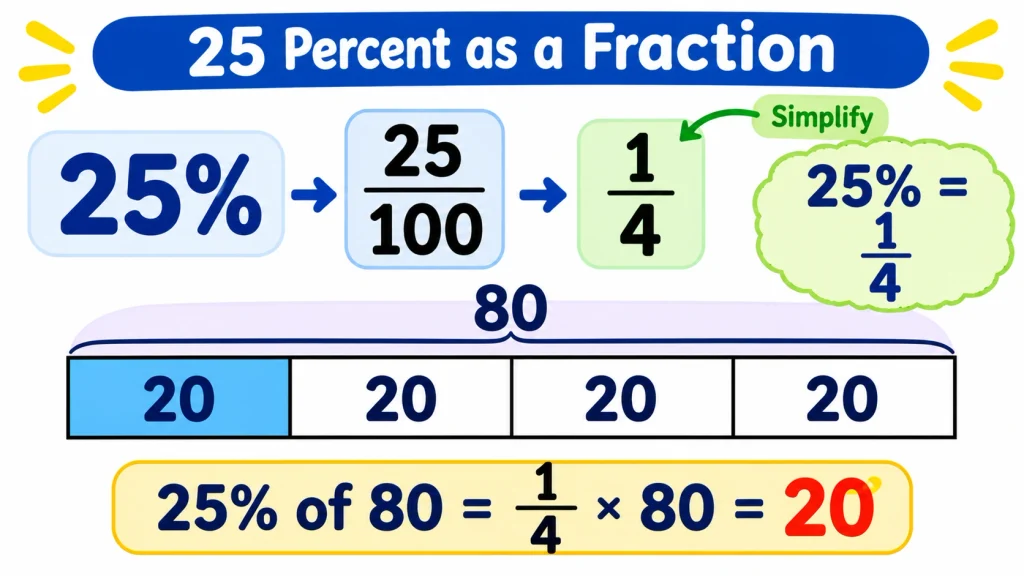
- Write the percent over 100. 25% is 25/100.
- Simplify. 25/100 is 1/4.
- Divide by the bottom number, then multiply by the top. 80 divided by 4 is 20, and 20 times 1 is 20.
25% of 80 is 20.
One more: for 60% of 45, 60/100 simplifies to 3/5. 45 divided by 5 is 9, and 9 times 3 is 27. 60% of 45 is 27. The method works because “of” means multiply: 25% of 80 is 1/4 × 80, the same step as multiplying fractions by whole numbers.
Method 3: The Decimal Method
The decimal method turns the percent into a decimal by dividing by 100, then multiplies. Use it for awkward percents, or when a calculator is allowed.
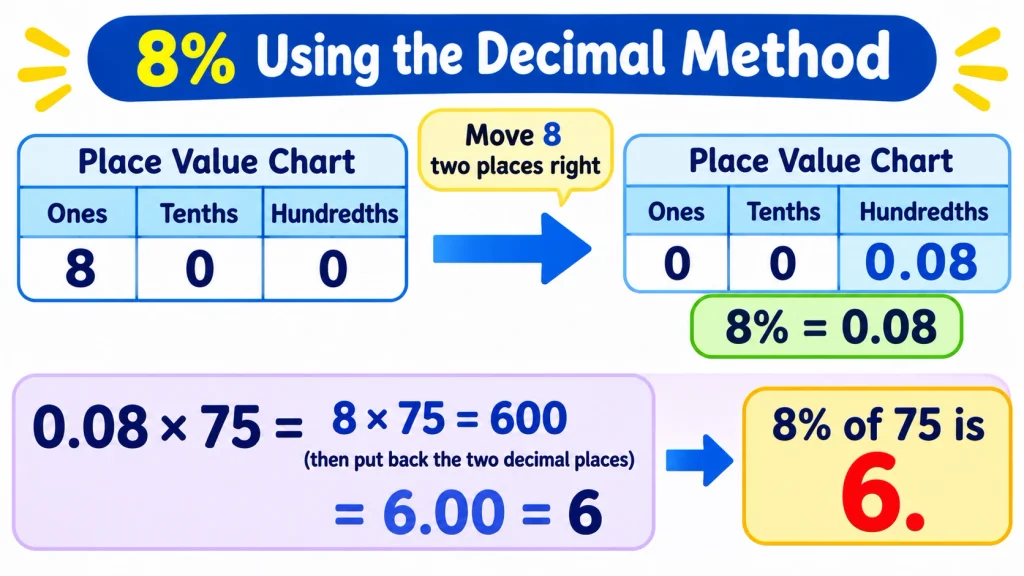
- Divide the percent by 100. 8 divided by 10 is 0.8, and 0.8 divided by 10 is 0.08. The decimal point has moved two places left, so 8% is 0.08.
- Multiply. For 0.08 × 75, work out 8 × 75 = 600, then put back the two decimal places: 6.00, which is 6.
8% of 75 is 6.
Check with Method 1: 1% of 75 is 0.75, and eight lots of 0.75 is 6. If the decimal point causes trouble, revise where the decimal point goes when multiplying decimals.
Which Method to Use When
Look at the percent before choosing a method.
[IMAGE: Decision flow for choosing a method: built from 10%, 5% and 1% leads to benchmarks; simplifies to an easy fraction leads to fractions; anything else leads to decimals]
| Method | Use this when | Example | Quick check |
|---|---|---|---|
| Benchmarks | The percent is a benchmark or a few added together: 10%, 15%, 35%, 95% | 15% of 60: 6 + 3 = 9 | A bit more than 10% (6)? Yes |
| Fraction | The percent simplifies to an easy fraction: 20%, 25%, 50%, 60%, 75% | 20% of 85: 85 divided by 5 = 17 | Does the bottom number divide evenly? |
| Decimal | The percent or the number is awkward: 8%, 17%, 23% | 23% of 410 = 94.3 | Compare with an estimate |
Estimate Before You Calculate
An estimate is a quick, rough answer made with friendly numbers. Make one before calculating, then compare: if the estimate and the answer are far apart, something went wrong.
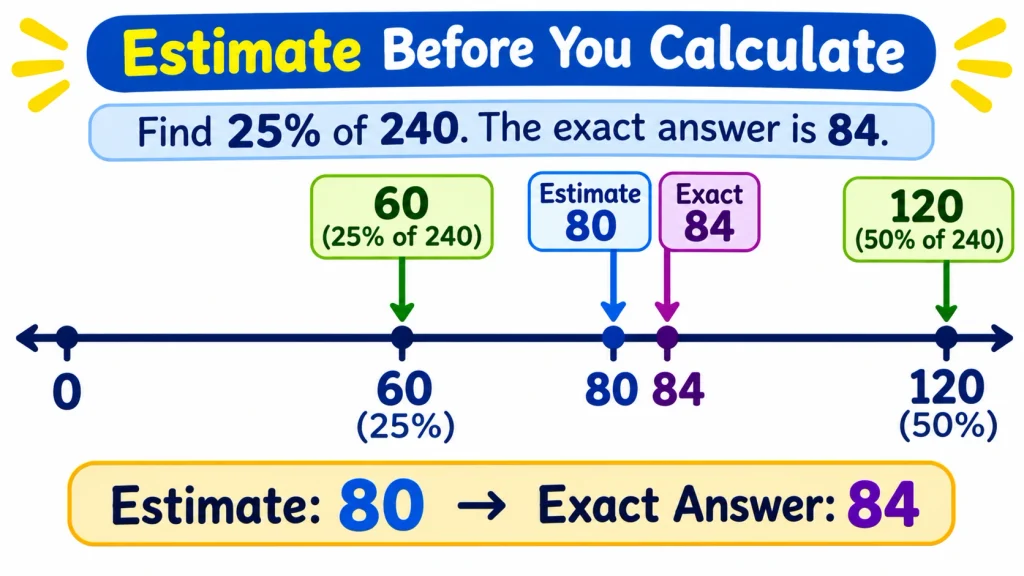
To estimate the percent of a number, round the percent and the number to friendly values, then use Method 1.
| Question | Estimate | Exact answer | Fits? |
|---|---|---|---|
| 35% of 240 | About a third of 240, which is 80 | 84 | Yes |
| 8% of 75 | A bit less than 10%, which is 7.5 | 6 | Yes |
| 23% of 410 | About 25% of 400, which is 100 | 94.3 | Yes |
The exact answer for 23% of 410: 10% is 41, so 20% is 82. 1% is 4.1, so 3% is 12.3. 82 + 12.3 is 94.3.
A child who writes 8% of 75 as 600, or 0.6, has an estimate of about 7 beside it, and neither answer fits. Contest rounds reward estimating too, as these mental math strategies show.
Where Percent Shows Up in Real Life
Percents appear wherever a part is measured against a whole. The percent of a number examples below use plain-number prices, so they work in any currency.
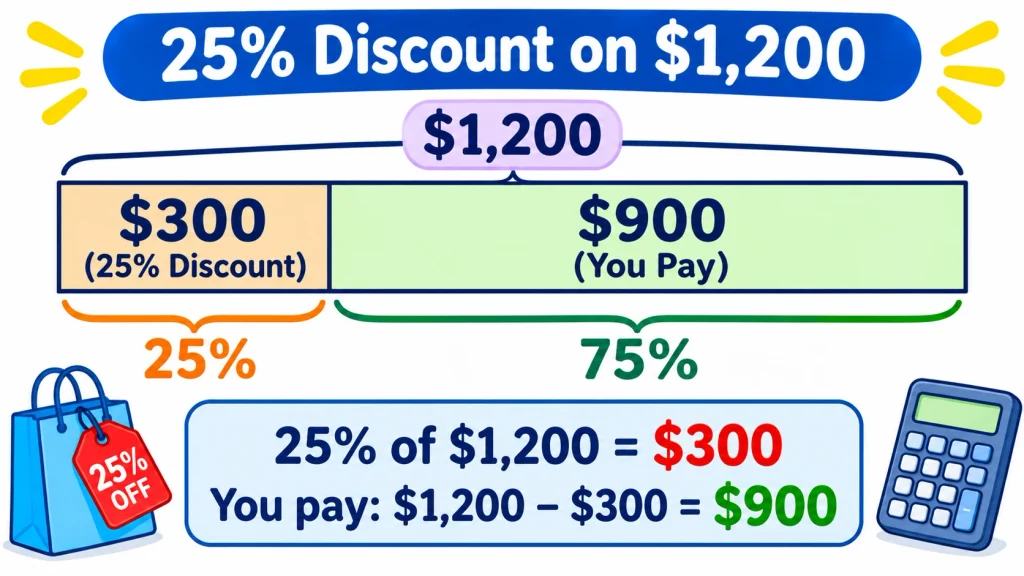
Example 1: A Shop Discount
A jacket costs 1,200, and the tag says 25% off.
- 25% is 1/4, and 1,200 divided by 4 is 300. The discount is 300.
- 1,200 minus 300 is 900.
The jacket costs 900. Check: paying 900 means paying 75%, and 600 (50%) plus 300 (25%) is 900.
Example 2: A Test Score
Rina scored 85% on a 40-question test. How many did she get right?
- 10% of 40 is 4, so 80% is 8 lots of 4, which is 32.
- 5% is half of 4, which is 2.
- 85% is 32 + 2, which is 34.
Rina got 34 questions right.
Example 3: A Tip or Service Charge
A restaurant bill is 640, and the family adds a 15% tip. Customs differ by country; some bills add a service charge instead.
- 10% of 640 is 64, and 5% is half of 64, which is 32.
- The tip is 64 + 32, which is 96.
- The total is 640 + 96, which is 736.
They pay 736.
Example 4: Sales Tax or VAT on a Bill
A bill is 450 before tax, and the tax rate is 8%. Rates vary by country, state and item, so 8% is only an example.
- 1% of 450 is 4.5, so 8% is 8 lots of 4.5, which is 36.
- The total is 450 + 36, which is 486.
The bill comes to 486. Check with the decimal method: 0.08 × 450 is 36.
Example 5: School Attendance
The school year has 180 days, and Arif’s attendance is 95%. How many days was he in school?
- 10% of 180 is 18, so 5% is 9.
- 95% is 100% minus 5%, and 180 minus 9 is 171.
Arif was in school on 171 days and missed 9.
[CTA BLOCK: mid-article app install]
Suggested copy: Keep the 10% habit sharp with short daily practice. Gonit is free on iOS and Android, with no ads.
Percent of a Number in 5th Grade: Where It Sits by Curriculum
In the US, finding a percent of a quantity is a Grade 6 standard, while some boards teach finding the percentage of a number in Class 5. Placement varies, so your child’s textbook is the final word.
[IMAGE: Three curriculum cards for Common Core, NCERT and NCTB, each showing where percent of a number appears and the Grade 5 skills that come first]
| Curriculum board | Where percent of a number usually appears | Grade 5 (Class 5) groundwork |
|---|---|---|
| Common Core (US) | Grade 6, standard 6.RP.A.3c: a percent of a quantity as a rate per 100 | 5.NBT.A.2 (decimal point placement when dividing by 10 and 100); 5.NF.B.5 and 5.NF.B.6 (multiplying fractions) |
| NCERT (India) | We could not confirm the class in the current books; Maths Mela, the Class 5 book, has no chapter titled percentage | Fractions. Some private publishers’ Class 5 books include a percentage chapter |
| NCTB (Bangladesh) | Class 5: finding the percentage of a number has its own chapter in Elementary Mathematics (Chapter 9 in the 2022 edition) | Fractions and decimals |
More topics at this level are in our Grade 5 math guides.
Common Mistakes With Percent of a Number
[IMAGE: Wrong and right working side by side: 20 x 150 = 3,000 crossed out, next to 20/100 x 150 = 30 ticked]
Mistake 1: Multiplying by the percent number instead of the percent. A child writes 20% of 150 as 20 × 150 = 3,000. Fix: 20% is 20/100, so divide by 100 too: the answer is 30. When the percent is under 100, an answer bigger than the starting number is a warning sign.
Mistake 2: Moving the decimal point the wrong way, or only one place. A child writes 5% as 0.5, so 5% of 300 becomes 150, or moves the point right and gets 500. Fix: move the point two places left, so 5% is 0.05 and 5% of 300 is 15.
Mistake 3: Confusing percent of with percent off. Asked the price of a 1,200 jacket at 25% off, a child answers 300. Fix: 300 is the amount that comes off. The price to pay is 1,200 minus 300, which is 900. Ask: “Does the question want what comes off, or what is left?”
Mistake 4: Assuming percentages of different totals can be added. A child scores 80% on a 50-mark test and 60% on a 100-mark test, then calls it 140%, or 70% overall. Fix: turn each percent into marks. 80% of 50 is 40 and 60% of 100 is 60, so the total is 100 marks out of 150. 70% of 150 would be 105, so 70% is wrong. Percents add only when they share a total.
Try This at Home: The Shop Flyer Challenge
The shop flyer challenge turns a real flyer into a percentage discount example for kids. It takes about ten minutes and shows that an estimate catches mistakes before a calculator does.

Materials: a shop flyer, receipt or takeaway menu with at least five prices; paper and a pencil; a phone calculator, kept face down until the end.
- Your child picks four items and writes their prices in a column.
- You call out a sale for each: 10%, 25%, 50% and 15% off.
- Your child writes an estimate of each sale price.
- Your child works out each exact discount with benchmarks and subtracts it.
- Turn the calculator over and check each answer together, including any tax or service line on a receipt.
The point: the calculator becomes the checker, not the method.
Percent Word Problems for Grade 5: Practice Questions
The questions run from easiest to hardest. Ask for an estimate before each one. If the wording stalls your child, reading the situation instead of hunting for keywords is the habit to build.
[IMAGE: Practice card with eight percent questions in two columns, easiest at the top, and a space for an estimate beside each]
- What is 10% of 90?
- What is 50% of 64?
- What is 25% of 120?
- What is 15% of 80?
- What is 75% of 36?
- A book costs 450 and is 20% off. How much do you pay?
- A class has 32 students. 25% walk to school, 50% come by bus, and the rest come by car. How many come by car?
- Which is larger: 30% of 70, or 70% of 30?
Answer Key With Reasoning
- 90 divided by 10 is 9.
- Half of 64 is 32.
- 25% is 1/4, and 120 divided by 4 is 30.
- 10% of 80 is 8, and 5% is half of that, 4. 8 + 4 is 12.
- 75% is 3/4. 36 divided by 4 is 9, and 9 times 3 is 27.
- 10% of 450 is 45, so 20% is 90. 450 minus 90 is 360.
- Walking and bus together are 25% + 50% = 75%, so the car group is 25%. 25% of 32 is 32 divided by 4, which is 8 students.
- 10% of 70 is 7, so 30% is 21. 10% of 30 is 3, so 70% is 21. They are equal, because both work out to 30 × 70 ÷ 100.
Percent in Early Competition Problems
Contest-style percent questions usually hide a shortcut that rewards understanding over long calculation. Math League lists basic ratio and percent among the topics of its 4th and 5th grade contests. The problems below are original and olympiad-style.
[IMAGE: Two bars of equal length labelled 4% of 75 and 75% of 4, both marked 3, showing that a% of b equals b% of a]
Problem 1. Without a calculator, find 4% of 75.
Solution. Swap the numbers: 4% of 75 equals 75% of 4, as in practice question 8. 75% of 4 is 3/4 of 4, which is 3.
Problem 2. A class of 40 is 60% girls. 25% of the girls wear glasses. How many girls wear glasses?
Solution. 10% of 40 is 4, so 60% is 24 girls. 25% of 24 is 6 girls. The trap is taking 25% of the whole class, which gives 10.
Problem 3. 20% of a number is 14. What is 50% of the same number?
Solution. 20% is 14, so 10% is 7. 50% is five lots of 10%, and 5 × 7 is 35. The number itself, 70, never has to be found.
For mixed practice, try these math olympiad questions by grade.
The Reverse Question: What Percent Is One Number of Another?
The reverse question gives the part and asks for the percent: Rina got 34 out of 40, so what percent is that? Write 34/40, simplify to 17/20, and multiply top and bottom by 5 to get 85/100, which is 85%. Finding what percent one number is of another is the natural next step, and it rests on the part-to-whole thinking in ratio and proportion for 5th grade.
Make Preparing for Math Olympiad Simple!


Do 5th graders learn percentages?
Whether percentage of a number is a Grade 5 topic depends on the curriculum. Under Common Core, finding a percent of a quantity is a Grade 6 standard, while Bangladesh’s NCTB Class 5 book has a full percentage chapter. Grade 5 work on fractions, decimals, and dividing by 10 and 100 builds the skills percent needs.
How do I explain percent to a 10-year-old?
Shade squares on a 100-square grid and say “percent means how many out of 100”. Then link it to fractions they know: 50% is a half and 25% is a quarter.
Can a percent be more than 100?
Yes. 100% is the whole amount, so 150% is the whole plus half again: 150% of 40 is 40 + 20, which is 60. Grade 5 problems usually stay at or below 100%.
Should my child use a calculator for percentages?
Not until they can estimate first. A calculator is only right when the right keys go in, and an estimate catches a slip like typing 0.5 for 5%.
Is percent the same as percentage?
The two words share one idea. “Percent” goes with a number, as in 25 percent, while “percentage” describes an amount in general. Finding the percentage of a number and finding a percent of a number are the same task.
What should my child know before learning percent?
Three skills: fractions out of 10 and 100, decimals to hundredths, and dividing by 10 and 100. A child who knows that 25/100 is 1/4 and that 240 divided by 10 is 24 is ready for every method here.
Conclusion
Finding a percent of a number comes down to one idea: percent means out of 100, so 10% is one tenth of the number. Once your child can find 10%, 5% and 1% in their head, every other percent is a few additions away.
Keep one habit at the kitchen table: estimate first, then calculate. An estimate that sits close to the answer is the quickest check there is.
The next step is the reverse question, finding what percent one number is of another, which builds on ratio and proportion.

Mikha Piregu is a Content Writer with experience spanning educational content, including math and math olympiad topics, as well as advocacy writing, research-based articles, and SEO-driven web content. He creates high-quality blog content, web copy, and feature articles that support brand visibility, audience engagement, and long-term organic growth through data-informed storytelling. Skilled in WordPress, WooCommerce, and modern digital tools, Mikha adapts content across various platforms, including blogs, websites, campaigns, and advocacy initiatives, with clarity and purpose.

There are no comments posted here yet.
Sign in to leave a comment