


To add fractions with different denominators, you must first convert them so they share a common bottom number,
If your child writes 1/2 + 1/3 = 2/5, they are not being careless. They are applying a known rule where it does not work. Adding fractions with unlike denominators is the first Class 5 topic where that happens, and the reason matters more than any shortcut.
This guide covers why, two methods, mixed numbers, three-fraction sums, activities and practice.
- Why unlike denominators cannot be added
- A quick recap
- What a common denominator does
- Visual models
- Method 1: the LCM method
- Method 2: cross-multiplication
- Which method to use
- Simplifying using HCF
- When the answer is improper
- Adding mixed numbers
- Adding three or more fractions
- The most common mistake
- Other mistakes to watch for
- Word problems
- CBSE and NCERT scope
- The Olympiad connection
- Eight activities
- Tips for parents
- Tips for teachers
- Practice questions with answers
- Conclusion
Why unlike denominators cannot be added
Ask your child what 3 metres plus 40 centimetres is. Nobody says 43. They are different sizes, so you convert first: 3 metres is 300 centimetres, and 300 + 40 = 340 centimetres.
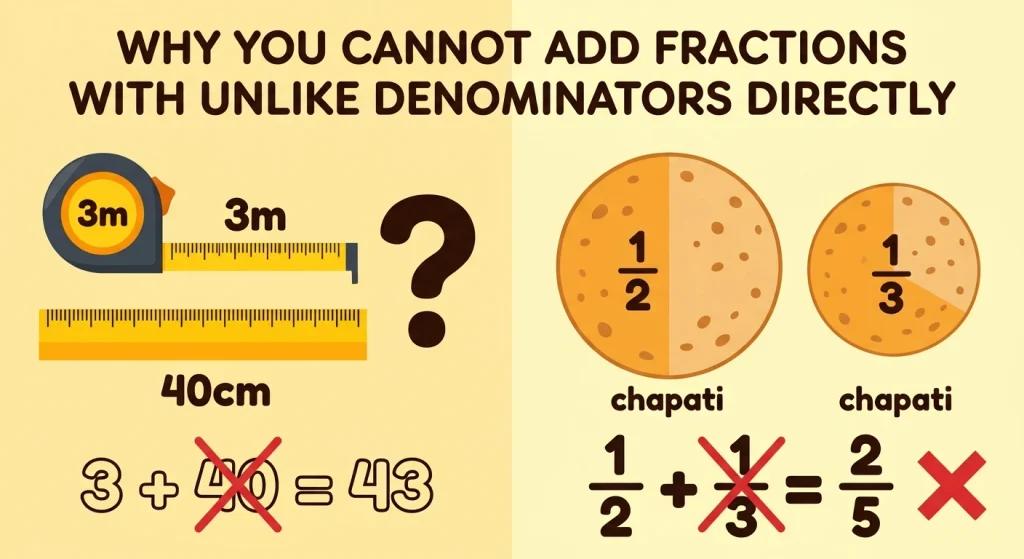
Fractions work the same way, and the denominator is the unit. The numerator counts pieces; the denominator names what kind of piece, as our guide to what the numerator and denominator mean explains. So 1/2 + 1/3 is one half-piece plus one third-piece. Two pieces, yes, but two pieces of what?
Here is the test. Is 2/5 bigger or smaller than 1/2? Smaller. But we added something to 1/2, so the answer must be bigger. That single observation does more than a dozen corrected worksheets.
A quick recap
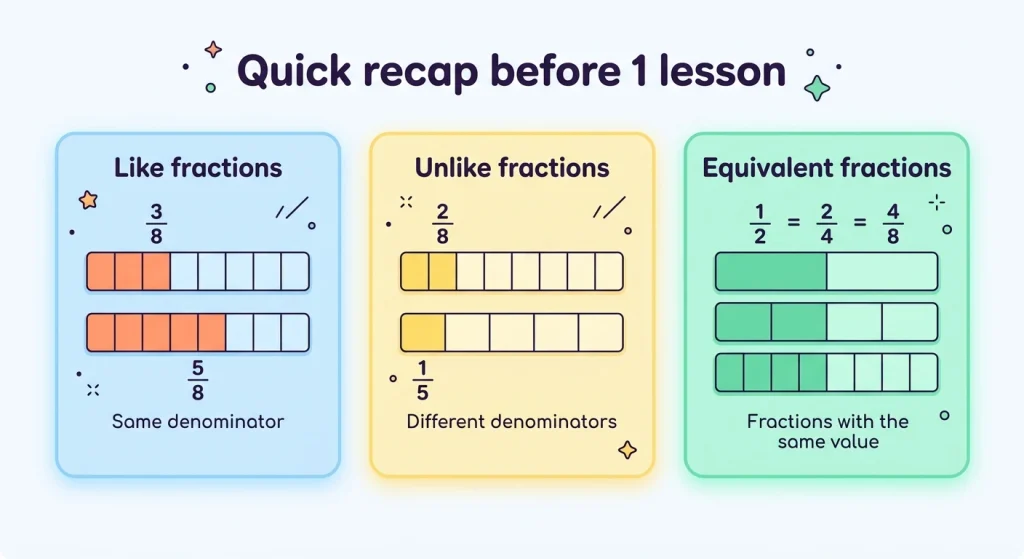
Like and unlike fractions. Same denominator means like fractions: 3/8 and 5/8. Different denominators means unlike: 3/8 and 2/5. Like fractions are easy because the pieces already match: 3/8 + 5/8 = 1. If this is shaky, start with adding fractions with like denominators.
Equivalent fractions. 1/2 is the same amount as 2/4, 3/6 and 5/10. Multiply numerator and denominator by the same number and the value does not change. This is the most important skill here, covered in our guide to equivalent fractions.
LCM and HCF. The LCM is the smallest number both denominators divide into: for 4 and 6 it is 12. The HCF is the largest number dividing both: for 18 and 24 it is 6. The LCM helps you add, the HCF helps you simplify.
What a common denominator does
A common denominator is one piece size that both fractions can be rewritten in.
A half cannot be written in thirds, nor a third in halves. Both can be written in sixths. Cut the half into 3 parts: 3/6. Cut the third into 2 parts: 2/6. Neither amount changed, only the piece size.
1/2 + 1/3 = 3/6 + 2/6 = 5/6
Is 5/6 bigger than 1/2? Comfortably, so this passes the test 2/5 failed. Any common multiple works; the lowest just keeps the numbers small.
How do you add fractions with unlike denominators?
To add fractions with unlike denominators, find a common denominator, usually the LCM of the denominators. Rewrite each fraction as an equivalent fraction with that denominator. Add the numerators and keep the denominator. Then simplify, and convert to a mixed number if the result is improper.
Visual models
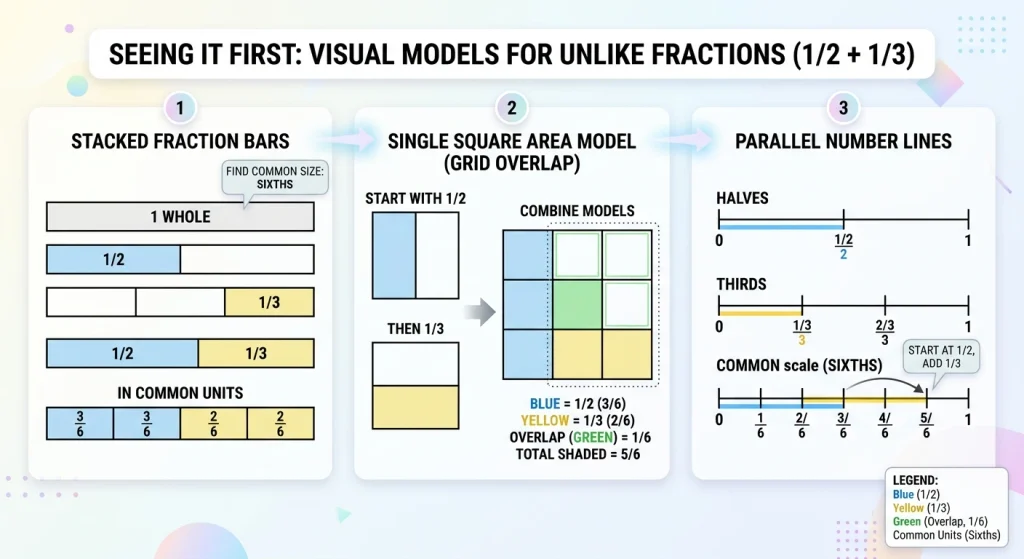
Fraction bars. Draw two identical rectangles, split one into halves and one into thirds, and shade one piece of each. The pieces are visibly different sizes. Now draw two more in sixths, shaded 3 and 2: the amounts match the originals, but the pieces now match each other.
Area model. Draw a square, cut it vertically into halves and shade one half, then cut it horizontally into thirds and shade one third in another colour. The grid creates sixths in front of the child’s eyes, which makes the LCM feel inevitable rather than arbitrary.
Number line. Mark halves above a 0 to 1 line and thirds below; the marks do not line up until you mark sixths. Use one model for a week before switching.
Method 1: the LCM method
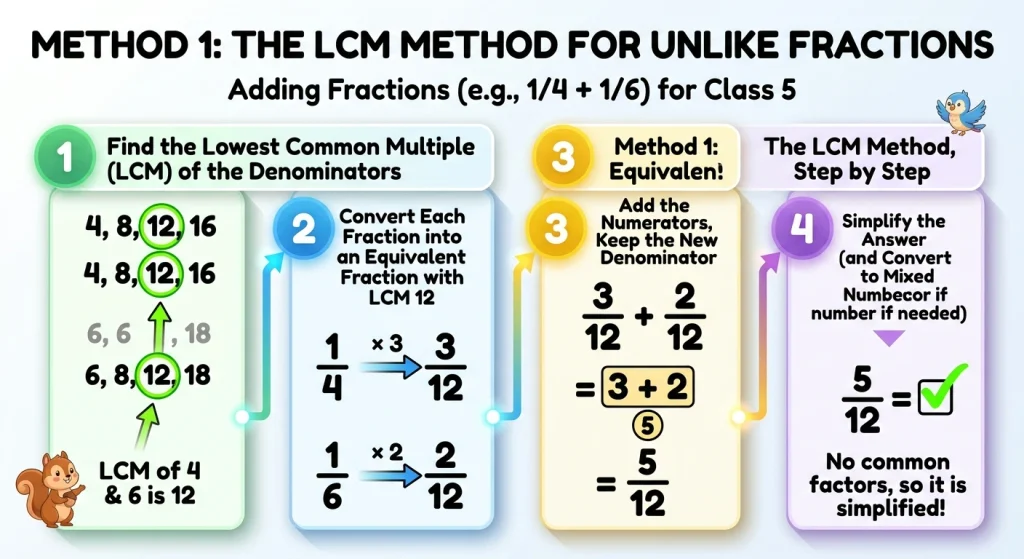
What is the LCM method for adding fractions?
The LCM method means finding the lowest common multiple of the denominators, converting each fraction into an equivalent fraction with the LCM as its denominator, adding the numerators while keeping the denominator, then simplifying.
Step 1. Find the LCM of the denominators. Step 2. Divide the LCM by each denominator, then multiply that fraction’s top and bottom by the result. Step 3. Add the numerators, keeping the denominator. Step 4. Simplify, and convert to a mixed number if needed.
Finding the LCM. For small numbers, list multiples of the larger denominator and check each against the smaller: for 6 and 8, that gives 24. For larger numbers use prime factorisation, which assumes your child can recognise prime and composite numbers. For 12 and 18: 12 = 2 x 2 x 3 and 18 = 2 x 3 x 3, so take two 2s and two 3s, giving 36. If the larger denominator is a multiple of the smaller, it is already the LCM.
Example 1. 1/4 + 1/6. The LCM of 4 and 6 is 12. Then 12 ÷ 4 = 3, so 1/4 becomes 3/12; 12 ÷ 6 = 2, so 1/6 becomes 2/12. Adding: 5/12, already simplest.
Example 2. 2/5 + 3/10. Since 10 is a multiple of 5, the LCM is 10. Only the first changes: 4/10 + 3/10 = 7/10.
Example 3. 1/6 + 1/10. The LCM is 30, so 5/30 + 3/30 = 8/30. The HCF of 8 and 30 is 2, so the answer is 4/15. Do not stop at 8/30.
Method 2: cross-multiplication
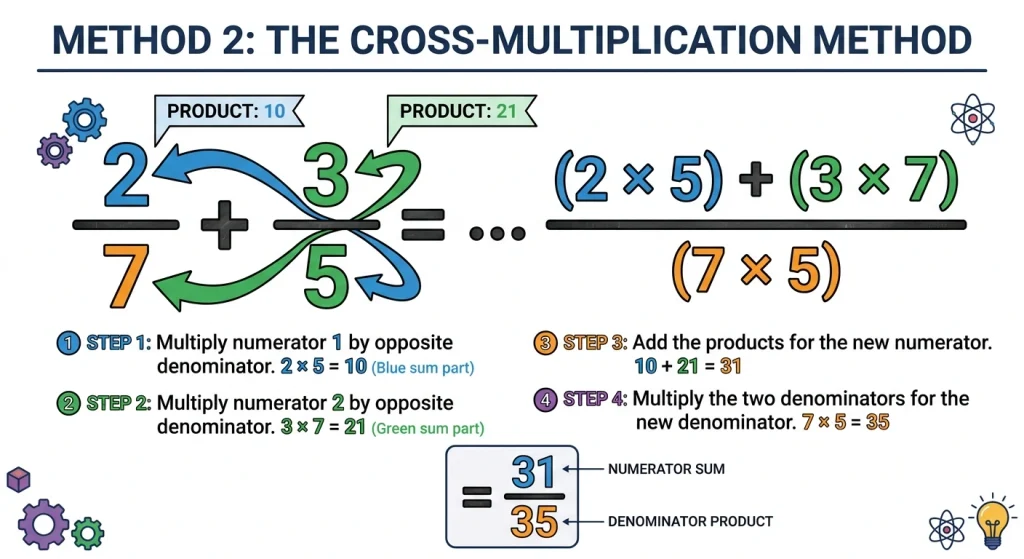
Cross-multiplication uses the product of the denominators instead of their LCM.
To add a/b + c/d: multiply a by d, multiply c by b, add those two results for the numerator, and multiply b by d for the denominator. Then simplify. As one pattern: a/b + c/d = (a x d + c x b) / (b x d).
This is not different mathematics. Multiplying the denominators always gives a common multiple, just not always the lowest.
Example 5. 2/7 + 3/5. Numerator: (2 x 5) + (3 x 7) = 31. Denominator: 35. Answer 31/35. Cross-multiplication wins here, because 7 and 5 share nothing, so 35 was the LCM anyway.
Example 6. 1/4 + 1/6 again gives 10/24, which still needs reducing to 5/12. Because 4 and 6 share a factor of 2, the denominator came out twice as large as necessary. Work this comparison on paper with your child; it shows exactly what the LCM is for.
Which method to use
One question decides it: do the denominators share a common factor?
Cross-multiply when they share nothing, such as 3 and 5 or 4 and 7. The product is the LCM, so you save the search.
Use the LCM method when they do share a factor, such as 4 and 6 or 12 and 18, or the numbers balloon and you face extra simplifying.
Always use the LCM when one denominator is a multiple of the other, such as 5 and 20. Only one fraction changes.
Simplifying using HCF
A fraction is simplest when numerator and denominator share no factor but 1. Most mark schemes expect it, and most children forget. Knowing the divisibility rules makes spotting factors faster.
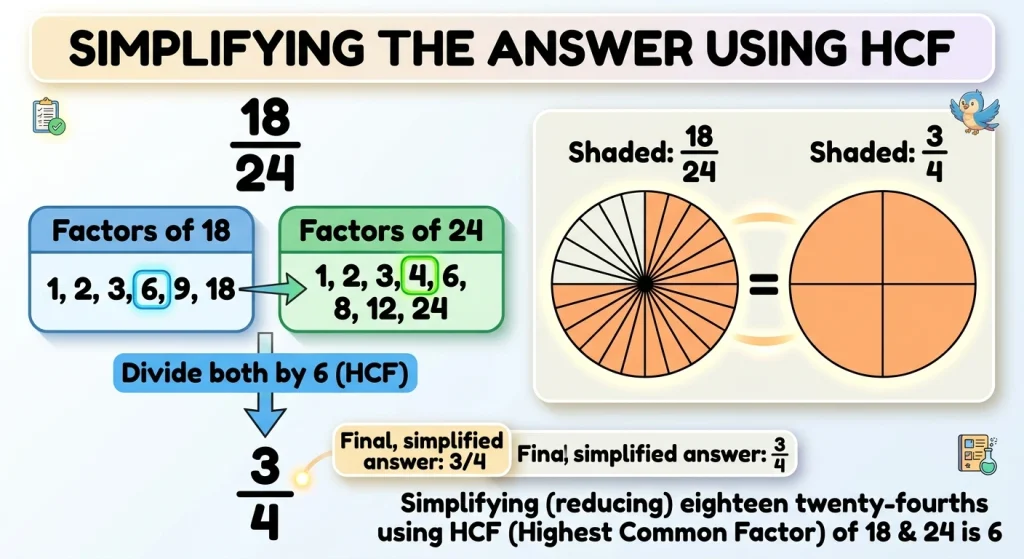
Divide both by their HCF: for 18/24 the HCF is 6, giving 3/4. If the HCF is hard to spot, divide by small factors repeatedly, 18/24 to 9/12 to 3/4. Two checks: if both numbers are even it can definitely be reduced, and if the numerator is 1 it cannot.
When the answer is improper
If the numerators add to more than the denominator, the total is more than one whole. That is not a mistake. Divide the numerator by the denominator: the quotient is the whole number, the remainder is the new numerator.
Example 7. 3/4 + 5/6. The LCM is 12, so 9/12 + 10/12 = 19/12. Since 19 divided by 12 is 1 remainder 7, the answer is 1 7/12.
Example 8. 5/6 + 7/8 gives 20/24 + 21/24 = 41/24 = 1 17/24. Both fractions are close to 1, so a sum just under 2 is right. Teach that estimate-first habit; it catches almost every slip.
Adding mixed numbers
Every Class 5 and Class 6 exam includes this case.
Method A: add the parts separately. For 2 1/4 + 1 2/3, add wholes (2 + 1 = 3), then fractions (3/12 + 8/12 = 11/12). Answer: 3 11/12.
When the fractions spill over, you must carry. For 3 5/6 + 2 3/4, the wholes give 5 and the fractions give 10/12 + 9/12 = 19/12 = 1 7/12, so carry the whole: 6 7/12. Children often write 5 19/12 and stop. The fraction part must always be less than 1.
Method B: convert to improper fractions. Multiply the whole by the denominator and add the numerator, so 3 5/6 becomes 23/6. Then 23/6 + 11/4 = 46/12 + 33/12 = 79/12 = 6 7/12, the same answer. Use Method B when the whole numbers are small, Method A when they are large.
Adding three or more fractions
Nothing new, except you need a common multiple of three denominators.
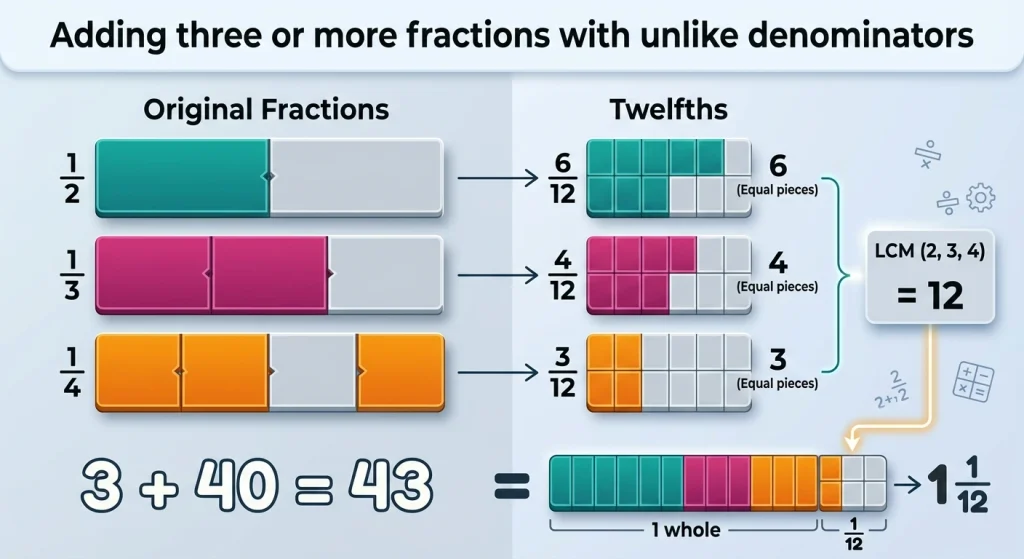
Example 9. 1/2 + 1/3 + 1/4. The LCM of 2, 3 and 4 is 12, so 6/12 + 4/12 + 3/12 = 13/12 = 1 1/12.
Example 10. 2/3 + 3/5 + 1/6. The LCM is 30, so 20/30 + 18/30 + 5/30 = 43/30 = 1 13/30.
Do not cross-multiply here: multiplying 3, 5 and 6 gives 90, three times larger than needed. To find the LCM of three numbers, test multiples of the largest against the other two.
The most common mistake
The error is adding both numerators and denominators: 1/2 + 1/3 = 2/5, or 3/4 + 1/5 = 4/9. Saying “that is not the rule” rarely helps, because the child was not using a rule. They were guessing by pattern. Use a counter-example instead.
Ask what 1/2 + 1/2 is. Everyone knows it is 1 whole. Now apply the faulty method: 2/4, which is one half. The method claims half a chapati plus half a chapati is half a chapati. The child will laugh, and the laugh is the correction.
Follow it with the metres and centimetres comparison and a fraction-bar drawing. Then build this habit: before calculating, predict whether the answer is more or less than 1.
Other mistakes to watch for
Changing only the denominator. Writing 1/4 as 1/12 instead of 3/12. Whatever you do to the bottom, do to the top.
Choosing an invalid common denominator. 10 does not work for 4 and 6, because 4 does not divide 10.
Forgetting to simplify. 8/30 is correct but incomplete.
Ignoring the whole numbers in mixed-number problems, or dropping the carry.
Word problems
If reading the problem is the harder part, our guide on how to solve math word problems gives a reliable routine.
Milk. Rani drinks 1/3 litre in the morning and 1/4 in the evening: 4/12 + 3/12 = 7/12 litre.
Atta. Amma uses 3/4 kg on Monday and 2/5 kg on Tuesday: 15/20 + 8/20 = 1 3/20 kg.
Study time. Arjun does maths for 1/2 hour and science for 1/3 hour: 3/6 + 2/6 = 5/6 hour, or 50 minutes.
Walk to school. Meera walks 2/5 km then 3/10 km: 4/10 + 3/10 = 7/10 km.
Each has a sanity check built in. If the milk answer comes out as 12 litres, something went wrong.
CBSE and NCERT scope
Fractions appear in Class 3 and Class 4 as parts of a whole, with equivalent fractions introduced in Class 4; see our guide to fractions for Class 3. Class 5 is where addition of unlike fractions formally arrives, with denominators under 20. Class 6 revisits it with larger denominators, prime factorisation and mixed numbers.
Everything later depends on it. Class 7 ratios and Class 8 algebraic fractions use the same conversion idea, as does converting a decimal to a fraction. A child who understands why sixths are needed will find it natural that 1/x + 1/y needs xy.
The Olympiad connection
Competition problems reward structure over brute force, as our guide on how to solve math olympiad problems explains.
Take 1/2 + 1/6 + 1/12 + 1/20. Brute force uses an LCM of 60: 30/60 + 10/60 + 5/60 + 3/60 = 4/5. Correct but slow. Now notice that 1/2 = 1 – 1/2, 1/6 = 1/2 – 1/3, 1/12 = 1/3 – 1/4 and 1/20 = 1/4 – 1/5. Almost everything cancels, leaving 1 – 1/5 = 4/5.
Unit fraction puzzles such as 1/2 + 1/3 + 1/6 = 1 appear regularly in Math Kangaroo and across the SOF IMO syllabus. Try a few math olympiad questions once the basics are secure. Olympiad readiness grows out of learning Class 5 fractions properly rather than quickly.
Eight activities
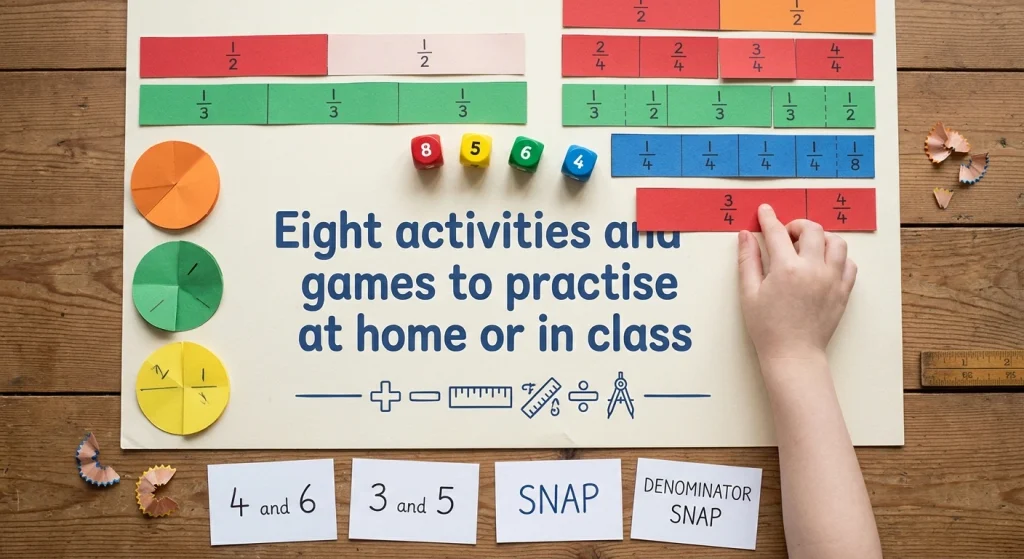
1. The chapati test. Tear two identical sheets, fold one in halves and one in thirds, tear off a piece of each, and ask the child to describe both using one unit.
2. Fraction strip kit. Cut eight identical paper strips and fold them into halves, thirds, quarters, fifths, sixths, eighths and tenths. Children lay them under one another to find common denominators. Keep the kit all year.
3. Common denominator snap. Write denominator pairs on slips. The first player to call the correct LCM keeps the slip.
4. Dice fractions. Roll four dice, make two fractions, add them, then compare answers in pairs.
5. Recipe challenge. Give a recipe using 1/2 cup of one thing and 1/3 cup of another, ask for the total, then ask them to double it.
6. Sorting race. The child sorts ten problem cards into “share a factor, use the LCM” and “no shared factor, cross-multiply” without solving any.
7. Spot the error. Write five worked solutions, three with deliberate errors, and let the child mark them. Children who find errors stop making them.
8. One-whole hunt. Find three different unit fractions adding to exactly 1.
Tips for parents
Spend more time on why than on how; a child who understands can rebuild a forgotten procedure. Do not correct straight away, ask for an estimate first. Keep denominators small while the concept settles, and insist on all four steps written out even when your child can work mentally. Keep a drawing beside every problem for the first fortnight, and practise four problems a day rather than twenty on a Sunday.
Tips for teachers
Open with a measurement conversion the class already knows, before any fraction appears. Spend a full lesson on equivalent fractions with no addition at all. Teach both methods in one week, then give a lesson purely on choosing between them, and keep a fraction wall displayed throughout. Write 1/2 + 1/3 = 2/5 on the board yourself and ask the class to prove you wrong. Ask students to explain their choice of denominator in a sentence. Differentiate by denominator size, not question count, and mention that subtracting fractions uses the identical first two steps.
Practice questions with answers
- 1/3 + 1/5
- 2/3 + 1/6
- 3/8 + 1/4
- 1/2 + 2/7
- 5/9 + 2/3
- 2/5 + 1/4
- 3/4 + 7/10
- 1/6 + 3/8
- 5/12 + 7/18
- 5/6 + 3/4
- 1 1/2 + 2 2/5
- 2 3/4 + 1 5/6
- 1/2 + 1/3 + 1/5
- A bottle holds 2/5 litre of juice and a glass holds 1/2 litre. How much altogether?
Answers. 1. 8/15 2. 5/6 3. 5/8 4. 11/14 5. 11/9 = 1 2/9 6. 13/20 7. 29/20 = 1 9/20 8. 13/24 9. 29/36 10. 19/12 = 1 7/12 11. 3 9/10 12. 4 7/12 13. 31/30 = 1 1/30 14. 9/10 litre
Make Preparing for Math Olympiad Simple!


Why can’t you add fractions with unlike denominators directly?
The denominator gives the size of each piece, and pieces of different sizes cannot be counted together, just as metres and centimetres cannot. Rewrite both with the same denominator first, then add the numerators.
Do I have to use the LCM, or will any common denominator work?
Any common multiple gives a correct answer. The LCM just keeps the numbers smallest and reduces the simplifying at the end.
Which is better, the LCM method or cross-multiplication?
Neither always. Cross-multiplication is faster when the denominators share no factor, such as 3 and 5; the LCM method is better when they do, such as 4 and 6.
How do you add three fractions with unlike denominators?
Find a common multiple of all three denominators, convert all three, add the numerators and simplify.
How do you add mixed numbers with unlike denominators?
Either add the wholes and fractions separately and carry any extra whole across, or convert both to improper fractions and use the LCM method.
Do I always have to simplify?
Yes, for full marks. 8/30 is the right value but counts as incomplete; it should be 4/15.
My child keeps adding the denominators. How do I stop it?
Show them the method gives 1/2 + 1/2 = 2/4, which says half a chapati plus half a chapati is half a chapati. An absurd answer breaks the habit faster than correction.
Conclusion
Adding fractions with unlike denominators is one idea applied carefully: pieces of different sizes cannot be counted until they are made the same size. The LCM, cross-multiplication, simplifying and carrying all follow from that sentence.
So take one thing from this guide: the order of teaching. Spend the first week on equivalent fractions and the metres and centimetres comparison, until your child can explain why 1/2 + 1/3 is not 2/5. The procedures then take days. Taught in reverse, they take months. The natural next step is subtracting fractions, which reuses the same first two steps.

Mikha Piregu is a Content Writer with experience spanning educational content, including math and math olympiad topics, as well as advocacy writing, research-based articles, and SEO-driven web content. He creates high-quality blog content, web copy, and feature articles that support brand visibility, audience engagement, and long-term organic growth through data-informed storytelling. Skilled in WordPress, WooCommerce, and modern digital tools, Mikha adapts content across various platforms, including blogs, websites, campaigns, and advocacy initiatives, with clarity and purpose.

There are no comments posted here yet.
Sign in to leave a comment