


To divide fractions, keep the first fraction as it is, change the division sign to multiplication, flip the second fraction to make its reciprocal, then multiply straight across and simplify.
- What dividing fractions actually means
- What is a reciprocal?
- Why do you flip and multiply when dividing fractions?
- The Keep, Change, Flip method
- Case 1: Dividing a fraction by a whole number
- Case 2: Dividing a whole number by a fraction
- Case 3: Dividing a fraction by a fraction
- Case 4: Dividing mixed numbers
- Cross-cancellation and simplifying
- The three mistakes children make most
- Real-life problems that need fraction division
- Where this leads next
- Eight activities to try at home
- Tips for parents and teachers
- Practice questions with answers
- Frequently asked questions
- Conclution
That is the keep, switch, flip rule, and it works for every kind of fraction division.
How to divide fractions in five steps
- Keep the first fraction exactly as it is.
- Switch the division sign (÷) to a multiplication sign (×).
- Flip the second fraction so the numerator and denominator swap places; that flipped fraction is its reciprocal.
- Multiply straight across: numerators together, denominators together.
- Simplify the answer, turning an improper fraction into a mixed number if the question needs one.
So 3/5 ÷ 2/7 = 3/5 × 7/2 = 21/10 = 2 1/10.
Now the part most guides leave out: why does flipping work at all? Take a one-litre bottle and a glass holding half a litre. You can fill two glasses, so 1 ÷ 1/2 = 2 — and the answer got bigger. That surprise is what quietly confuses children in Class 5, 6 and 7.
The rest of this guide shows, on a number line you can draw in a notebook, why flipping and multiplying is the same thing as dividing, so the rule sticks instead of being memorised.
What dividing fractions actually means
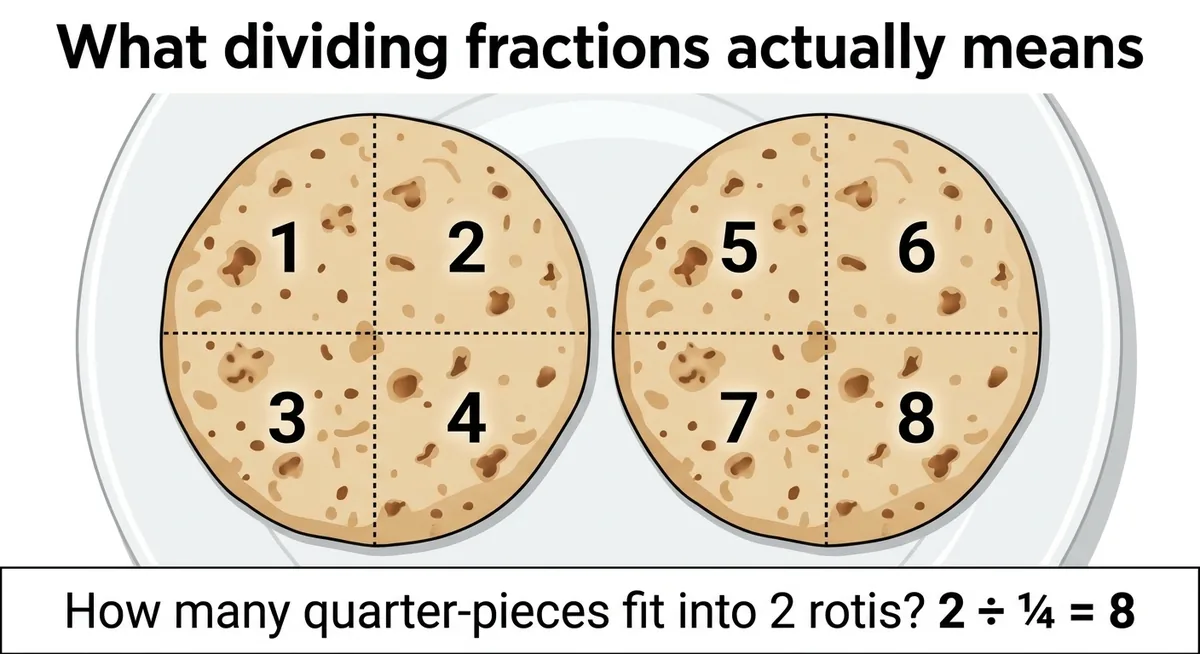
12 ÷ 4 can be read two ways: share 12 ladoos among 4 children, or ask how many groups of 4 fit into 12. Both give 3, so in Class 3 it hardly matters. With fractions it matters enormously, because sharing among “half a person” is nonsense while the grouping reading keeps working — 3 ÷ 1/2 asks how many half-pieces fit into 3.
How many of these fit into that? is the most useful sentence in the chapter. Say it before writing anything. Cut a roti into quarters: how many quarter-pieces in 2 rotis? Eight. You have solved 2 ÷ 1/4 = 8 with no pencil. If numerator and denominator are still shaky, settle those first.
Why the answer can be bigger
Children arrive carrying a rule they have never questioned: dividing makes things smaller. 20 ÷ 5 = 4, every time. Then 2 ÷ 1/4 = 8 appears and the rule collapses.
Dividing does not shrink things. It asks how many of the divisor fit inside the dividend, and a great many small pieces fit.
| Question | Reading | Answer |
|---|---|---|
| 2 ÷ 2 | How many 2s in 2? | 1 |
| 2 ÷ 1 | How many 1s in 2? | 2 |
| 2 ÷ 1/2 | How many halves in 2? | 4 |
| 2 ÷ 1/4 | How many quarters in 2? | 8 |
| 2 ÷ 1/8 | How many eighths in 2? | 16 |
As the divisor shrinks, the answer grows. Ask your child to predict the next row before you write it.
What is a reciprocal?
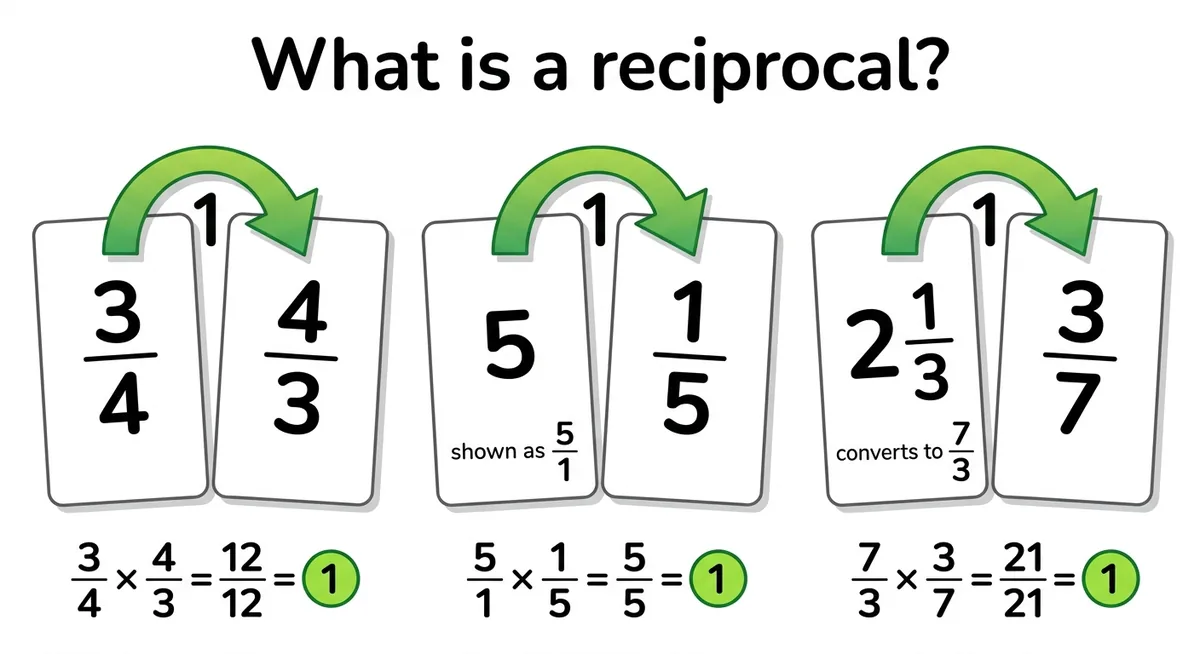
The reciprocal is not a footnote here. It is the whole chapter.
A reciprocal is the number you multiply by to get exactly 1. Hold on to that rather than “the flipped fraction”; flipping is what it looks like, 1 is what it does. 2/3 × 3/2 = 1. 5/8 × 8/5 = 1. 7 × 1/7 = 1. Only zero has no reciprocal, which is the real reason you can never divide by zero.
| Number | Reciprocal | How |
|---|---|---|
| 3/4 | 4/3 | swap top and bottom |
| 1/6 | 6 | swap; 6/1 is just 6 |
| 5 | 1/5 | write 5 as 5/1, then swap |
| 2 1/3 | 3/7 | convert to 7/3 first, then swap |
Two rows deserve attention. The reciprocal of 1/6 is 6, a whole number, which is exactly why dividing by a small fraction gives a large answer. And a mixed number is never flipped as it stands: 2 1/3 becomes 7/3 (2 × 3 + 1 = 7), then 3/7. Check it — 7/3 × 3/7 = 21/21 = 1. Teach that check; it catches every error here. The same converting habit turns up in adding fractions and subtracting fractions.
Why do you flip and multiply when dividing fractions?
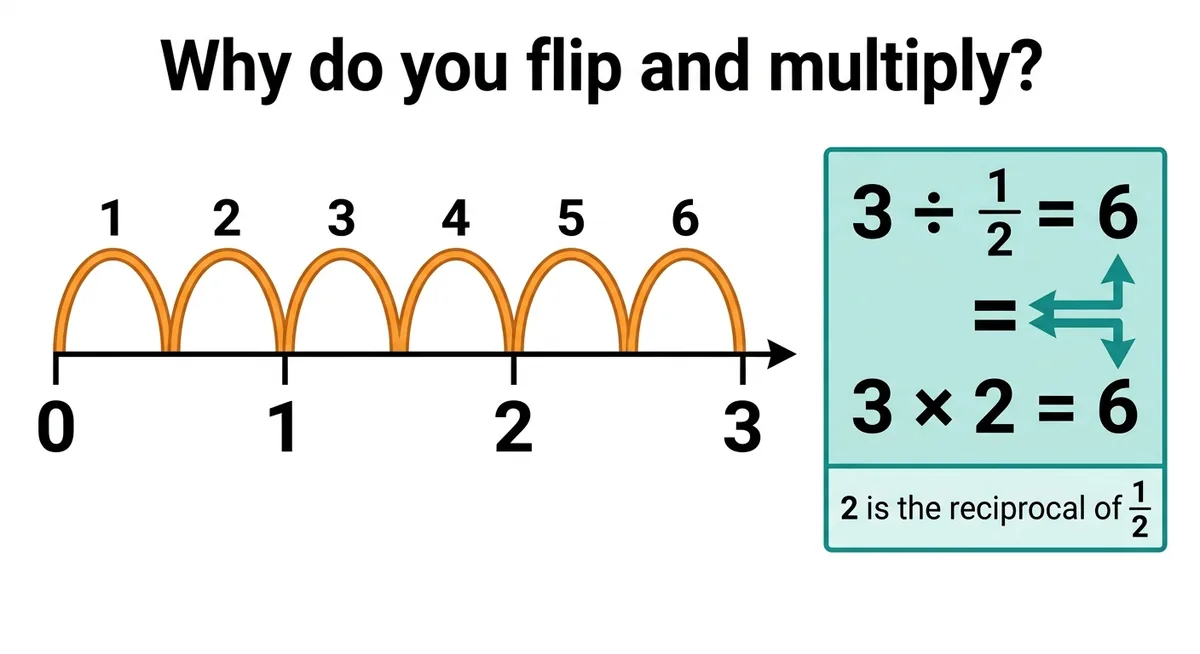
Short answer: dividing by a number and multiplying by its reciprocal are the same operation. Not similar, not a shortcut, identical, every time.
The number line proof
Draw a line from 0 to 3 and mark the whole numbers. How many halves fit into 3? Mark 1/2, 1, 1 1/2, 2, 2 1/2, 3, and count the hops: six. So 3 ÷ 1/2 = 6, and 6 is 3 × 2, where 2 is the reciprocal of 1/2.
Try thirds: each whole holds three one-thirds, so three wholes hold nine. 3 ÷ 1/3 = 9 = 3 × 3.
The reason is visible on the line. Dividing by 1/4 chops every unit into 4 pieces, so you end up with four times as many pieces. Dividing by a quarter multiplies your count by four.
And when the top isn’t 1? Read 2/3 as “two thirds stuck together”. Dividing by 1/3 multiplies your count by 3, but each group holds two of them, so halve it. Multiply by 3, then divide by 2, which is multiplying by 3/2, the reciprocal of 2/3.
So a fraction says multiply by my top, divide by my bottom. Dividing by it reverses both instructions. That is all flipping does.
The algebra, in two lines
Write 3/4 ÷ 2/5 as a stacked fraction and multiply the top and bottom by 5/2, the reciprocal of the bottom. Multiplying the top and bottom by the same number leaves a fraction’s value unchanged the rule behind equivalent fractions.
The bottom becomes 1 and vanishes, leaving the first fraction times the reciprocal of the second. That is flip and multiply, proved.
Which one flips
The reciprocal was chosen to cancel the bottom — the divisor, the number after the ÷ sign. Nothing in the proof touches the first fraction, so it never moves.
A two-second check: 1 ÷ 1/2 should be 2, because two halves fit into one. Flip the second, 1 × 2/1 = 2. Correct. Flip the first, 1/1 × 1/2 = 1/2 — obviously wrong, since you cannot fit half a half-piece into a whole.
The Keep, Change, Flip method
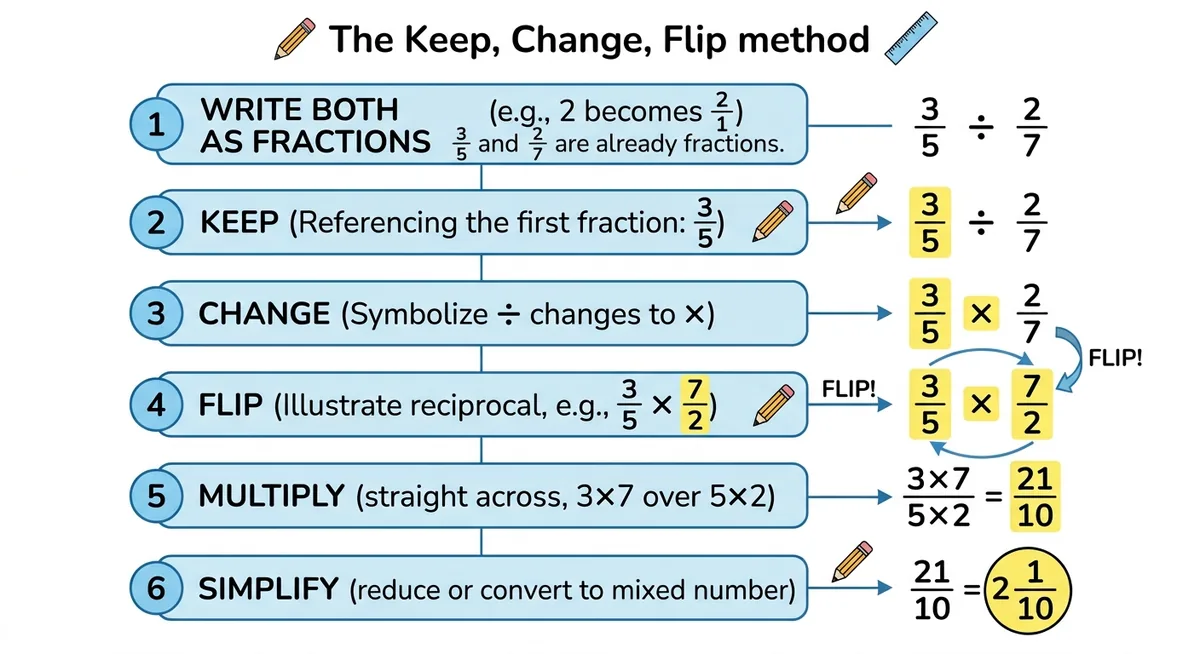
Now the rule is just a fast way of doing what you already understand. Indian classrooms call it Keep, Change, Flip (KCF); “invert and multiply” means the same thing.
- Write both numbers as fractions. A whole number goes over 1 (6 → 6/1); a mixed number becomes improper (2 1/4 → 9/4).
- Keep the first fraction exactly as it is.
- Change the ÷ sign to a × sign.
- Flip the second fraction to its reciprocal.
- Multiply across — tops together, bottoms together.
- Simplify, and convert back to a mixed number if the question used one.
Worked once, 3/5 ÷ 2/7: keep 3/5, change the sign, flip 2/7 to 7/2, multiply to 21/10, convert to 2 1/10.
One habit worth insisting on — say “keep, change, flip” aloud and point at the second fraction on the word flip. The pointing attaches the word to the right number. And step 6 is not optional: 8/12 left unsimplified loses marks in a CBSE paper.
Case 1: Dividing a fraction by a whole number
The gentlest case, and a Class 5 one. You are sharing a fractional amount among a whole number of parts, so the answer gets smaller — which feels comfortable. Write the whole number over 1, then KCF.
- 3/4 ÷ 3 — three-quarters of a chocolate bar among 3 children. 3/4 × 1/3 = 3/12 = 1/4 each. Three quarter-pieces among three children is one each, so it checks out.
- 2/5 ÷ 4 → 2/5 × 1/4 = 2/20 = 1/10
- 7/8 ÷ 2 → 7/8 × 1/2 = 7/16
A shortcut hides here: dividing a fraction by a whole number multiplies the denominator and leaves the numerator alone. Children often spot it, which is a good sign — but keep writing the full steps, since method marks are awarded for them.
Case 2: Dividing a whole number by a fraction
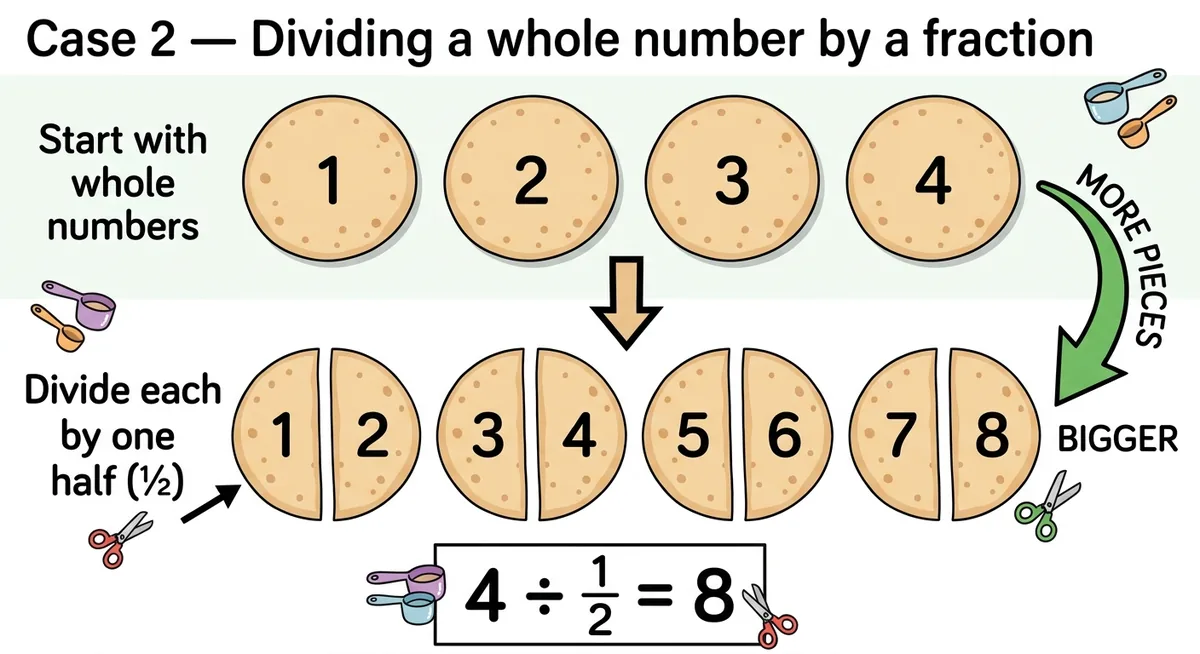
This is the case that matters most, and the one most guides rush. The answer comes out larger than the whole number you started with — and that surprise is evidence of understanding, not a problem to explain away.
- 4 ÷ 1/2 — four rotis, each halved. 4/1 × 2/1 = 8 half-pieces. Eight is more than four, exactly as the plate shows.
- 6 ÷ 2/3 — six metres of cloth in two-thirds-metre pieces. 6/1 × 3/2 = 18/2 = 9. Estimate first: each piece is a little under a metre, so expect a few more than six. Nine fits.
- 5 ÷ 3/4 → 5/1 × 4/3 = 20/3 = 6 2/3. Five litres of milk into three-quarter-litre bottles fills 6 bottles with two-thirds of a bottle left — not two-thirds of a litre. Word problems test that distinction.
- 2 ÷ 1/8 → 2/1 × 8/1 = 16
If your child announces that 2 ÷ 1/8 = 1/4, send them back to the rotis. Sixteen pieces are visible on the plate; a quarter of a roti answers nothing.
Case 3: Dividing a fraction by a fraction
The case the chapter is named after, and by now it needs no new teaching. If the second fraction is smaller than the first, the answer is more than 1; if bigger, less than 1. That lets your child predict the size before calculating.
- 1/2 ÷ 1/6 → 1/2 × 6/1 = 6/2 = 3. Half a pizza holds three one-sixth slices.
- 3/4 ÷ 1/8 → 3/4 × 8/1 = 6
- 2/3 ÷ 4/9 → 2/3 × 9/4 = 18/12 = 1 1/2
- 3/8 ÷ 3/4 → 3/8 × 4/3 = 12/24 = 1/2 — less than 1, because three-quarters is bigger than three-eighths, so only half of it fits.
Case 4: Dividing mixed numbers
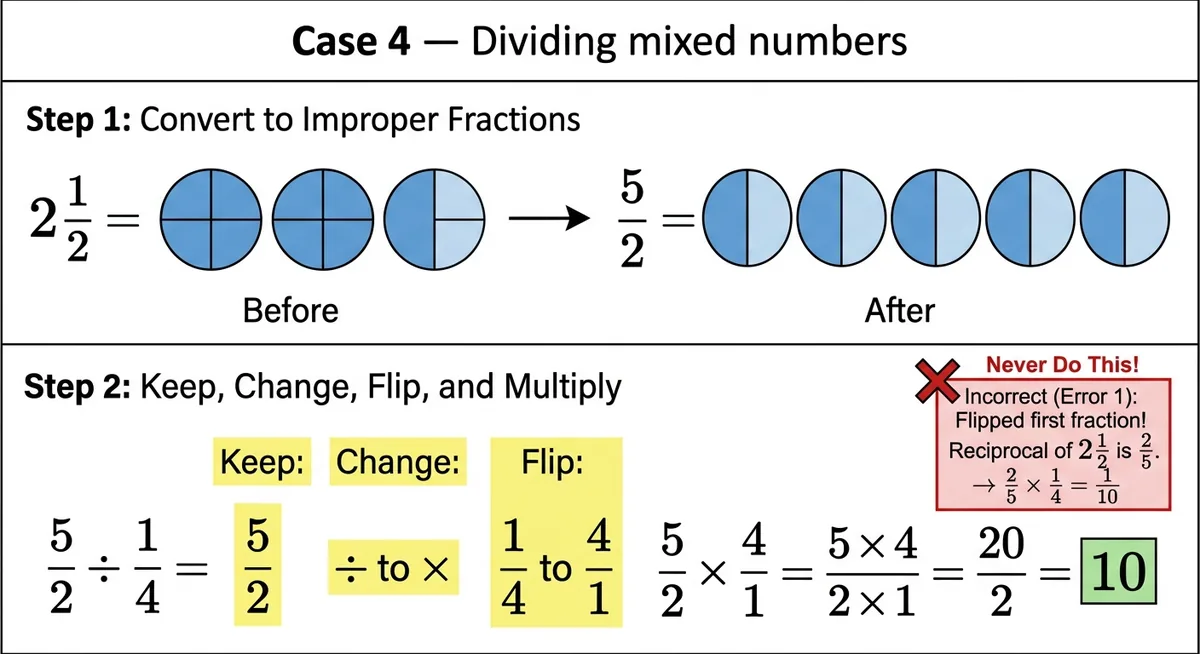
Class 6 and 7 lean heavily on this, and it is where careless marks vanish. Convert every mixed number to an improper fraction before anything else. KCF works on fractions, not on mixed numbers.
- 2 1/2 ÷ 1/4 → 5/2 × 4/1 = 20/2 = 10. Two and a half rotis in quarter-pieces: ten.
- 3 1/3 ÷ 2/5 → 10/3 × 5/2 = 50/6 = 8 1/3
- 4 1/2 ÷ 1 1/2 → 9/2 × 2/3 = 18/6 = 3. Read it back — how many 1 1/2-litre bottles from 4 1/2 litres? Three. Sense and arithmetic agree.
- 5 ÷ 1 2/3 → 5/1 × 3/5 = 15/5 = 3
Make the conversion a written line every time, never a mental one.
Cross-cancellation and simplifying
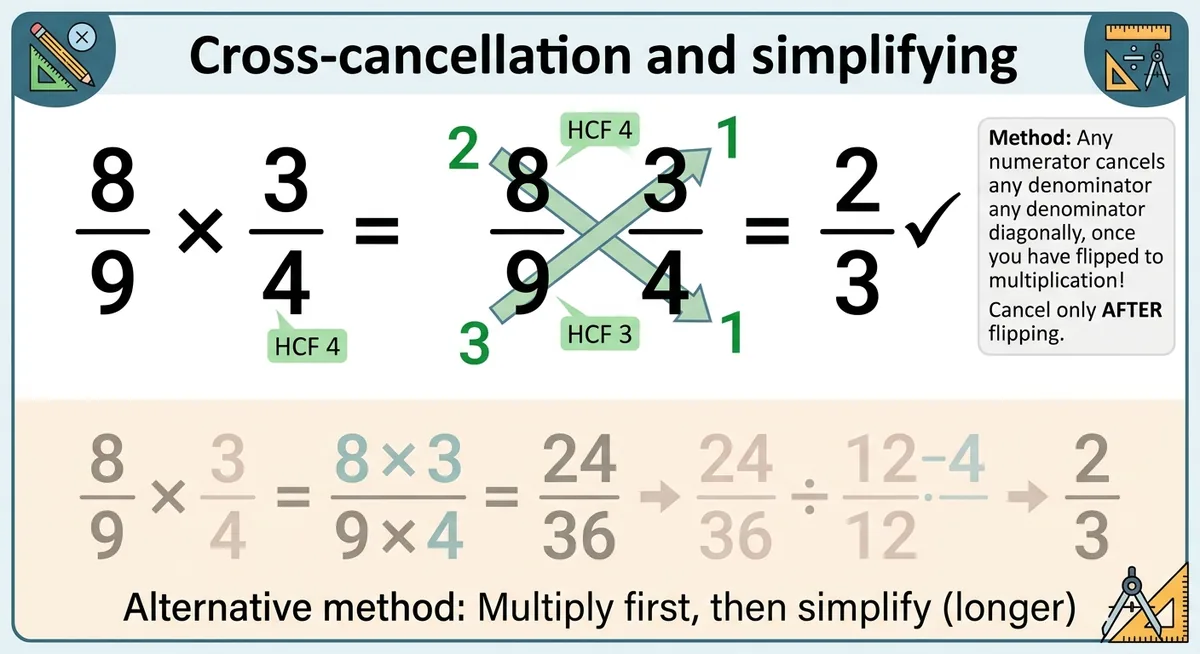
Most guides skip cross-cancellation. That is a real loss — it turns ugly arithmetic into easy arithmetic.
Once you have flipped, you have a multiplication, and any numerator can be cancelled against any denominator, even diagonally. Take 8/9 ÷ 4/3. Flip first: 8/9 × 3/4. Now 8 and 4 share a factor of 4 (→ 2 and 1), and 9 and 3 share 3 (→ 3 and 1). What is left is 2/3 × 1/1 = 2/3.
| Step | Without cancelling | With cross-cancellation |
|---|---|---|
| After flipping | 8/9 × 3/4 | 8/9 × 3/4 |
| Multiply | 24/36 | 2/3 |
| Simplify | HCF 12 → 2/3 | already done |
| Hardest sum | 24 ÷ 12, 36 ÷ 12 | 8 ÷ 4, 9 ÷ 3 |
Two rules that must not be broken: cancel only after flipping, and cancel one top against one bottom, never two tops. Another one — 15/16 ÷ 5/8 → 15/16 × 8/5; cancel 15 and 5 by 5, 16 and 8 by 8, leaving 3/2 = 1 1/2.
If no cancellation is spotted, nothing is lost: simplify at the end instead by dividing top and bottom by their HCF. For 18/24 the HCF is 6, giving 3/4. For bigger numbers use prime factors — 36 = 2 × 2 × 3 × 3 and 48 = 2 × 2 × 2 × 2 × 3 share 12, so 36/48 = 3/4. A run through the divisibility rules and prime and composite numbers makes this much faster. If both numbers are still even, you are not finished.
The three mistakes children make most
1. Flipping the first fraction. The mnemonic says flip, but not which one. On 2/3 ÷ 4/5, flipping the first gives 3/2 × 4/5 = 1 1/5; flipping the second gives 2/3 × 5/4 = 10/12 = 5/6. Both look plausible, which is what makes this error expensive. The fix: the first fraction is the amount you have, and it never changes only the instruction about cutting it up does.
2. Forgetting to flip. On 3/5 ÷ 1/2, multiplying straight across gives 3/10; flipping properly gives 3/5 × 2/1 = 6/5 = 1 1/5. The wrong answer is smaller than 3/5, and that is the giveaway: half-pieces are smaller than three-fifths, so more than one must fit. The fix: before multiplying, ask whether the divisor is smaller than the dividend. If it is, the answer has to be more than 1.
3. Flipping during a multiplication. On 2/3 × 3/4, a well-drilled child flips out of habit and gets 8/9 instead of 6/12 = 1/2. The fix: flipping is the reason the sign changes from ÷ to ×. No ÷ sign, no flip. Circle the operation sign before starting.
Three smaller ones worth naming: finding a common denominator first (that is for adding and subtracting only), flipping a mixed number as it stands, and leaving the answer unsimplified.
Real-life problems that need fraction division
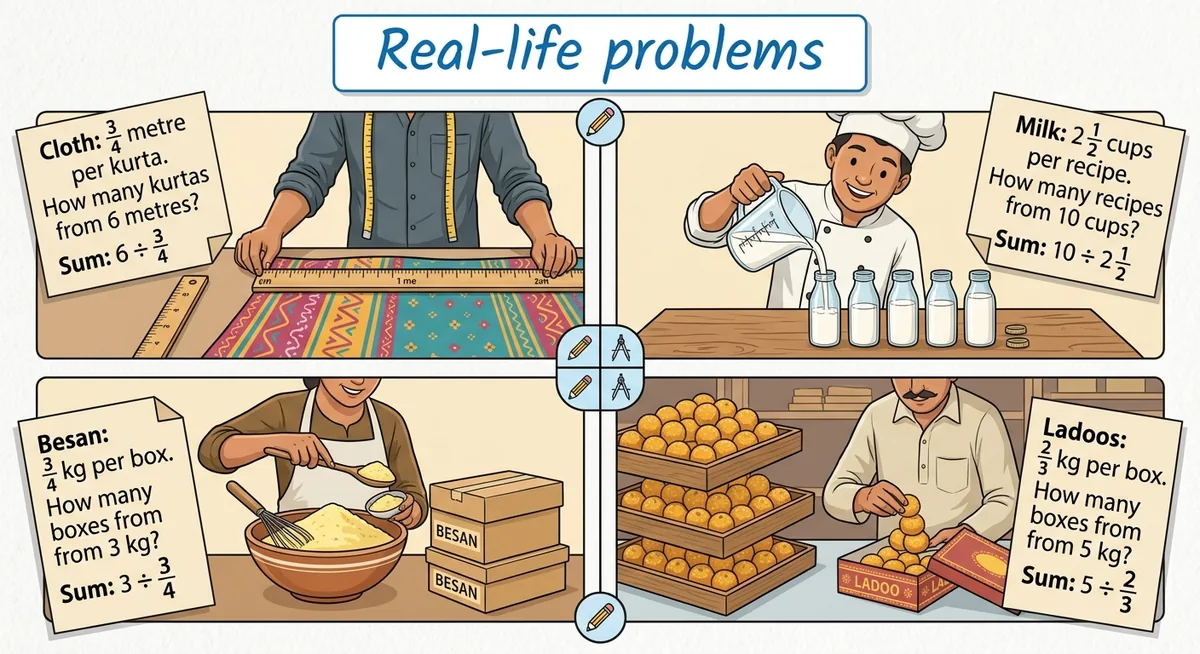
The arithmetic is rarely the hard part; deciding which number is the divisor is. Ask: what is being cut up, and how big is each piece? The thing being cut is the dividend; the piece size is the divisor. Our guide to solving math word problems goes deeper into reading questions like these.
- Sharing. 3/4 kg of besan into 3 boxes: 3/4 × 1/3 = 1/4 kg each.
- Measurement. 9 m of cloth, 3/4 m per kurta: 9/1 × 4/3 = 12 kurtas.
- Scaling down. 2 1/2 cups of milk for 5 people: 5/2 × 1/5 = 1/2 cup each.
- Filling. A 7 1/2-litre cooler, 1 1/4-litre bottles: 15/2 × 4/5 = 6 bottles.
- Speed. Ravi walks 2 1/4 km in 3/4 of an hour: 9/4 × 4/3 = 3 km in an hour bigger than 2 1/4, as it should be.
- Leftovers. 5 kg of ladoo mixture, 2/3 kg a box: 15/2 = 7 1/2, so 7 full boxes with half a box, which is 1/3 kg, left over. Converting that half-box back into kilograms is the step children forget.
Where this leads next
Fraction division does not end with the unit test. Every division is a multiplication in disguise, so a ÷ b = a × 1/b ties the two operations together for good. Ratio and rate questions in Class 7 and 8 speed, price per kilogram, work done per hour — are fraction division wearing different clothes. In algebra, solving 2/3 x = 8 means multiplying both sides by 3/2; the reciprocal is the tool that isolates x.
Olympiad questions rarely ask you to compute 3/4 ÷ 2/5. They ask how many 5/6 m pieces a 7 1/2 m rope gives, or what fraction of a tank is left after part is drawn off. The arithmetic stays Class 6 arithmetic; the difficulty is in setting the sum up, which is exactly why understanding beats memorising. Our guide to solving Olympiad problems takes that further.
Eight activities to try at home
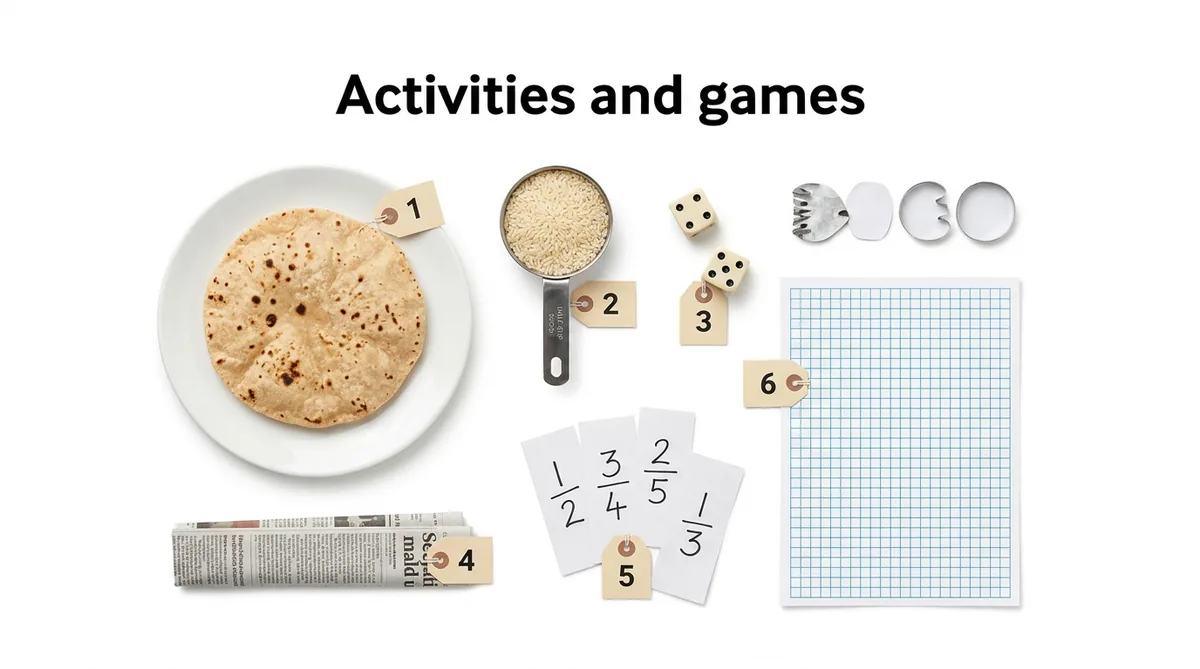
Everything below uses what is already in the kitchen or the school bag.
- Roti count. Cut a roti into quarters. How many quarter-pieces in 1 roti? In 2? Write 2 ÷ 1/4 = 8 alongside, then switch to sixths and let your child predict first.
- Measuring cups. Two cups of rice and a half-cup scoop: how many scoops? Then a third-cup scoop. Smaller scoop, more scoops.
- Newspaper strips. Call a long strip 1 whole and fold it into eighths. How many eighths in the whole? In half of it?
- Reciprocal snap. Fractions on twenty paper slips, reciprocals on twenty more. Race to pair them — but you must multiply and show the answer is 1 before claiming a pair.
- Dice division. Two dice make a fraction. Roll four times, divide the first fraction by the second, simplify. Larger answer wins the round.
- Graph paper. Shade 3/4 of a 4 × 4 grid, then mark it off in groups of 1/8. Count six groups: 3/4 ÷ 1/8 = 6, drawn rather than calculated.
- Shopkeeper. 5 kg of pretend sugar, 2/3 kg a packet. How many packets, and what is left? Swap roles so your child sets the question too.
- Spot the mistake. Solve five sums with two of them wrong, and let your child mark your work. Catching your error builds more confidence than getting their own right.
In the car, with no paper at all: how many half-hours in 3 hours? How many quarter-litres in 2?
Tips for parents and teachers
At home. Ask “how many fit?” before every sum. Don’t correct instantly; ask instead whether the answer should be bigger or smaller than the start, and let them find it. Keep the cutting real (rotis, oranges, chikki) for as long as possible. Ten minutes a day beats an hour on Sunday. And if you were taught the rule without the reason, say so: “Let’s work it out together” makes you a partner rather than an examiner.
In class. Delay the mnemonic by a full lesson and spend the first one on “how many fit?” with number lines and paper strips. Lead with whole-number-divided-by-fraction, since the surprise generates discussion. Write divisions in stacked form alongside the ÷ sign it makes the cancelling proof visible and prepares students for algebraic fractions. Mix multiplication and division questions early, or children stop reading the sign. Mark the method, not only the answer. And put three anonymous wrong workings on the board for the class to diagnose; it produces better discussion than any correct example. If the group is still shaky on what a fraction is, step back to fractions for Class 3 first.
Practice questions with answers
Set A — fraction ÷ whole number: 1/2 ÷ 2 · 3/5 ÷ 3 · 4/7 ÷ 2 · 5/6 ÷ 10 · 9/10 ÷ 6
Set B — whole number ÷ fraction: 3 ÷ 1/2 · 4 ÷ 1/4 · 6 ÷ 2/3 · 5 ÷ 5/8 · 7 ÷ 3/4
Set C — fraction ÷ fraction: 1/2 ÷ 1/4 · 3/4 ÷ 1/2 · 2/5 ÷ 4/5 · 7/8 ÷ 7/16 · 5/9 ÷ 10/27
Set D — mixed numbers: 2 1/2 ÷ 1/2 · 3 1/3 ÷ 2 · 4 1/2 ÷ 1 1/2 · 5 1/4 ÷ 3/8 · 2 2/3 ÷ 1 1/5
Set E — word problems: a 4 1/2 m ribbon cut into 3/4 m pieces; 2/3 kg of jaggery among 4 children; an 8-litre bucket filled with a 2/5-litre mug; 1 1/2 cups of sugar for 6 people; Meera cycles 3 3/4 km in 5/8 of an hour — how far in a full hour?
Answers. A: 1/4, 1/5, 2/7, 1/12, 3/20. B: 6, 16, 9, 8, 9 1/3. C: 2, 1 1/2, 1/2, 2, 1 1/2. D: 5, 1 2/3, 3, 14, 2 2/9. E: 6 pieces, 1/6 kg, 20 mugfuls, 1/4 cup, 6 km.
If Sets A and B go well but Set D does not, the problem is the mixed-number conversion, not the division.
Make Preparing for Math Olympiad Simple!


Frequently asked questions
How do you divide fractions?
Keep the first fraction unchanged, change ÷ to ×, flip the second fraction to its reciprocal, multiply the numerators together and the denominators together, then simplify. For example, 3/5 ÷ 2/7 = 3/5 × 7/2 = 21/10 = 2 1/10.
Why do you flip and multiply when dividing fractions?
Because dividing by a number is the same as multiplying by its reciprocal. Write the division as one fraction over another and multiply top and bottom by the reciprocal of the bottom. The bottom becomes 1 and disappears, leaving the first fraction times the flipped second.
Which fraction do you flip?
Always the second one the divisor, the number after the ÷ sign. The first never changes.
What is the reciprocal of a fraction?
The number you multiply it by to get 1. Swap top and bottom (3/4 → 4/3). Write a whole number over 1 first (5 → 1/5). Convert a mixed number first (2 1/3 → 7/3 → 3/7). Zero has no reciprocal.
Why is the answer bigger than what I started with?
Because division asks how many of the divisor fit inside the dividend, and many small pieces fit. 2 ÷ 1/4 = 8 is correct, not a mistake.
Do I need a common denominator?
No. Common denominators are for adding and subtracting only.
How do you divide mixed numbers?
Convert every mixed number to an improper fraction first, then keep, change, flip. 3 1/3 ÷ 2/5 = 10/3 × 5/2 = 50/6 = 8 1/3.
In which class is this taught?
Under the NCERT scheme, fraction ÷ whole number appears in Class 5 and early Class 6; whole number ÷ fraction and fraction ÷ fraction in Class 6; mixed numbers and multi-step word problems in Class 7. Converting decimals to fractions is a useful companion topic.
Conclution
Flip and multiply is not a trick. It works because dividing by a number and multiplying by its reciprocal are the same operation, something your child can see on a number line long before they can prove it on paper.
Keep asking “how many of these fit into that?”, keep remembering that it is the divisor that flips, and keep simplifying to the very end.
Get those three habits in place and fraction division stops being a rule to memorise and becomes something your child can rebuild whenever they need it.

Mikha Piregu is a Content Writer with experience spanning educational content, including math and math olympiad topics, as well as advocacy writing, research-based articles, and SEO-driven web content. He creates high-quality blog content, web copy, and feature articles that support brand visibility, audience engagement, and long-term organic growth through data-informed storytelling. Skilled in WordPress, WooCommerce, and modern digital tools, Mikha adapts content across various platforms, including blogs, websites, campaigns, and advocacy initiatives, with clarity and purpose.

There are no comments posted here yet.
Sign in to leave a comment