


To convert a fraction to a decimal, write the fraction as a division, divide the top number by the bottom number, and place the decimal point. Three steps, a pencil and some paper.
- Fractions and Decimals Are the Same Value, Written Two Ways
- A Quick Recap: Decimal Place Value
- Method 1: How to Convert a Fraction to a Decimal in 3 Easy Steps
- Method 2: The Equivalent Fraction Shortcut
- Which Method Should You Use?
- Terminating and Recurring Decimals
- Converting Improper Fractions and Mixed Numbers
- Fraction to Decimal Chart
- The Mistake Almost Every Child Makes
- Other Common Mistakes, and How to Fix Them
- From Decimals to Percentages
- Where Class 5 to 7 Students Actually Use This
- Fraction to Decimal in Olympiad Problems
- Activities and Games
- Tips for Parents
- Tips for Teachers
- Conclusion
Most children get stuck before step one. They look at 3/8 and cannot remember which number goes inside the division bracket. Then they meet 1/3, find the division never finishes, and decide something has gone wrong. Neither is a sign of weak maths. Both are signs that nobody explained what a fraction and a decimal actually are.
This guide explains how to convert fraction to decimal and provides two methods, worked examples for each fraction type in Classes 5 to 7, a reference chart, activities, and practice questions.
Fractions and Decimals Are the Same Value, Written Two Ways
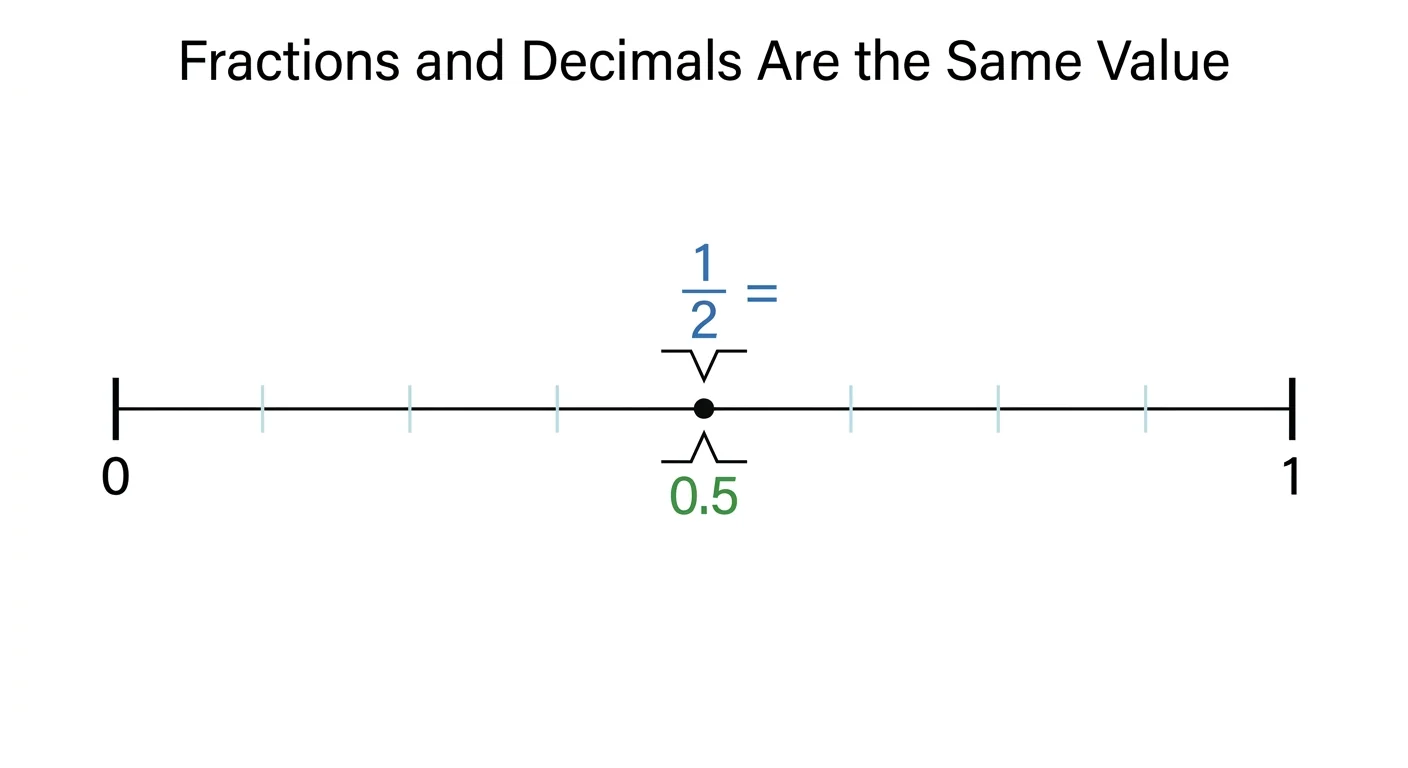
A fraction and a decimal are not two kinds of number. They are two spellings of one value, the way half, 0.5 and 50 paise out of a rupee all point to the same amount.
Picture a number line from 0 to 1 and mark the exact middle. That point has two correct names, 1/2 and 0.5, and nothing about it changes depending on which you write. Mark a quarter of the way along and it is both 1/4 and 0.25.
So converting is re-spelling, not calculating. Try it: ask your child which is bigger, 5/8 or 7/12, and most of them pause. Ask which is bigger, 0.625 or 0.583, and nobody hesitates. Same two numbers, and one spelling makes the question easy. That is the real reason this skill matters. If the words numerator and denominator are still shaky, settle those before going further.
A Quick Recap: Decimal Place Value
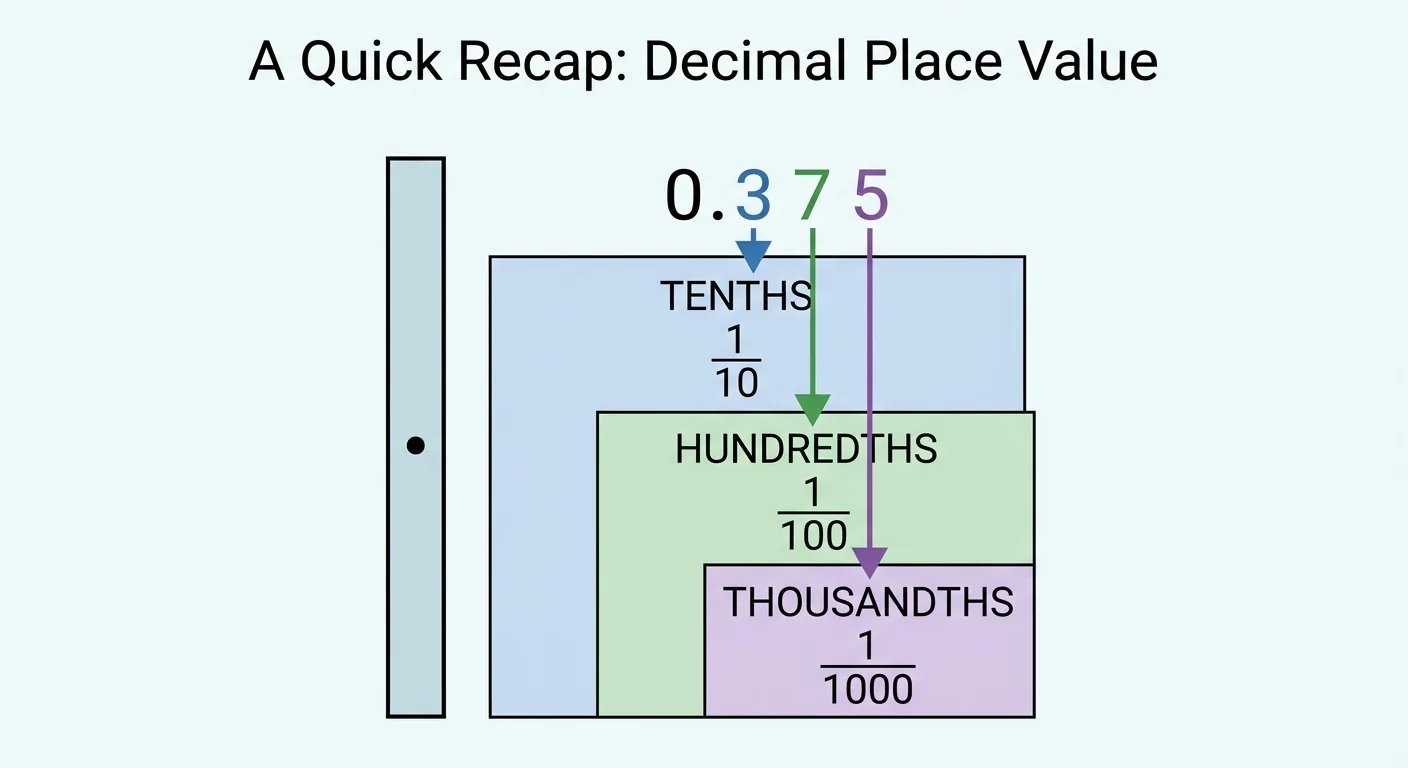
Both methods below depend on what the digits after a decimal point mean. Each place is ten times smaller than the one before it:
| Place | Name | Fraction it stands for |
|---|---|---|
| 1st after the point | Tenths | 1/10 |
| 2nd after the point | Hundredths | 1/100 |
| 3rd after the point | Thousandths | 1/1000 |
So 0.375 is 3 tenths, 7 hundredths and 5 thousandths, which is 375/1000.
This is the key to everything that follows. Every place after the decimal point is already a fraction over 10, 100 or 1000. A decimal is simply a fraction whose power-of-ten denominator has been hidden away, and converting means finding that denominator or dividing until it appears.
In CBSE and NCERT terms, your child met tenths and hundredths in Class 5, handled thousandths in Class 6, and is expected to move between fractions, decimals and percentages by Class 7. If place value is unsteady, work through a place value chart and some expanded form practice before the conversion work, not during it.
Method 1: How to Convert a Fraction to a Decimal in 3 Easy Steps
This method works on every fraction with no exceptions. It is slower than the shortcut you will meet next, so teach it first and keep it as the fallback.
To convert a fraction to a decimal: write the fraction as a division, divide the numerator by the denominator adding a decimal point and zeros as needed, and place the decimal point in the answer directly above the one in the dividend.
Step 1: Write the fraction as a division. The fraction line means divided by, so 3/8 means 3 divided by 8. The top number goes inside the division bracket, the bottom number outside. Say it out loud every time: top number inside, bottom number outside. One sentence, and it prevents the commonest error in the whole topic. A way to make it stick: 3/8 is three things shared between eight people, so the three is what is being shared and goes inside.
Step 2: Divide, adding a decimal point and zeros. If the top number is smaller than the bottom, the division will not start. That is expected. Put a decimal point after the top number and add zeros, because 3, 3.0 and 3.000 are all worth exactly three. Then divide as usual, carrying remainders across. Keep going until the remainder is zero, or until a remainder repeats. If the long division itself is the sticking point, practise that separately.
Step 3: Place the decimal point. The point in your answer sits directly above the point inside the bracket. Put it there the moment you write it in the dividend and you will never lose it. If there is no whole number, write the zero: 0.375, not .375.
Five Worked Examples
1/2. 2 does not go into 1, so write 1.0 and divide 10 by 2, which gives 5 exactly. 1/2 = 0.5
3/4. Write 3.00. 4 into 30 goes 7 times with 2 left, carry to make 20, and 4 into 20 goes 5 times. 3/4 = 0.75, which is also 75 paise in a rupee.
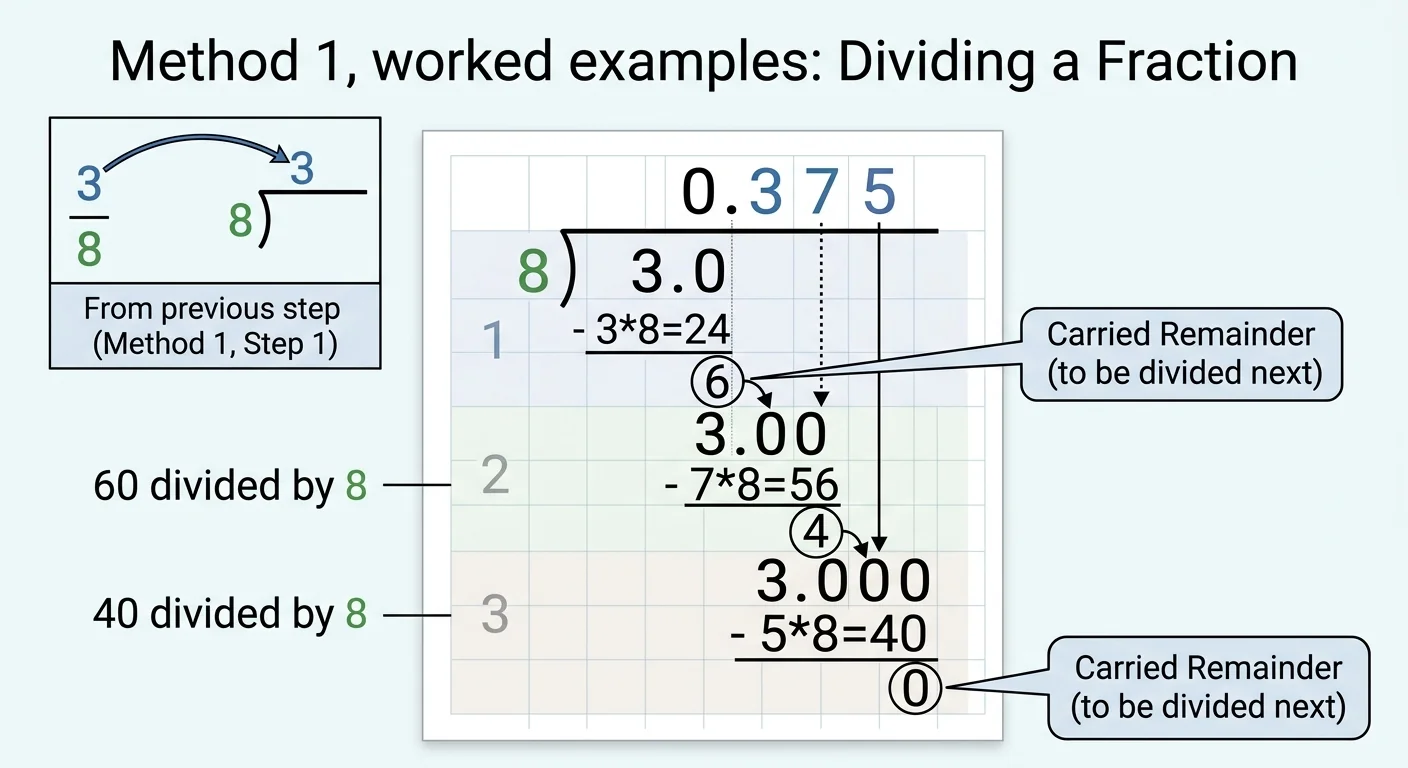
3/8. Write 3.000. 8 into 30 goes 3 with 6 left, 8 into 60 goes 7 with 4 left, 8 into 40 goes 5 exactly. 3/8 = 0.375. A denominator of 8 usually needs three decimal places.
5/16. Write 5.0000. 16 into 50 goes 3 with 2 left, into 20 goes 1 with 4 left, into 40 goes 2 with 8 left, into 80 goes 5 exactly. 5/16 = 0.3125. Four places, and it still ends.
7/40. Write 7.000. 40 into 70 goes 1 with 30 left, into 300 goes 7 with 20 left, into 200 goes 5 exactly. 7/40 = 0.175
Work all five on paper with your child rather than reading them. The method becomes automatic through the hand, not the eye.
Method 2: The Equivalent Fraction Shortcut
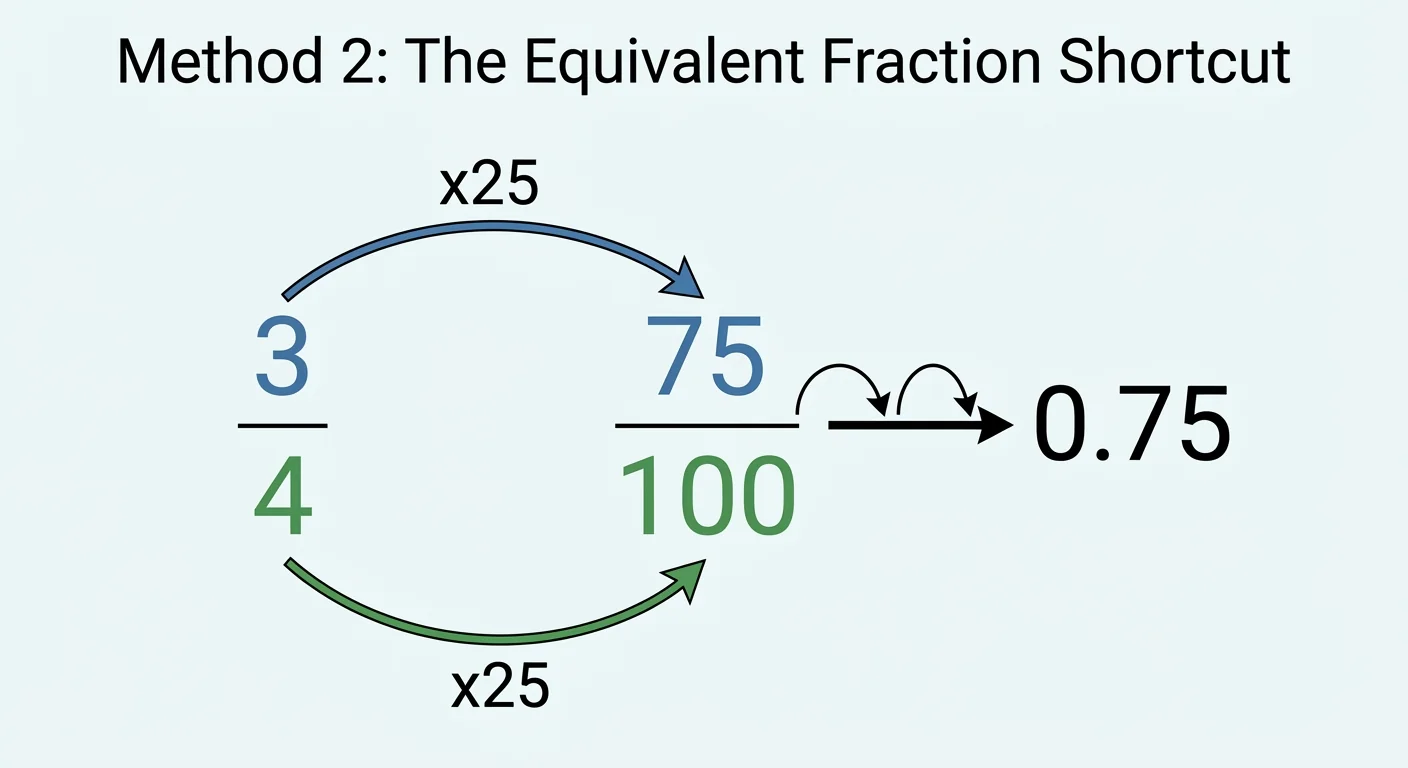
A decimal is a fraction whose denominator is 10, 100 or 1000. So if you can turn the denominator into one of those, you read the decimal straight off the page with no division at all.
Ask one question: what do I multiply this denominator by to reach 10, 100 or 1000? Then multiply the numerator by the same number. Multiplying top and bottom by the same number never changes a fraction’s value, which is the whole idea behind equivalent fractions.
These pairs are worth memorising, and a solid multiplication table makes them quick:
| Denominator | Multiply by | You get |
|---|---|---|
| 2 | 5 | 10 |
| 4 | 25 | 100 |
| 5 | 20 | 100 |
| 8 | 125 | 1000 |
| 20 | 5 | 100 |
| 25 | 4 | 100 |
| 50 | 2 | 100 |
Once the denominator is a power of ten, write the numerator and count the zeros. One zero means the point moves one place from the right, two zeros two places, three zeros three.
Four Worked Examples
1/5. 5 x 2 = 10, so 1/5 becomes 2/10. One zero, one place. 1/5 = 0.2
3/4. 4 x 25 = 100, so 3/4 becomes 75/100. Two zeros, two places. 3/4 = 0.75, the same answer long division gave us, in about five seconds.
7/20. 20 x 5 = 100, so 7/20 becomes 35/100. 7/20 = 0.35
3/25. 25 x 4 = 100, so 3/25 becomes 12/100. 3/25 = 0.12
One warning worth giving early: no whole number multiplies 3, 7 or 11 into a power of ten, so this method cannot touch 1/3, 2/7 or 5/11. When the shortcut will not open the lock, go back to Method 1.
Which Method Should You Use?
Look at the denominator before doing anything else. One glance decides it.
| If the denominator is | Use | Because |
|---|---|---|
| 2, 4, 5, 8, 10, 20, 25, 40, 50, 100 | Method 2, the shortcut | It reaches a power of ten in one multiplication |
| 16, 32, 125, 200, 500 | Method 2 if your child is confident with big multipliers, otherwise Method 1 | The multiplier works but is large |
| 3, 6, 7, 9, 11, 12, 13 | Method 1, division | No whole-number multiplier reaches a power of ten |
| Anything you do not recognise | Method 1, division | It always works |
There is a quick test behind that table, worth teaching in Class 7. Simplify the fraction, then break the denominator into prime factors. Only 2s and 5s means the shortcut works and the decimal ends. Any other prime means division and a recurring decimal. Check it on 7/16: sixteen is four 2s, so it ends, at 0.4375. Check it on 5/12: twelve carries a 3, so it recurs. The divisibility rules make that factor check almost instant.
Most children settle into the habit within a week. They try the shortcut first and switch to division when the denominator refuses to cooperate.
Terminating and Recurring Decimals
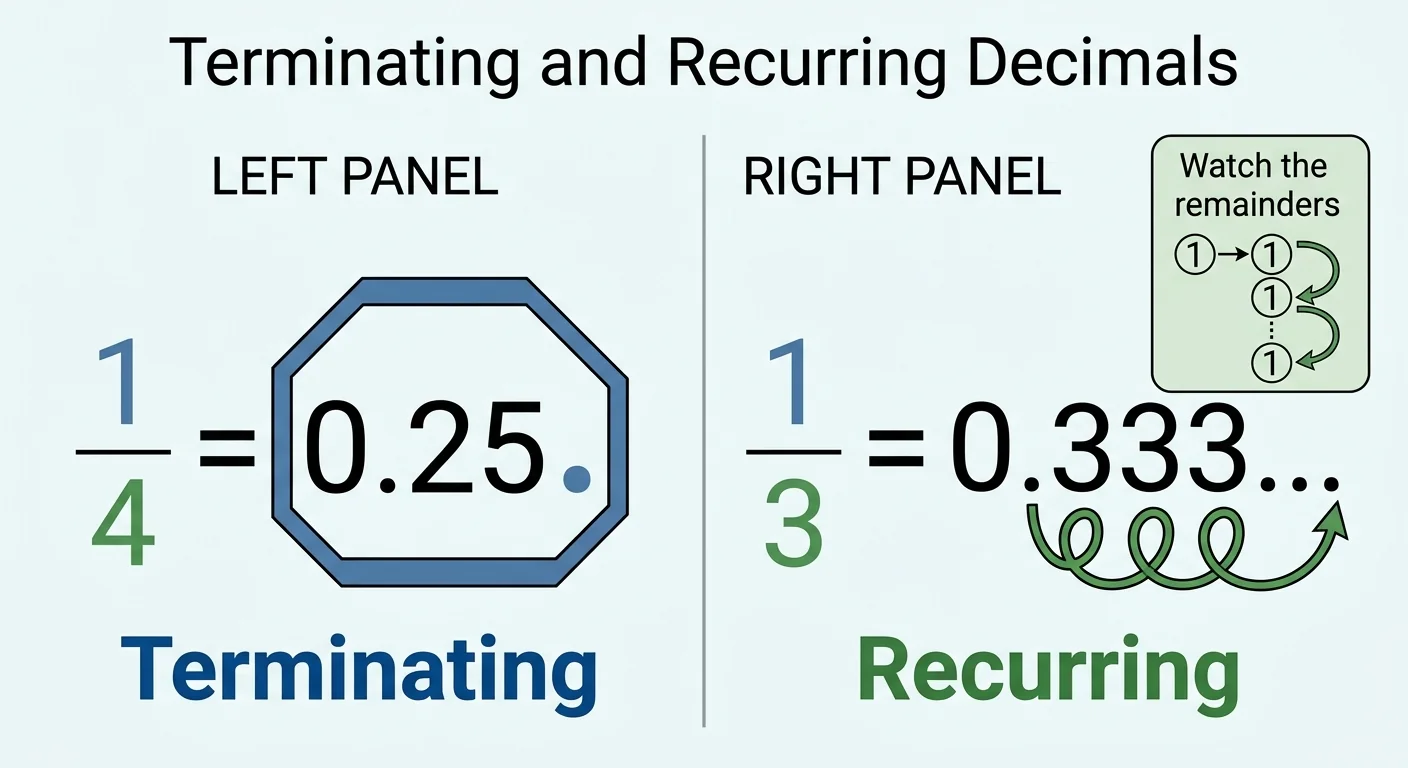
Some divisions finish and some never do. Your child needs to know the second kind is normal.
A terminating decimal stops, because the remainder reaches zero. 1/2 = 0.5, 3/8 = 0.375 and 5/16 = 0.3125 all terminate. A recurring decimal, also called repeating, never stops: the same digit or block repeats forever, as in 1/3 = 0.333…
Why does it repeat? Watch the remainders when you divide 1 by 3. You get 1 left over, then 1 again, then 1 again. Once a remainder comes back, every step after it is a step you have already taken, so the digits repeat too. Children find that explanation satisfying once they see it on paper.
How to write one. Three dots (0.333…), a dot above the repeating digit, or a bar above the repeating block. When a block repeats, mark its first and last digit: 1/7 = 0.142857142857…, so dots sit over the 1 and the 7. CBSE papers accept the dot or the bar but not 0.33, because that is a different, smaller number.
| Fraction | Decimal | What repeats |
|---|---|---|
| 1/3 | 0.333… | the digit 3 |
| 2/3 | 0.666… | the digit 6 |
| 1/6 | 0.1666… | the 6 only, after a 1 |
| 1/7 | 0.142857142857… | the block 142857 |
| 1/9 | 0.111… | the digit 1 |
| 5/12 | 0.41666… | the 6 only, after 41 |
Two deserve a second look. In 1/6 and 5/12 the repeat does not start straight after the point, so the dot goes over the 6 alone. Children often mark the whole thing, turning 0.1666… into 0.161616…, a different number. And 1/7 is the showpiece: those same six digits cycle through 2/7, 3/7 and every other sevenths fraction, just starting at a different point.
Converting Improper Fractions and Mixed Numbers
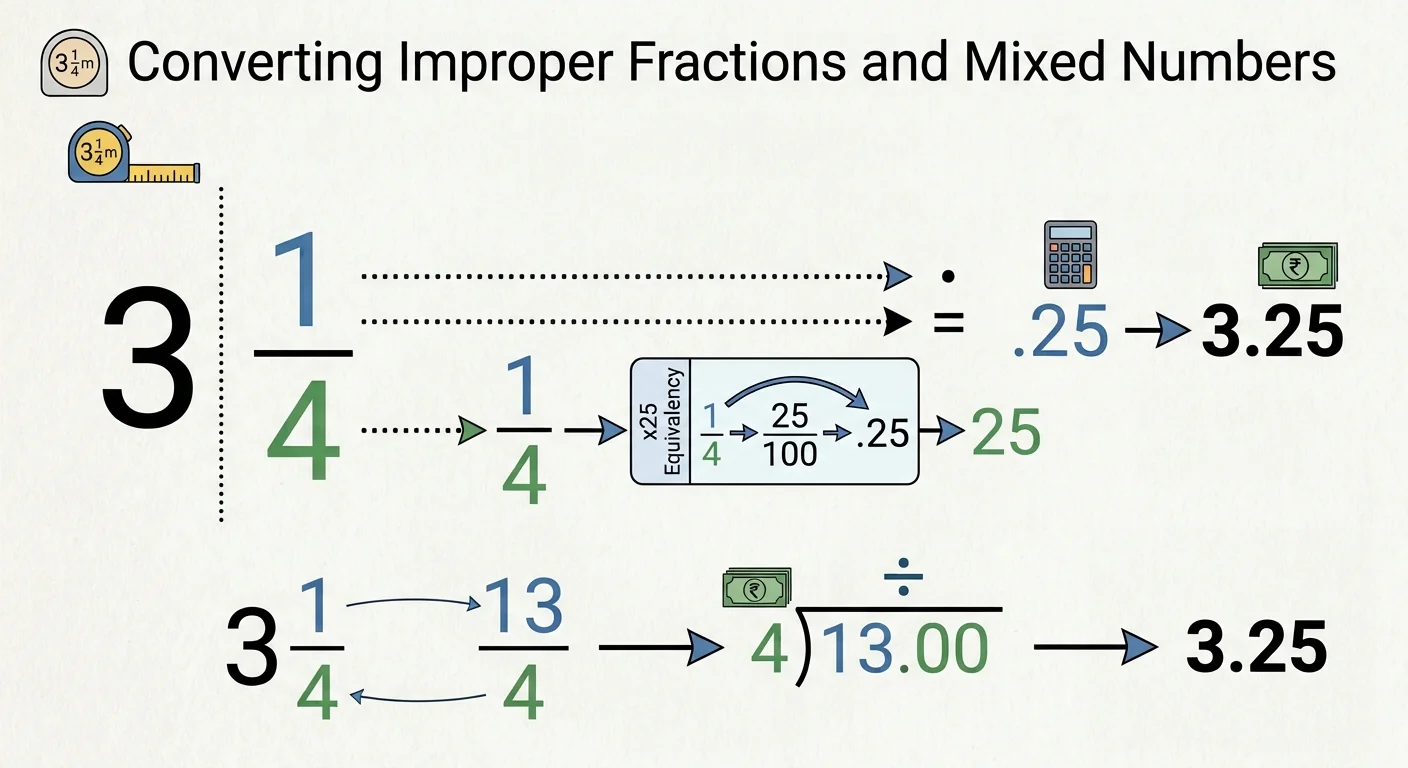
An improper fraction has a numerator bigger than its denominator, like 7/5. The method does not change: divide top by bottom. The only difference is that the answer will be 1 or more.
- 7/5: 5 into 7 goes once with 2 left, carry to make 20, 5 into 20 goes 4 times. 7/5 = 1.4
- 11/4: 4 into 11 goes twice with 3 left, then 30 gives 7 with 2 left, then 20 gives 5. 11/4 = 2.75
- 9/8: 8 into 9 goes once with 1 left, then 10 gives 1 with 2 left, 20 gives 2 with 4 left, 40 gives 5. 9/8 = 1.125
Use that as a check. If your child converts 7/5 and writes 0.714, the division went the wrong way round.
A mixed number has a whole part and a fraction part, like 3 and 1/4. Two routes, both correct.
Route A: keep the whole number aside. Convert only the fraction part and put the whole number back in front. For 3 and 1/4, convert 1/4 to 0.25, so the answer is 3.25. For 2 and 3/5, convert 3/5 to 0.6, giving 2.6.
Route B: make it improper first. Multiply the whole number by the denominator, add the numerator, keep the denominator, then divide. For 3 and 1/4: 3 x 4 = 12, plus 1 is 13, so 13/4, and 13 divided by 4 is 3.25. Same answer.
Route A is faster and makes more sense to most children, so start there. Route B matters because exam questions usually expect it, and because it is the only one that stays tidy when the fraction part recurs. For 2 and 1/7, convert to 15/7 and divide: 2.142857142857…
One caution worth repeating at home. The whole number is not a digit of the decimal. 3 and 1/4 is 3.25, never 3.14 and never 3.4. The whole number sits untouched to the left of the point.
Fraction to Decimal Chart
Here is the fraction to decimal chart your child will use most, with the working beside every row. A chart you can see the reasoning behind teaches the method again; a bare list teaches nothing.
| Fraction | Decimal | How it was found |
|---|---|---|
| 1/2 | 0.5 | x5 gives 5/10 |
| 1/3 | 0.333… | 1 divided by 3, remainder repeats |
| 2/3 | 0.666… | 2 divided by 3, remainder repeats |
| 1/4 | 0.25 | x25 gives 25/100 |
| 3/4 | 0.75 | x25 gives 75/100 |
| 1/5 | 0.2 | x2 gives 2/10 |
| 2/5 | 0.4 | x2 gives 4/10 |
| 3/5 | 0.6 | x2 gives 6/10 |
| 4/5 | 0.8 | x2 gives 8/10 |
| 1/6 | 0.1666… | 1 divided by 6, the 6 repeats |
| 5/6 | 0.8333… | 5 divided by 6, the 3 repeats |
| 1/8 | 0.125 | x125 gives 125/1000 |
| 3/8 | 0.375 | x125 gives 375/1000 |
| 5/8 | 0.625 | x125 gives 625/1000 |
| 7/8 | 0.875 | x125 gives 875/1000 |
| 1/10 | 0.1 | already tenths |
| 3/10 | 0.3 | already tenths |
| 7/10 | 0.7 | already tenths |
| 1/12 | 0.08333… | 1 divided by 12, the 3 repeats |
| 5/12 | 0.41666… | 5 divided by 12, the 6 repeats |
| 7/12 | 0.58333… | 7 divided by 12, the 3 repeats |
| 11/12 | 0.91666… | 11 divided by 12, the 6 repeats |
Three patterns turn those 22 facts into a handful. The fifths climb in steps of 0.2 and the eighths in steps of 0.125, so once 1/8 = 0.125 is known the rest need only addition. Every denominator made of 2s and 5s ends, and every denominator carrying a 3 recurs, which is the prime-factor test visible in one column. And the sixths and twelfths all recur on a single digit after a settled start, so mark only the repeating digit.
If you print this chart, print it without the decimal column and let your child fill it in. A chart they derived beats a chart they were handed. Going the other way, from a decimal back to a fraction, is covered in our guide to decimal to fraction conversion.
The Mistake Almost Every Child Makes
Dividing the denominator by the numerator instead of the other way round. This one error produces more wrong answers here than everything else combined.
Here is what it looks like. Asked to convert 5/8, a child writes 8 divided by 5 and gets 1.6. Now show them why that cannot be right rather than telling them. Five eighths is less than one whole, because five parts out of eight is less than all eight, so the answer must be under 1. An answer of 1.6 belongs to 8/5, a different number.
The correct working: 5.000, 8 into 50 goes 6 with 2 left, 8 into 20 goes 2 with 4 left, 8 into 40 goes 5 exactly. 5/8 = 0.625, comfortably under 1.
Give your child this one-second check and the error mostly disappears. If the top number is smaller than the bottom, the answer must start with 0. If it does not, the division went the wrong way.
Other Common Mistakes, and How to Fix Them
| Mistake | What it looks like | The fix |
|---|---|---|
| No decimal point in the answer | Writing 375 for 3/8 | Place the point as soon as you write it in the dividend |
| Stopping the division early | Writing 0.3 for 3/8 | Keep going until the remainder is 0 or repeats |
| Writing a recurring decimal as if it ends | Writing 1/3 = 0.33 | Use the dot, bar or three dots |
| Marking the wrong digits as repeating | Writing 1/6 as 0.16 with both marked | Divide far enough to see where the repeat begins |
| Multiplying only the denominator | Turning 3/4 into 3/100 | Say it aloud: whatever I do below, I do above |
| Dropping the whole number | Writing 3 and 1/4 as 0.25 | The whole number never moves |
| Adding zeros before the point | Turning 3 into 30 instead of 3.0 | Zeros go only after the point |
From Decimals to Percentages
Once a fraction is a decimal, a percentage is one step away: multiply by 100, which moves the point two places right. So 0.75 becomes 75%, and 0.2 becomes 20%. The chain your child will use from Class 7 onwards is fraction to decimal to percentage: 3/5 becomes 0.6 becomes 60%. It works because per cent means per hundred, which is place value again.
Where Class 5 to 7 Students Actually Use This
Money. A rupee has 100 paise, which makes it the most natural decimal practice there is. Half a rupee is Rs 0.50, three quarters is Rs 0.75. Buy 3/4 kg of dal at Rs 80 a kilo and 0.75 x 80 = Rs 60, done in your head. Our money word problems give more of this kind of practice.
Measurement. Tapes, rulers and kitchen scales all read in decimals. A quarter litre of milk is 0.25 litres, or 250 ml. A cloth piece of 2 and 1/2 metres reads 2.5 m on the tape.
Marks. A test out of 20 gives a score as a fraction. 17/20 becomes 0.85, which is 85%, and now it can be compared with a score out of 40 without any help.
Cricket. Strike rate, economy rate and run rate are all fractions turned into decimals. 48 runs from 32 balls is 48/32, which is 1.5, a strike rate of 150. If the word problem itself is the hurdle rather than the arithmetic, work on that separately.
Fraction to Decimal in Olympiad Problems
Olympiad papers rarely ask for a conversion directly. They ask something that becomes easy once you convert.
Ordering unlike fractions. Arrange 5/8, 7/12, 3/5 and 2/3. A common denominator means working with 120. Converting gives 0.625, 0.5833…, 0.6 and 0.666…, and the order falls out: 7/12, 3/5, 5/8, 2/3.
Finding what fits between. Name a fraction between 1/3 and 2/5. Those are 0.333… and 0.4, so 0.35 sits between, and 0.35 is 35/100, or 7/20.
Pattern questions. Knowing 1/7 = 0.142857142857… lets a child find the 100th digit after the point by working out where 100 lands in the six-digit cycle. More of this style in our math olympiad questions and the guide on how to solve olympiad problems.
Speed. A child who knows the chart converts instantly while a child who must divide every time runs out of minutes. This is one of the few places in junior maths where memorising genuinely pays, as long as the understanding came first.
8 Activities and Games
Everything below uses what is already in the house.
- The paise board. Shade 1/2, then 1/4, then 3/5 on a 100-square grid. Count the shaded squares, write that over 100, and the hundredths become visible: half is 50/100 is 0.50 is 50 paise.
- Coin conversions. Ask for 1/4, 3/4 and 1/5 of a rupee in coins. Write each answer three ways: fraction, paise, decimal.
- Beat the chart. One person calls a fraction, the other answers before a ten-count. Swap. Two minutes a day for a week covers most of the chart.
- Measuring tape hunt. Give a list of fractions of a metre. Your child converts each, then finds that length on the tape and checks it.
- Recipe doubling. Convert each fraction in a recipe to a decimal, then halve or double the batch. The arithmetic gets easier, which is the point to land.
- Terminate or recur? Call out a denominator. Your child predicts, using the 2s-and-5s test, then divides and checks.
- Rangoli fractions. Colour sections of a 10 x 10 rangoli grid, then work out the fraction and decimal each colour covers. They must add to 1.0, which is a built-in check.
- Match the pairs. Fractions on one set of slips, decimals on another, played face down as a memory game. Include a few recurring ones.
Tips for Parents
Start with the idea, not the procedure. If your child cannot tell you why 1/2 and 0.5 are the same number, the chart is just more things to memorise. Say the division aloud every time: top number inside, bottom number outside. Boring, repetitive, and it works.
Let a wrong answer breathe. When your child gets 1.6 for 5/8, ask whether 5/8 is more or less than a whole; the correction they reach themselves is the one that lasts. Use money daily, because rupees and paise are a decimal system they already half know. When the shortcut fails, say so cheerfully: 1/3 defeats it for everybody. And ten minutes often beats an hour occasionally.
Tips for Teachers
Teach division first and equivalence second, so students always have a fallback. Spend a full lesson on the number line before any conversion; marking 1/2 and 0.5 at the same point does more work than a page of practice.
Plan for the reversal error instead of reacting to it: put 5/8 on the board, work both divisions side by side, and let the class decide which must be right. Have students sort denominators into shortcut and division piles before any arithmetic, which makes the decision rule explicit. Assign chart rows to groups and build the class chart from their working. And mark notation strictly from the start, because a student who writes 0.33 for 1/3 in Class 6 will still write it in Class 10. Students who are shaky on adding fractions or subtracting fractions will need that ground covered too.
Practice Questions with Answers
Set A: the shortcut. Convert 1/4, 2/5, 9/20, 7/25, 5/8. Answers: 0.25, 0.4, 0.45, 0.28, 0.625
Set B: division. Convert 3/16, 7/8, 9/40, 11/16, 13/32. Answers: 0.1875, 0.875, 0.225, 0.6875, 0.40625
Set C: improper fractions and mixed numbers. Convert 9/4, 13/5, 4 and 1/2, 2 and 3/8, 5 and 7/20. Answers: 2.25, 2.6, 4.5, 2.375, 5.35
Set D: recurring decimals. Convert 2/3, 5/6, 4/9, 7/12, 2/7. Answers: 0.666…, 0.8333… (only the 3 repeats), 0.444…, 0.58333… (only the 3 repeats), 0.285714285714…
Set E: word problems.
- A shopkeeper sells 3/5 kg of sugar. Write the weight as a decimal.
- Riya scored 17/20 in a test. Write it as a decimal and a percentage.
- A ribbon is 2 and 1/4 metres long. Write the length as a decimal.
- An auto fare is 7/8 of a hundred-rupee note. How many rupees and paise?
- Arrange 3/4, 5/8 and 7/10 from smallest to largest by converting each.
Answers: 0.6 kg; 0.85 and 85%; 2.25 m; Rs 87.50, so 87 rupees and 50 paise; 5/8 = 0.625, 7/10 = 0.7, 3/4 = 0.75, so the order is 5/8, 7/10, 3/4
Make Preparing for Math Olympiad Simple!


How do you convert a fraction to a decimal?
Divide the numerator by the denominator. Write the fraction as a division with the top number inside the bracket, add a decimal point and zeros as needed, divide, and place the point in the answer above the one in the dividend. For 3/8, dividing 3 by 8 gives 0.375.
What is the easiest way to convert fractions to decimals?
If the denominator is 2, 4, 5, 8, 10, 20, 25 or 50, use the equivalent fraction method: multiply top and bottom by whatever turns the denominator into 10, 100 or 1000, then move the point one place per zero. For 3/4, x25 gives 75/100, so 0.75. For any other denominator, divide.
Which number do you divide by which?
Always the numerator by the denominator. 5/8 means 5 divided by 8, which is 0.625, not 8 divided by 5. If the top number is smaller, the answer must be less than 1.
What is a terminating decimal?
One that stops, because the division reaches a remainder of zero. 1/4 = 0.25 and 3/8 = 0.375 terminate.
What is a recurring decimal?
One where a digit or block repeats forever, because a remainder repeats during the division. 1/3 = 0.333… Write it with three dots, a dot above the repeating digit, or a bar above the block.
How do you know whether a decimal will terminate or recur?
Simplify, then break the denominator into prime factors. Only 2s and 5s means it terminates; any other prime means it recurs. 7/16 terminates because 16 is four 2s; 5/12 recurs because 12 contains a 3.
How do you convert a mixed number to a decimal?
Convert only the fraction part and put the whole number back in front: 3 and 1/4 becomes 3.25. Converting to an improper fraction first and dividing gives the same answer.
How do you convert an improper fraction to a decimal?
Divide the numerator by the denominator as usual. The answer will be 1 or more: 7/5 becomes 1.4, 11/4 becomes 2.75.
Can every fraction be written as a decimal?
Yes. Every fraction gives either a terminating or a recurring decimal, with no third possibility.
At which class is this taught?
In the CBSE and NCERT sequence, Class 5 covers tenths and hundredths, Class 6 covers thousandths and conversion both ways, and Class 7 expects confident movement between fractions, decimals and percentages. For younger children, start with fractions for Class 3.
Should my child memorise the chart?
Yes, but after understanding the methods, not instead of them. A child who can derive 3/8 = 0.375 and also recall it has both speed and a way to check.
Conclusion
Converting a fraction to a decimal comes down to one idea and two tools. The idea is that a fraction and a decimal are the same value wearing different clothes, so nothing is being created, only rewritten. The tools are division, which works on every fraction, and the equivalent fraction shortcut, which works fast when the denominator can reach 10, 100 or 1000.
Give your child the three steps, the decision rule and the chart, and most of the confusion disappears. The rest is practice: a few minutes most days, a coin or a measuring tape in hand, and the habit of asking one question before dividing anything at all. Is the answer going to be less than 1, or more?

Mikha Piregu is a Content Writer with experience spanning educational content, including math and math olympiad topics, as well as advocacy writing, research-based articles, and SEO-driven web content. He creates high-quality blog content, web copy, and feature articles that support brand visibility, audience engagement, and long-term organic growth through data-informed storytelling. Skilled in WordPress, WooCommerce, and modern digital tools, Mikha adapts content across various platforms, including blogs, websites, campaigns, and advocacy initiatives, with clarity and purpose.



There are no comments posted here yet.
Sign in to leave a comment