


Multiplying fractions is straightforward: multiply the top numbers straight across and multiply the bottom numbers straight across.
- Why Multiplying Fractions Is Easier Than Adding Fractions
- What Multiplying Fractions Actually Means
- How to Multiply Fractions in Three Steps
- Case 1: Multiplying a Fraction by a Whole Number
- Case 2: Multiplying a Fraction by a Fraction
- Case 3: Cross Cancellation, or Simplifying Before You Multiply
- Case 4: Multiplying Mixed Numbers
- Case 5: Multiplying Three or More Fractions
- Simplifying Your Answer Using HCF
- The Biggest Mistake, and Others to Watch
- Real Life Problems That Use Multiplying Fractions
- How It Connects to Division, Ratio and Olympiad Problems
- Eight Activities and Games
- Practice Questions With Answers
- Conclusion
Step-by-Step Instructions
- Multiply the numerators (the top numbers) together.
- Multiply the denominators (the bottom numbers) together.
- Simplify the fraction to its lowest terms if possible.
Multiplying fractions is the easiest operation in the fractions chapter. No common denominator, no LCM, no rewriting before you start. Multiply the top numbers, multiply the bottom numbers, simplify.
But a rule a child cannot explain is one they forget by the next unit test. So this guide shows exactly why multiplying across works, using a picture any Class 5 student can draw in thirty seconds, then walks through every case in the CBSE and NCERT syllabus from Class 5 to Class 7.
Why Multiplying Fractions Is Easier Than Adding Fractions
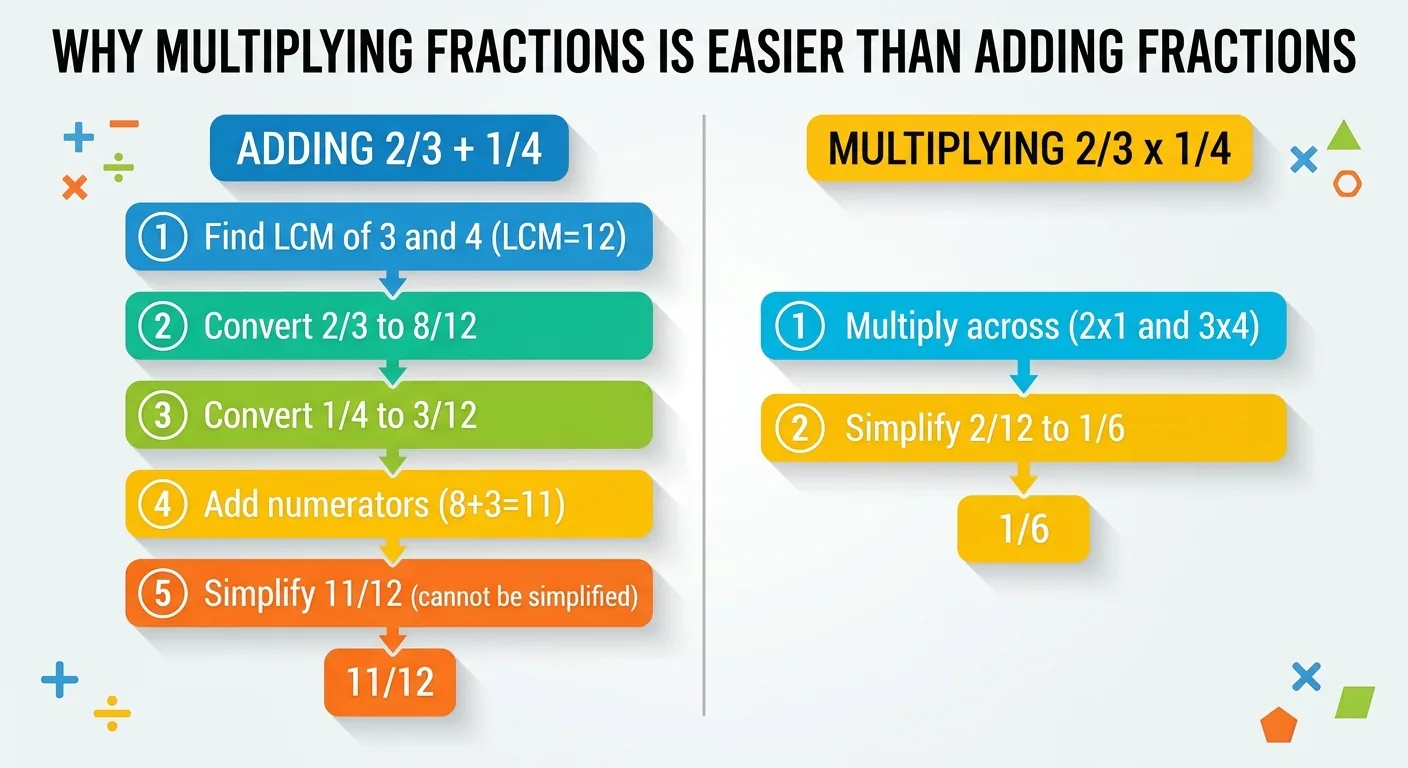
To add 2/3 and 1/4, your child must find the LCM of 3 and 4, convert 2/3 into 8/12, convert 1/4 into 3/12, add, and simplify. Even adding fractions with like denominators needs that denominator check first, and subtracting fractions works the same way.
Multiplication asks none of that. For 2/3 times 1/4, multiply 2 by 1 and 3 by 4, giving 2/12, or 1/6.
Why the difference? Addition combines pieces, and only pieces of the same size can be combined. Multiplication takes a part of a part, which works with any sizes. Say this to your child. It reframes the topic from “another hard rule” into “the easy one”, and children who expect difficulty create difficulty.
What Multiplying Fractions Actually Means
One sentence first: multiplying fractions means finding a fraction of a fraction.
When we write 1/2 times 3/4, we are asking what half of three quarters is. The multiplication sign reads as the word “of”. That translation unlocks nearly every word problem in the chapter.
Seeing it: the area model
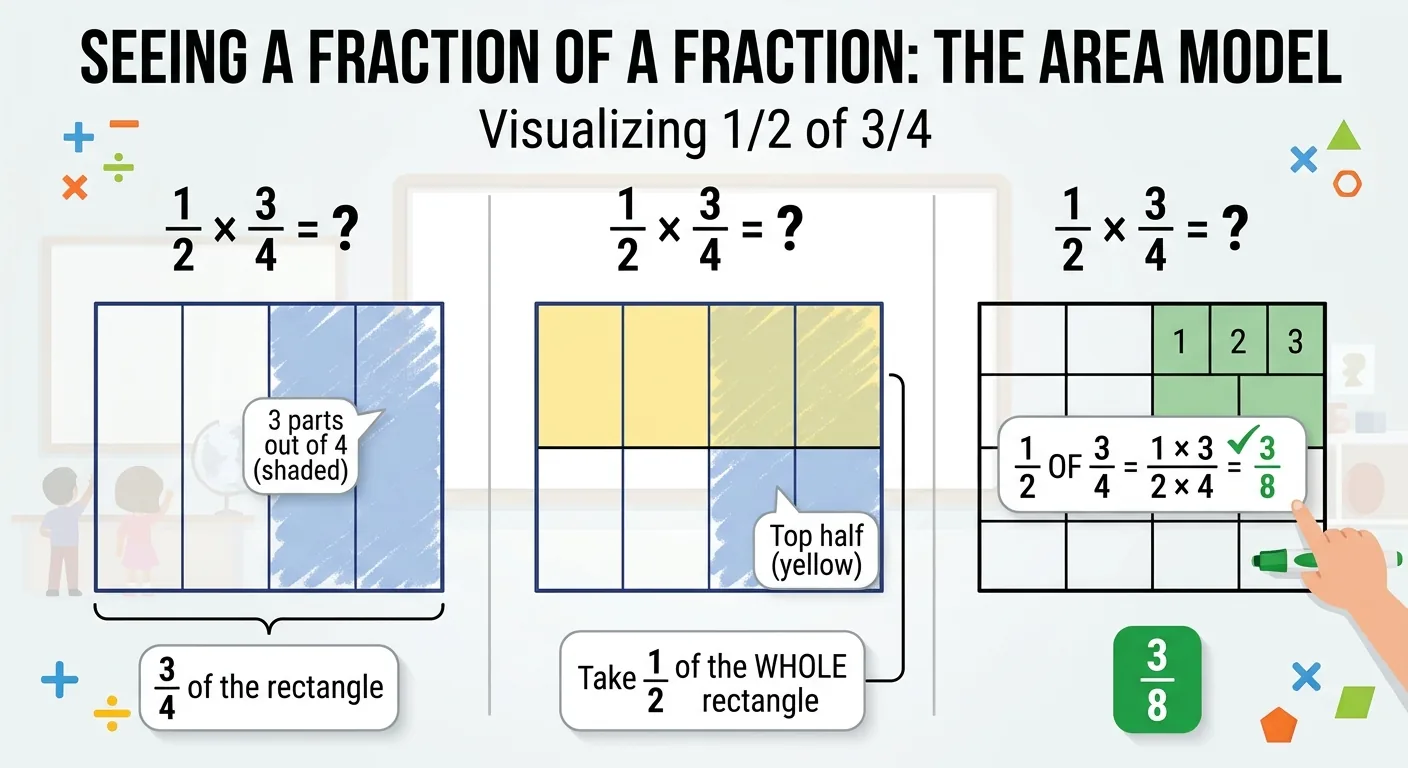
Ask your child to draw a rectangle.
Step one. Divide it into 4 equal vertical strips and shade 3 blue. That shows 3/4.
Step two. Divide the same rectangle into 2 horizontal strips and shade the top one yellow. That is 1/2 of the whole.
Step three. Look where blue and yellow overlap. That green patch is one half of three quarters.
Now count. The two sets of lines cut the rectangle into 8 small boxes, because 2 rows times 4 columns is 8. The green overlap covers 3 of them, because 1 row times 3 columns is 3. So half of three quarters is 3/8.
Repeat for 2/3 times 3/5 and 1/4 times 2/3. Most children spot the pattern by the third rectangle.
Why the rule works
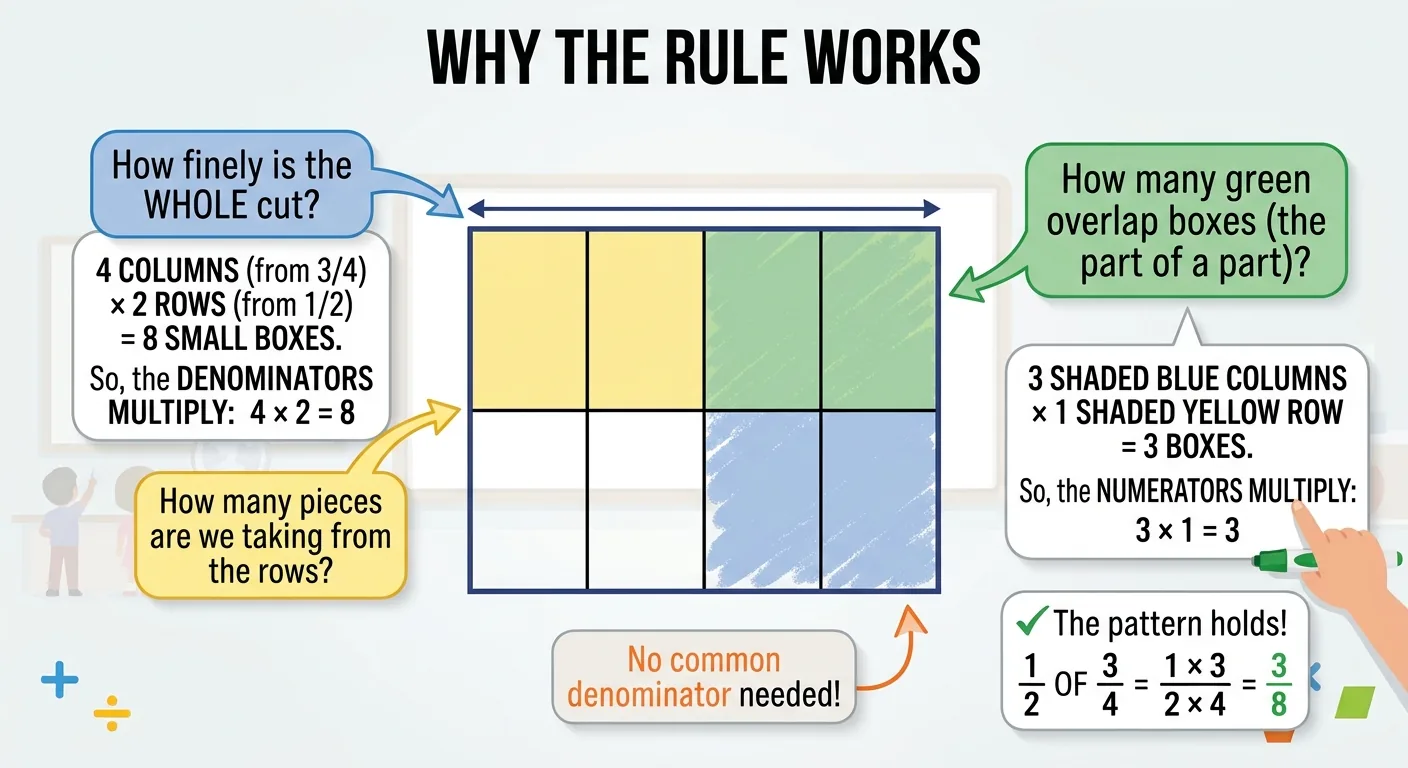
The total number of boxes came from multiplying the denominators. Cutting into quarters and then halves gives eighths: denominators say how finely the whole is cut.
The number of green boxes came from multiplying the numerators. They say how many of those pieces you actually took. If numerator and denominator are still shaky, settle that first.
So “numerator times numerator over denominator times denominator” is not an arbitrary instruction. It is a count of a grid. The picture also shows that no common denominator was ever needed, and that the green patch is always smaller than either shaded region, which is the best sense check your child can carry into an exam hall.
How to Multiply Fractions in Three Steps
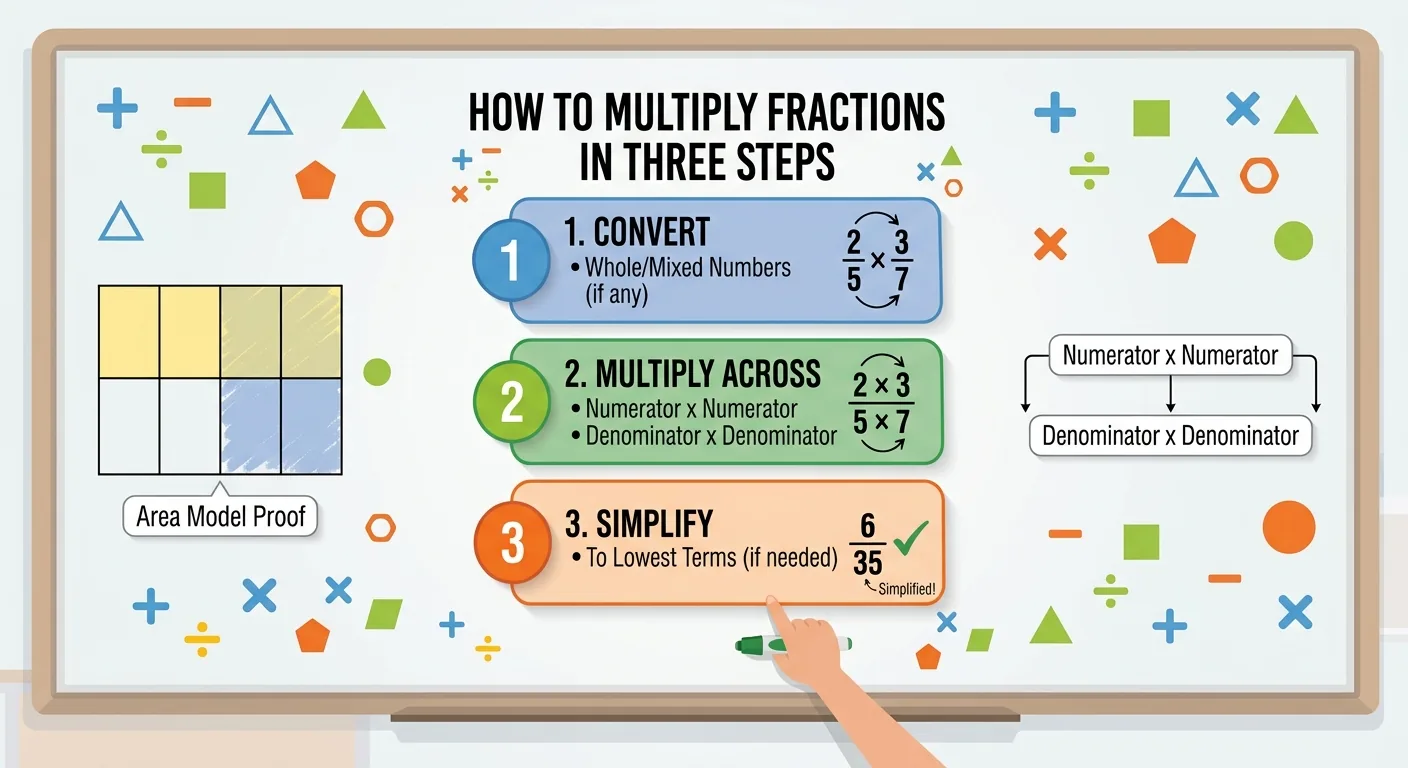
- Convert. Whole numbers become a fraction over 1. Mixed numbers become improper fractions.
- Multiply across. Numerators together, denominators together.
- Simplify. Divide top and bottom by their HCF, and convert back to a mixed number if the question used one.
Worked example, 2/5 times 3/7: nothing to convert; 2 times 3 is 6 and 5 times 7 is 35; 6 and 35 share no factor, so the answer is 6/35.
Everything below is this method applied to a different starting shape.
Case 1: Multiplying a Fraction by a Whole Number
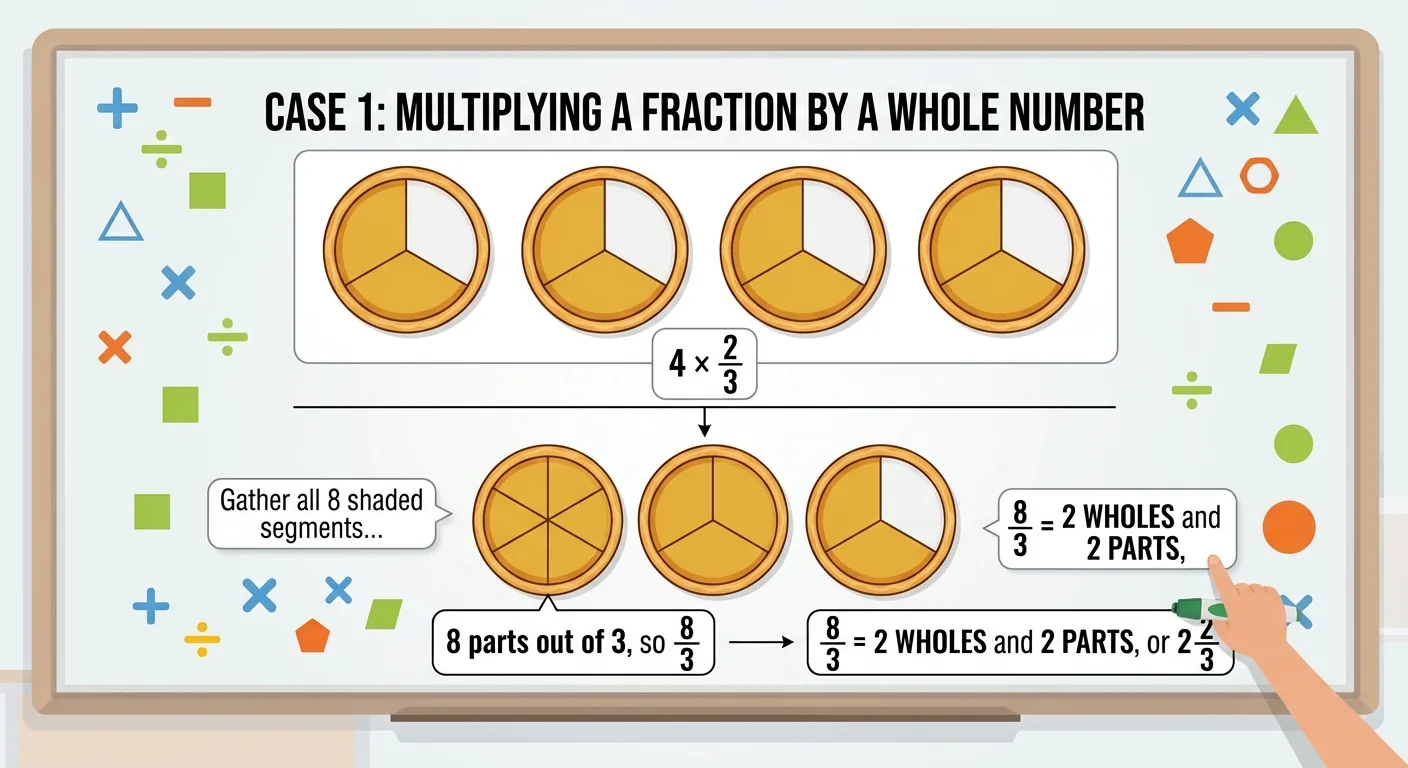
Children already read multiplication as repeated addition, so 4 times 2/3 means 2/3 added four times, giving 8/3. Fluency with the multiplication table makes this case almost automatic.
Method. Write the whole number over 1, then multiply as normal.
Example 1: 3/5 times 4. Rewrite as 3/5 times 4/1. Numerators: 12. Denominators: 5. Product 12/5, which is 2 2/5.
Example 2: 2/3 times 12. Numerators: 24. Denominators: 3. Product 24/3, which is 8. Notice the answer is bigger than 2/3. Multiplying by a number greater than 1 stretches; multiplying by a number less than 1 shrinks.
Watch for. Children often multiply the whole number into the denominator too, writing 12/20. Remind them 4 is 4/1.
Case 2: Multiplying a Fraction by a Fraction
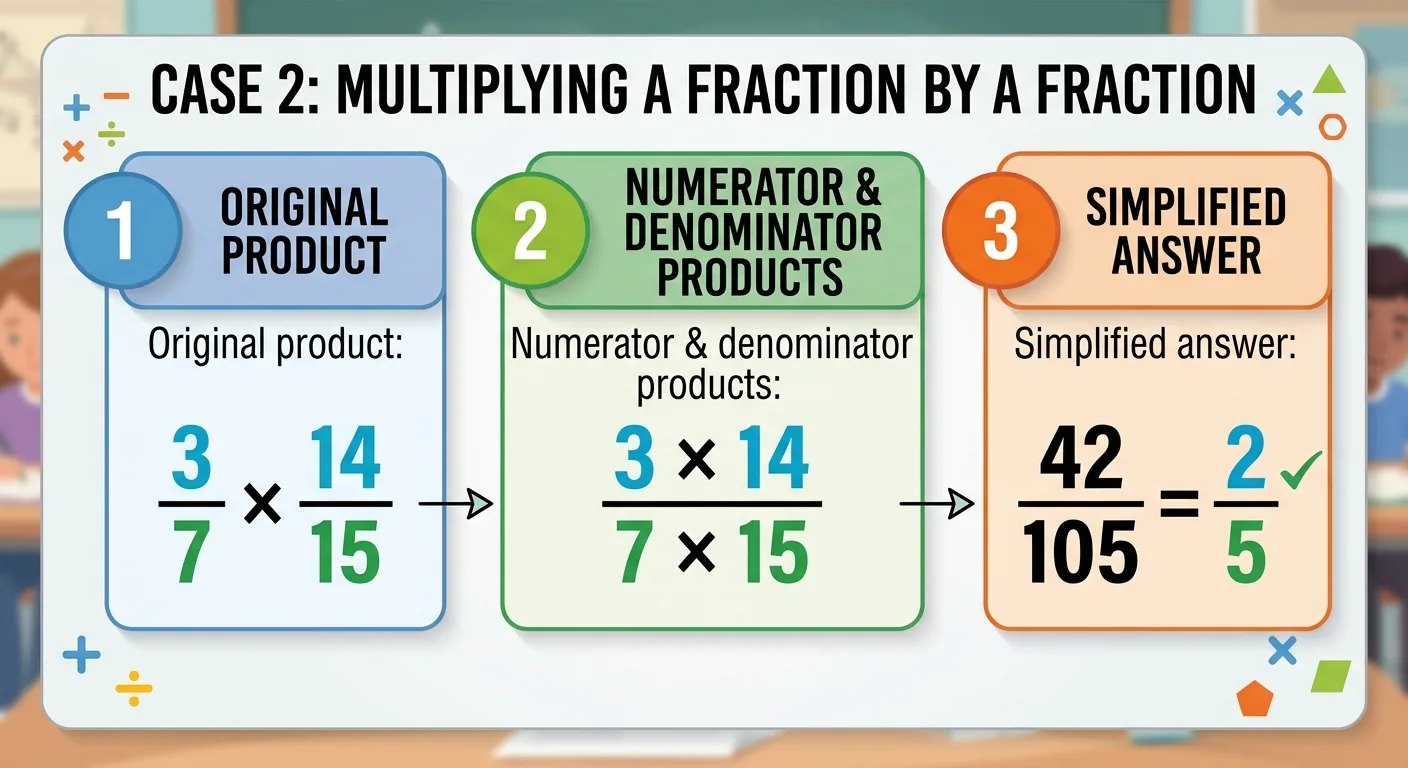
This is the core skill, and the one the area model was built for.
Example 1: 1/2 times 3/4. Numerators 3, denominators 8, so 3/8. Sense check: smaller than both, exactly as half of three quarters should be.
Example 2: 2/3 times 4/5. Numerators 8, denominators 15, so 8/15, already in lowest terms.
Example 3: 3/7 times 14/15. Numerators 42, denominators 105, so 42/105. The HCF is 21, giving 2/5.
That last one demanded uncomfortable arithmetic, and spotting that 21 divides both numbers is harder still. There is a better way.
Case 3: Cross Cancellation, or Simplifying Before You Multiply
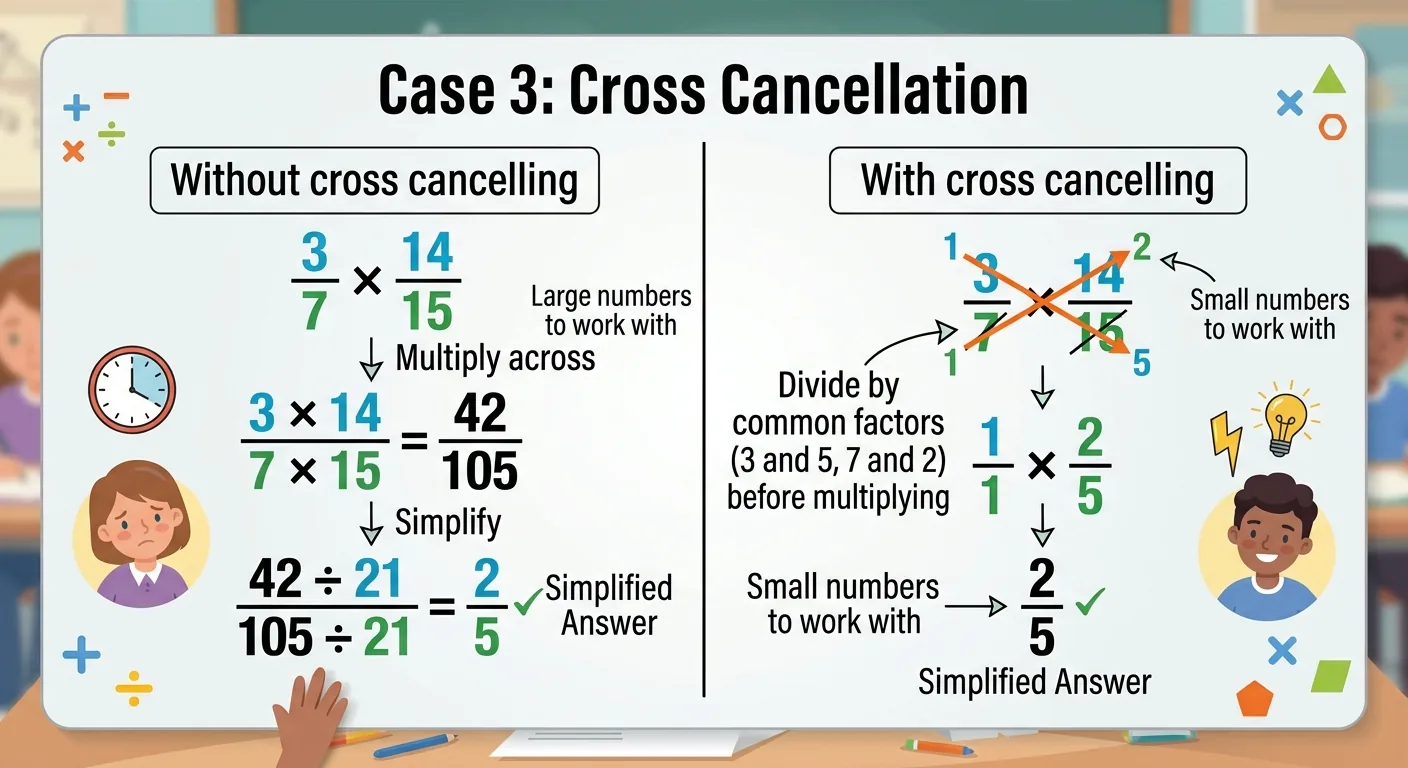
Cross cancellation separates a confident student from a tired one, and most guides demote it to a footnote.
What it is. Before multiplying, find a common factor between the numerator of one fraction and the denominator of the other, and divide both by it. Then multiply the smaller numbers left behind.
Why it works. Simplifying means dividing top and bottom by the same number. In a multiplication every numerator ends up on top and every denominator at the bottom of one fraction anyway, so it makes no difference which top you cancel against which bottom. This is also why cancelling is allowed in multiplication but never in addition, where numerators and denominators never pool together. The same factor hunting powers equivalent fractions, and divisibility rules make spotting the factors much quicker.
The same problem both ways: 3/7 times 14/15.
Without cancelling: 42/105, then hunt for the HCF of 21, reaching 2/5.
With cancelling: 3 and 15 both divide by 3, leaving 1 and 5. 14 and 7 both divide by 7, leaving 2 and 1. The problem becomes 1/1 times 2/5, which is 2/5. No number above 15 ever appears.
Example 2: 5/12 times 8/15. 5 and 15 give 1 and 3; 8 and 12 give 2 and 3. So 1/3 times 2/3, which is 2/9. The long way gives 40/180, also 2/9.
When to use it. Scan diagonally before every multiplication: three seconds lost if nothing cancels, a two digit multiplication and an HCF hunt saved if something does. Cancel a top against a bottom only.
Case 4: Multiplying Mixed Numbers
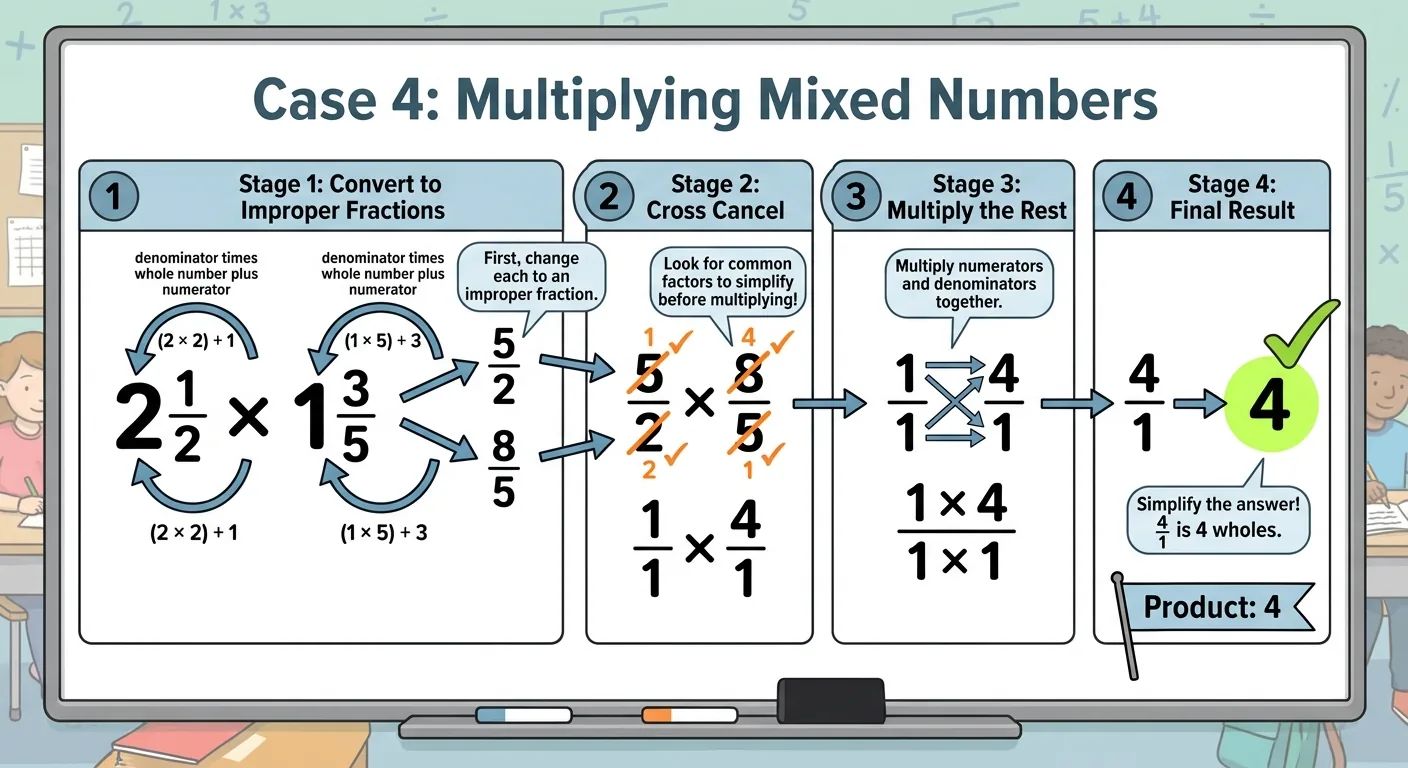
A mixed number like 2 1/2 cannot be multiplied in that form.
Method. Convert each mixed number to an improper fraction by multiplying the denominator by the whole number and adding the numerator. Cross cancel, multiply across, then simplify and convert back.
Example 1: 2 1/2 times 1 3/5. These become 5/2 and 8/5. Cancel the 5s, and 8 against 2 to give 4 and 1. Left with 1/1 times 4/1, which is 4.
Example 2: 3 1/3 times 2 1/4. These become 10/3 and 9/4. Cancel 9 against 3 to give 3 and 1, and 10 against 4 to give 5 and 2. Left with 5/1 times 3/2, which is 15/2, or 7 1/2.
The mistake that costs most marks. Many children multiply the whole parts and fraction parts separately, turning 2 1/2 times 1 3/5 into 2 3/10. The real answer is 4. Show them that gap once and it sticks.
Case 5: Multiplying Three or More Fractions
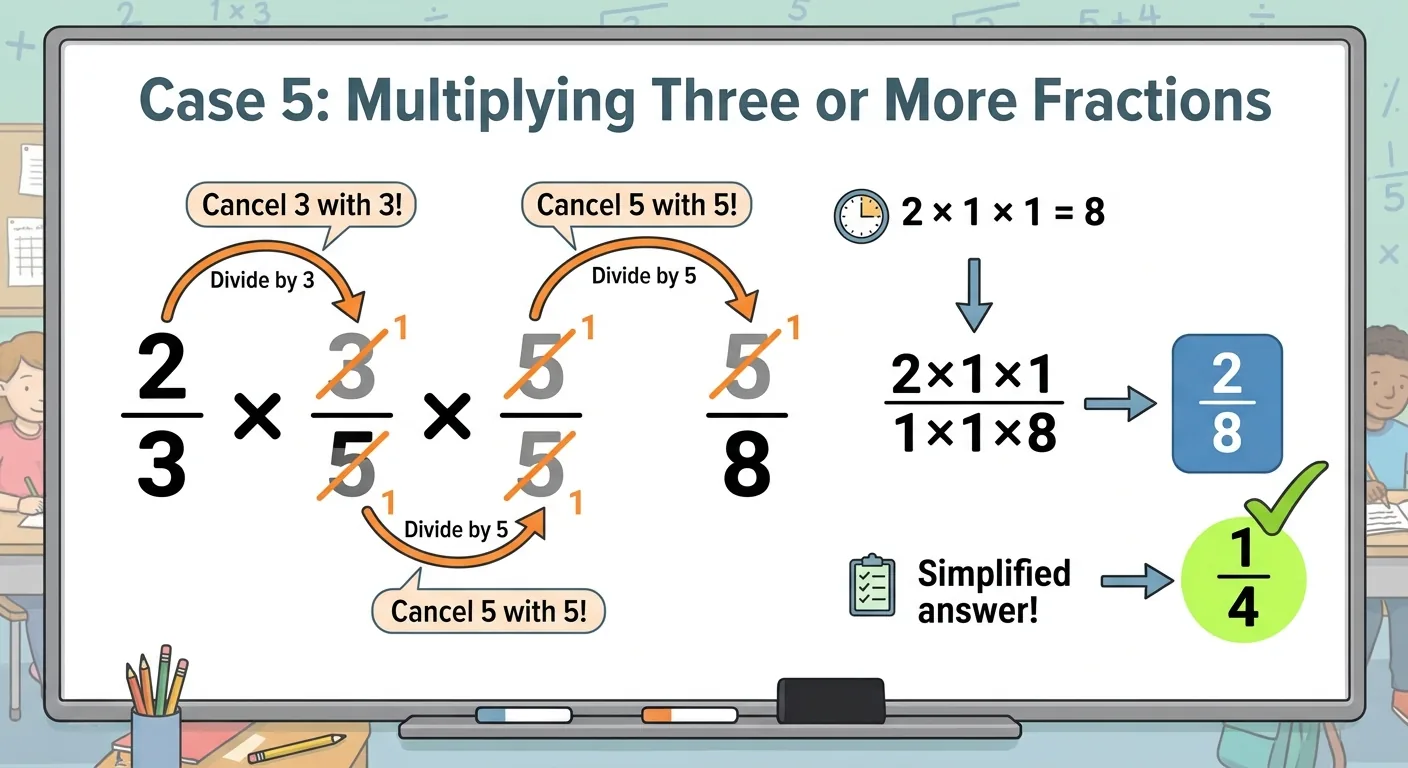
Nothing new. Multiply all numerators for the new numerator, all denominators for the new denominator, cancelling across any pair first.
Example 1: 2/3 times 3/5 times 5/8. The 3s cancel and the 5s cancel, leaving 2/8, which is 1/4. The long way gives 30/120, also 1/4.
With three or more factors, cancellation stops being a convenience. Without it, children multiply three digit denominators by hand and make errors that have nothing to do with fractions.
Simplifying Your Answer Using HCF
An answer is not finished until it is in lowest terms.
Example: 42/105. 42 is 2 times 3 times 7, and 105 is 3 times 5 times 7, so the shared factors give an HCF of 21. The answer is 2/5. Breaking numbers into factors like this is easier once prime and composite numbers are familiar.
If the HCF is hard to spot, divide by any common factor you see and repeat: 18/24 by 2 gives 9/12, then by 3 gives 3/4.
The Biggest Mistake, and Others to Watch
Looking for a common denominator. This is the error that fills Class 5 and 6 copies, and it comes from good intentions. Asked for 1/2 times 1/3, the child converts to 3/6 and 2/6, then carries over the addition habit of keeping the denominator and multiplying only the numerators, writing 6/6, which is 1.
Half of one third cannot be 1. It cannot be near 1. The correct answer is 1/6. Go back to the rectangle: three columns, one shaded; two rows, one shaded; the overlap is 1 box out of 6. There is no common denominator anywhere in that picture.
The sense check to teach. Multiply two proper fractions and the answer must be smaller than both. If it is bigger, nine times in ten this is why.
Cross multiplying. Multiplying the first numerator by the second denominator belongs to comparing and dividing. Draw two horizontal arrows, one across the tops, one across the bottoms.
Flipping the second fraction. That belongs to division. Expect it if your child has just finished that unit.
Forgetting to simplify. 42/105 is a correct product but an incomplete answer, and CBSE marking schemes expect lowest terms.
Leaving an improper fraction when the question used mixed numbers, and cancelling two numerators against each other.
Real Life Problems That Use Multiplying Fractions
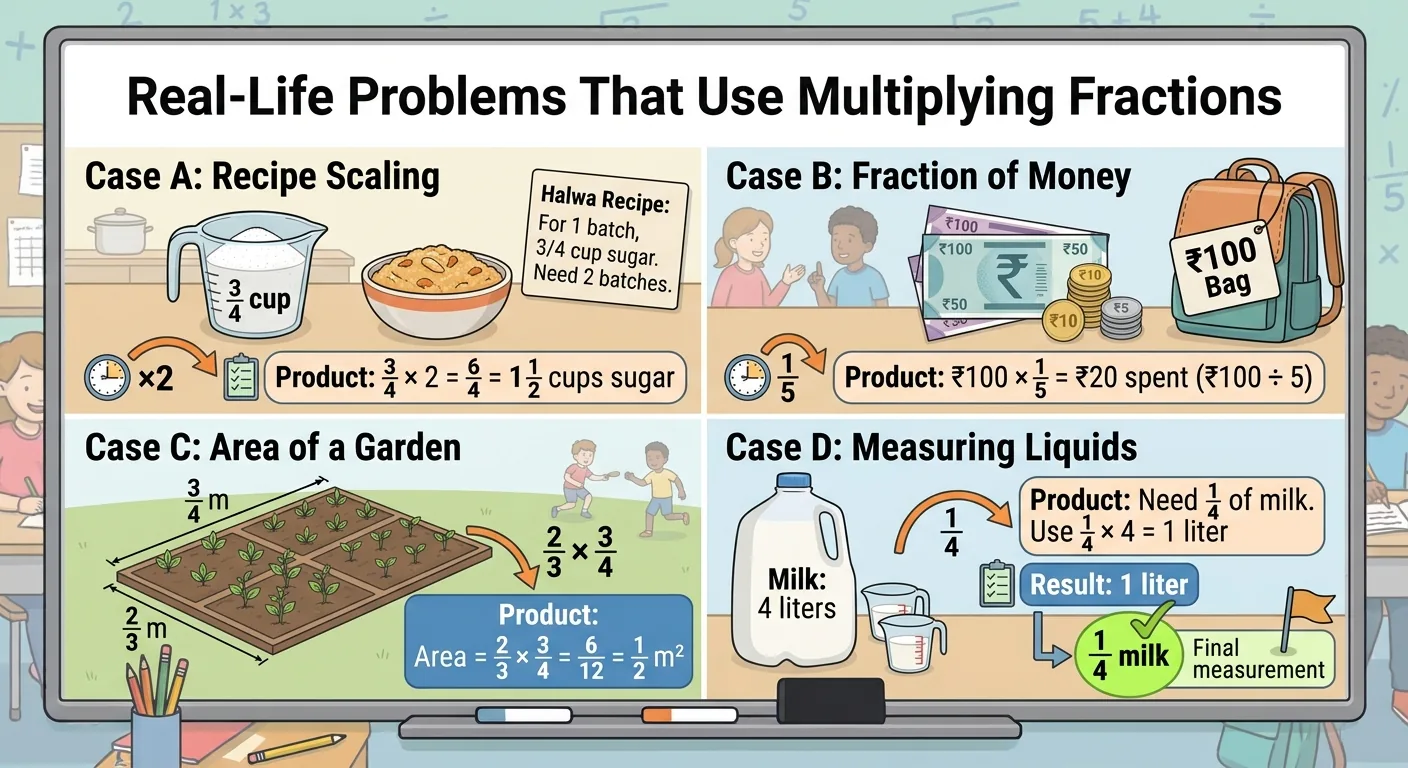
Scaling a recipe. A halwa recipe needs 3/4 cup of sugar per batch and you are making 2 1/2 batches. 3/4 times 5/2 gives 15/8, or 1 7/8 cups.
A fraction of money. Rohan gets ₹480 pocket money and spends 2/5 on story books. Cancel 480 against 5 and multiply: ₹192.
Area of a rectangle. A kitchen garden measures 3/4 m by 2/3 m. Cancelling gives 1/2 square metre. The same method underpins area and perimeter work later.
A fraction of a fraction. In a Class 5 section, 2/3 are girls and 3/4 of those girls play kho kho. 2/3 times 3/4 is 1/2, so exactly half the section.
The common thread is the word “of”. Once a child reliably translates “of” into a multiplication sign, math word problems stop being a separate skill.
How It Connects to Division, Ratio and Olympiad Problems
Division is multiplication in disguise. Dividing by a fraction means multiplying by its reciprocal, so 3/4 divided by 2/5 is 3/4 times 5/2. A child fluent here has already done most of the work, which is why multiplication is taught first and why it sits alongside long division in the Class 5 arc.
Ratio and percentage lean on it. A percentage is a fraction over 100, so 35 percent of 240 is 35/100 times 240. Map scales and unitary method are the same machinery.
Olympiads reward fluency here. Competitions like SOF IMO, Math Kangaroo and IOQM set products designed to collapse under cancellation:
Work out 1/2 times 2/3 times 3/4 times 4/5.
Multiply everything out and you get 24/120 and still have to simplify. Scan for cancellation and the 2s, 3s and 4s vanish, leaving 1/5 in about four seconds. Extend the chain to 9/10 and everything between the first numerator and the last denominator cancels, leaving 1/10. These telescoping products are a genuine competition skill that starts here. More in this style appears in our math olympiad questions collection and our guide to solving olympiad problems.
Eight Activities and Games
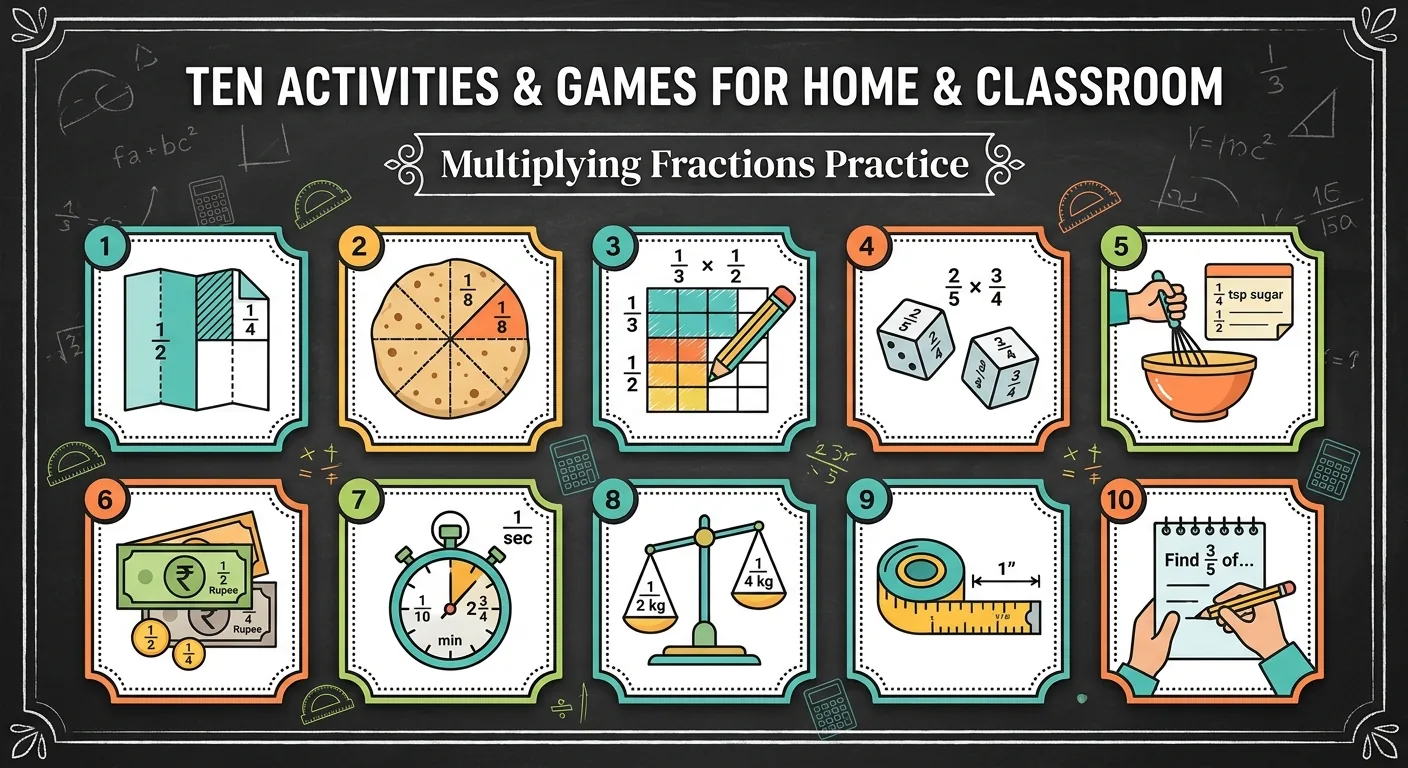
1. The paper fold. Fold a sheet into 4 vertical strips, colour 3. Fold it into 2 horizontal strips, colour the top one in another colour. Count the overlap. The area model made physical, for the price of one sheet.
2. Roti fractions. Cut a roti into quarters, take three, then take half of what you took. Ask your child to name the amount before eating it.
3. Grid colouring race. Two players with blank 6 by 6 grids. Call out a product like 2/3 times 1/2. First to shade the overlap and name the answer scores.
4. Dice duel, smallest wins. Roll four dice, arrange them as two fractions, multiply. Smaller product wins. Children discover the shrinking rule without a lecture.
5. Kitchen scaling. Hand over a real recipe and ask for one and a half times the batch, then cook it.
6. Rupee discount game. Price-tag household items and call out “one third off” or “three quarters of the price”.
7. Spot the smaller. Write a product like 5/6 times 7/8 and ask, before calculating, whether the answer beats 5/6. Ten in two minutes builds exam-saving estimation sense.
8. Write the question. Give the answer, say 3/10, and ask your child to invent a word problem for it. Writing a question needs deeper understanding than answering one.
For parents: start with the rectangle even if your child knows the procedure, say “of” instead of “times”, keep the numbers small, and let the sense check correct them by asking “should this be bigger or smaller than 3/4?” rather than saying “wrong”.
For teachers: budget a full period for the area model before the rule goes on the board, since rushing it is why the common denominator error survives into Class 7. Teach cross cancellation in week one, not as enrichment, put 3/6 times 2/6 giving 6/6 on the board as a worked error for the class to diagnose, and mark for simplified form from day one.
Practice Questions With Answers
A. Fraction by whole number: 1) 2/7 times 3 2) 5/6 times 12 3) 7/10 times 25
B. Fraction by fraction: 4) 1/3 times 2/5 5) 3/4 times 8/9 6) 5/8 times 4/15
C. Cross cancellation: 7) 9/16 times 8/27 8) 14/25 times 10/21
D. Mixed numbers: 9) 1 1/2 times 2 2/3 10) 3 1/5 times 1 1/4
E. Three factors and word problems: 11) 1/2 times 2/5 times 5/7 12) 3/4 times 4/9 times 3/8 13) A recipe needs 2/3 cup of milk per batch. How much for 4 1/2 batches? 14) A shopkeeper sells 3/5 of a 150 kg sack of rice. How many kilograms? 15) A mat measures 2 1/4 m by 1 1/3 m. What is its area?
Answers: 1) 6/7 2) 10 3) 17 1/2 4) 2/15 5) 2/3 6) 1/6 7) 1/6 8) 4/15 9) 4 10) 4 11) 1/7 12) 1/8 13) 3 cups 14) 90 kg 15) 3 square metres
Make Preparing for Math Olympiad Simple!


How do you multiply fractions?
Multiply the numerators together for the new numerator, multiply the denominators together for the new denominator, then simplify to lowest terms. For example, 2/3 times 4/5 gives 8/15. You do not need a common denominator.
How do you multiply mixed numbers with fractions?
Convert the mixed number to an improper fraction first, then multiply across and simplify. For 1 1/4 times 2/3, convert 1 1/4 to 5/4, multiply to get 10/12, and simplify to 5/6.
Do you need a common denominator to multiply fractions?
No. That is needed only for addition and subtraction, where pieces must be the same size before combining. Multiplication takes a part of a part, which works with any denominators.
Why does multiplying two fractions give a smaller answer?
You are taking a part of something already a part, so half of three quarters must be less than three quarters. This holds whenever both fractions are below 1. If one is above 1, such as 5/2, the answer can be larger.
What is cross cancellation?
Dividing a numerator of one fraction and a denominator of the other by a common factor before multiplying. In 3/7 times 14/15, the 3 and 15 divide by 3 and the 14 and 7 divide by 7, leaving 2/5.
Can you multiply three fractions at once?
Yes. Multiply all numerators and all denominators, cancelling across any pair first. For 2/3 times 3/5 times 5/8, cancelling leaves 1/4.
How do you multiply a fraction by a whole number?
Write the whole number over 1 and multiply as usual. 3/5 times 4 becomes 3/5 times 4/1, which is 12/5, or 2 2/5.
In which class is multiplying fractions taught?
In the CBSE and NCERT sequence it is introduced in Class 5, developed with mixed numbers and word problems in Class 6, and extended to rational numbers in Class 7. Younger students usually meet the groundwork through fractions for Class 3.
Should I simplify before or after multiplying?
Either, and both give the same answer. Cross cancelling first keeps the numbers small and is usually faster.
What is the difference between multiplying and dividing fractions?
To divide, flip the second fraction and then multiply. 3/4 divided by 2/5 becomes 3/4 times 5/2.
Conclusion
Multiplying fractions rewards understanding over memorisation. The rule takes a minute to learn. What makes it stick is the rectangle: once a child has seen that four columns and two rows make eight boxes, the rule stops being something to remember and becomes something to picture.
Keep four habits going. Draw the model when a question feels unfamiliar. Read the multiplication sign as the word “of”. Scan diagonally for cross cancellation before multiplying. Check that the answer is smaller than both fractions you started with.
A Class 5 student with those four habits is ready for far more than the unit test: division of fractions, ratio, percentage, and competition mathematics.

Mikha Piregu is a Content Writer with experience spanning educational content, including math and math olympiad topics, as well as advocacy writing, research-based articles, and SEO-driven web content. He creates high-quality blog content, web copy, and feature articles that support brand visibility, audience engagement, and long-term organic growth through data-informed storytelling. Skilled in WordPress, WooCommerce, and modern digital tools, Mikha adapts content across various platforms, including blogs, websites, campaigns, and advocacy initiatives, with clarity and purpose.


There are no comments posted here yet.
Sign in to leave a comment